Oklahoma Social Studies USG.C.2
Standard Cluster
Describe the historical and philosophical foundations of the republican system of government in the United States of America. Evaluate the extent to which historical ideas and principles of human nature and authority have shaped the United States of America as a constitutional republic. Analyze the influence of historical documents regarding the concepts of limited government and popular sovereignty, including the Magna Carta and the Mayflower Compact. Analyze the influence of certain Biblical texts on founding documents such as the Constitution of the United States and the Declaration of Independence. Analyze colonial ideas on liberty, the practice of self-government, and the influence of religious thought on foundational documents (e.g., Massachusetts Body of Liberties, Fundamental Orders of Connecticut). Describe how Enlightenment philosophy contributed to the concept of a social contract, the existence of natural, inalienable rights (e.g., life, liberty, and the pursuit of happiness). Examine the Declaration of Independence and its grievances to explain the principle of self-rule as based on the consent of the governed and as exercised through representative government. Compare points of view toward the structure and powers of government as expressed during debates over ratification of the Constitution of the United States. Explain the general features of the Constitution of the United States of America as outlined by Alexander Hamilton in Federalist Paper No. 1 and by James Madison in Federalist Paper No. 10. Compare concerns regarding centralized government as expressed in essays by the Anti-Federalists, such as Brutus Essay 1 and George Mason’s concerns regarding the lack of a national bill of rights. Explain concerns the Founders expressed regarding democracy. Analyze ways in which the Federalist and the Anti-Federalist debates about the nature and extent of government continue in modern times.
Oklahoma Academic Standards for Social Studies (2026)
Cluster contents
Standards in This Cluster
USG.C.2 is a cluster heading. These are the individual standards under it.
- USG.C.2.1
Evaluate the extent to which historical ideas and principles of human nature and authority have shaped the United States of America as a constitutional republic...
- USG.C.2.1.A
Analyze the influence of historical documents regarding the concepts of limited government and popular sovereignty, including the Magna Carta and the Mayflower ...
- USG.C.2.1.B
Analyze the influence of certain Biblical texts on founding documents such as the Constitution of the United States and the Declaration of Independence.
- USG.C.2.1.C
Analyze colonial ideas on liberty, the practice of self-government, and the influence of religious thought on foundational documents (e.g., Massachusetts Body o...
- USG.C.2.1.D
Describe how Enlightenment philosophy contributed to the concept of a social contract, the existence of natural, inalienable rights (e.g., life, liberty, and th...
- USG.C.2.1.E
Examine the Declaration of Independence and its grievances to explain the principle of self-rule as based on the consent of the governed and as exercised throug...
- USG.C.2.2
Compare points of view toward the structure and powers of government as expressed during debates over ratification of the Constitution of the United States.
- USG.C.2.2.A
Explain the general features of the Constitution of the United States of America as outlined by Alexander Hamilton in Federalist Paper No. 1 and by James Madiso...
- USG.C.2.2.B
Compare concerns regarding centralized government as expressed in essays by the Anti-Federalists, such as Brutus Essay 1 and George Mason’s concerns regarding t...
- USG.C.2.2.C
Explain concerns the Founders expressed regarding democracy.
- USG.C.2.2.D
Analyze ways in which the Federalist and the Anti-Federalist debates about the nature and extent of government continue in modern times.
Teacher's field guide
What This Cluster Means
What Students Need to Do
- Students compare early laws and agreements, biblical passages, and Locke's ideas to explain rights, limited power, and consent. They use Declaration grievances to show why elected representation mattered. They explain why some founders feared unchecked majorities and compare arguments about national power.
What Mastery Looks Like
- Students can identify a limit on royal power in Magna Carta and a promise of self-government in the Mayflower Compact. They connect a Declaration grievance to consent and explain Hamilton's case for choosing a new government. They contrast Madison's concern about factions with Brutus's fear of distant power and Mason's call for a bill of rights.
Common Misconceptions
- Students may assume Magna Carta gave everyone equal political rights or that the Mayflower Compact created the Constitution. They may treat a shared idea in a biblical passage and a founding document as proof of direct copying. Some confuse Madison's concern about factions with Brutus's concern about a powerful national government.
How to Assess It
- Exit ticket: How does the Declaration's complaint about taxes imposed without consent support elected representation? Compare it with the Mayflower Compact's agreement to make laws together.
Lesson moves
Ways to Teach It
Give pairs excerpts from Magna Carta, Mayflower Compact, Massachusetts Body of Liberties, and Fundamental Orders; sort them by limits on power or self-rule.
Compare Genesis 1:27 with the Declaration's equality claim; write one possible connection and one reason similarity alone cannot prove direct influence.
Play source match with Federalist 1, Federalist 10, Brutus 1, and Mason's objections; pairs link each to choice, factions, central power, or rights.
Present a proposed national school lunch rule; students write one argument for federal control and one for state control using founding-era concerns.
Free download
Printable USG.C.2 Worksheet
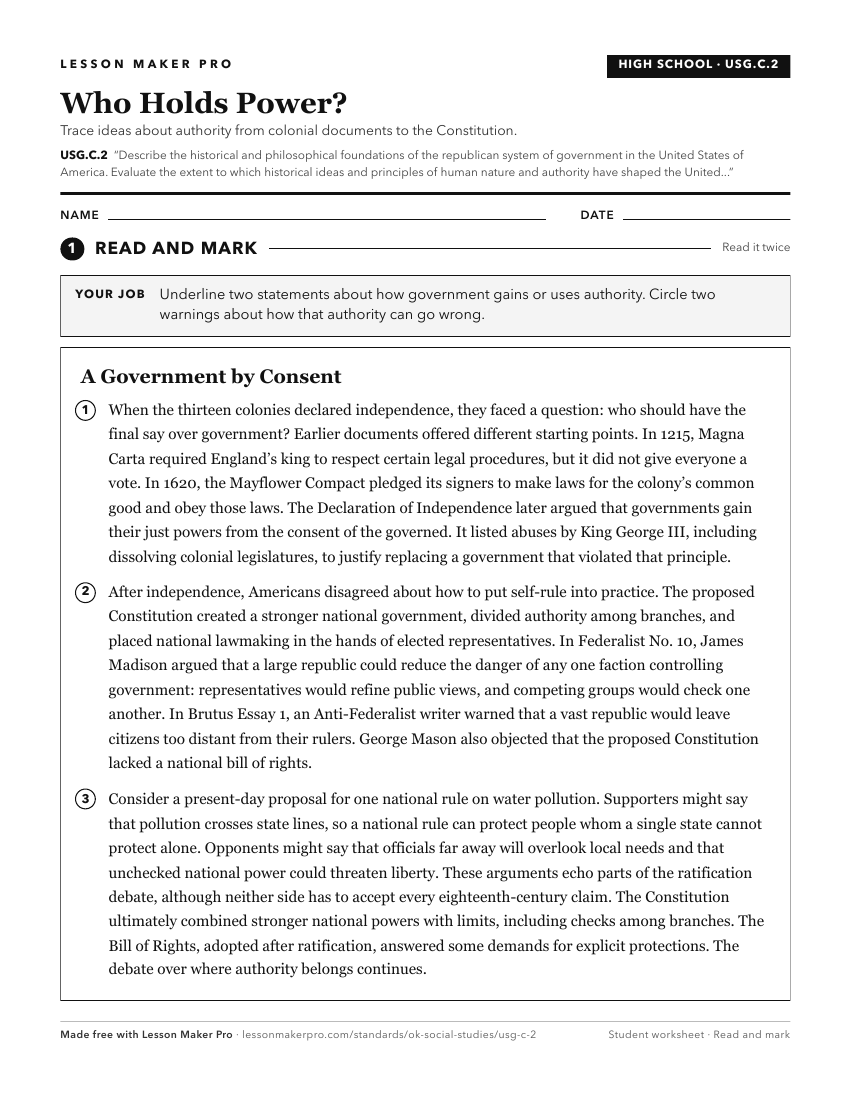
A ready-to-print activity worksheet aligned to USG.C.2, with an answer key for the teacher on its own page. No account needed.
PDF, US Letter, prints cleanly in black and white.
Download the worksheetKeep exploring
Related Standards
- USG.C.3
Analyze the fundamental principles of the American republic, as established in the Constitution of the United States of America.
- USG.C.1.3
Examine the founding principles of the United States of America’s constitutional republic.
- 2.C.1
Explain the importance of the basic principles that provide the foundation of the United States of America’s system of government.
Turn this cluster into a lesson
Grade, subject, topic, and the complete cluster are prefilled. Create one free, no account needed.
Also for this cluster:Make a WorksheetMake a QuizMake a Sub Lesson