Oklahoma Social Studies USG.C.1.3
Standard Cluster
- USG.C.1
- Compare the formation of contemporary governments in terms of access, use, and justification of power.
Examine the founding principles of the United States of America’s constitutional republic. Explain the principle of popular sovereignty which asserts that governments are created and sustained by the consent of the people who are the legitimate source of all political authority. Analyze how the United States of America’s government reflects both a democracy and a republic. Explain how the Constitution of the United States of America reflects a balance between a concern for the public good and a concern for the protection of individual rights. Evaluate how religious traditions, moral philosophy, and enlightenment principles contributed to the development of key American founding ideas, such as natural rights, liberty, and limited government during the drafting of the Constitution of the United States.
Oklahoma Academic Standards for Social Studies (2026) · USG.C.1
Cluster contents
Standards in This Cluster
USG.C.1.3 is a cluster heading. These are the individual standards under it.
- USG.C.1.3.A
Explain the principle of popular sovereignty which asserts that governments are created and sustained by the consent of the people who are the legitimate source...
- USG.C.1.3.B
Analyze how the United States of America’s government reflects both a democracy and a republic.
- USG.C.1.3.C
Explain how the Constitution of the United States of America reflects a balance between a concern for the public good and a concern for the protection of indivi...
- USG.C.1.3.D
Evaluate how religious traditions, moral philosophy, and enlightenment principles contributed to the development of key American founding ideas, such as natural...
Teacher's field guide
What This Cluster Means
What Students Need to Do
- Students explain why government power comes from the people's consent. They compare direct voting with lawmaking by elected representatives. They use founding texts to examine public goals, individual rights, and earlier ideas about liberty and limited government.
What Mastery Looks Like
- A student can explain how voters give representatives authority without voting on every law. They can pair the Preamble's public goals with an individual right in the First Amendment. They can link a founding idea to a specific religious, moral, or Enlightenment source.
Common Misconceptions
- Students may think popular sovereignty means voters decide every law directly. They may treat democracy and a republic as opposites, or assume a majority vote can erase a constitutional right. Some attribute founding ideas to only one tradition.
How to Assess It
- Give students the Preamble and First Amendment as an exit ticket. Ask them to explain who authorizes government, why voters elect lawmakers, how the texts address both public goals and personal rights, and one earlier idea behind a right.
Lesson moves
Ways to Teach It
Give pairs short excerpts from Locke, a colonial election sermon, and Cicero; have them sort claims about rights, public duty, and limits on power.
Ask: If voters demand a ban on unpopular speeches, should Congress pass it? Use the First Amendment and the Preamble in your answer.
Run a card match: students pair “We the People,” a congressional election, and free speech with consent, representation, and individual rights.
Bring a school board election notice and meeting agenda; students mark where residents choose representatives and where residents can speak about a proposed rule.
Free download
Printable USG.C.1.3 Worksheet
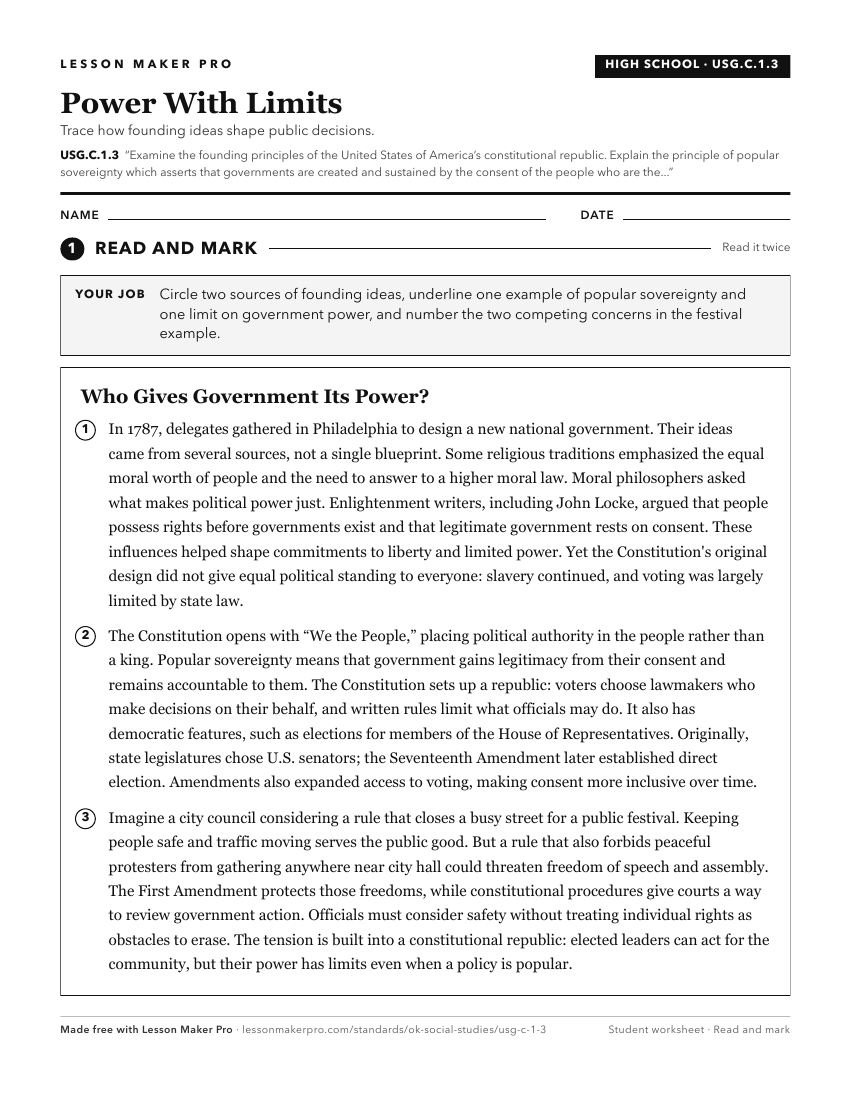
A ready-to-print activity worksheet aligned to USG.C.1.3, with an answer key for the teacher on its own page. No account needed.
PDF, US Letter, prints cleanly in black and white.
Download the worksheetKeep exploring
Related Standards
- 4.P.2.1.C
Examine the principles of the Constitution of the United States of America, including how laws are made in a democratic society and are used to protect individu...
- USG.C.2.1
Evaluate the extent to which historical ideas and principles of human nature and authority have shaped the United States of America as a constitutional republic...
- USG.C.3
Analyze the fundamental principles of the American republic, as established in the Constitution of the United States of America.
- 8.C.4
Examine the key principles and structure of the United States of America’s government as established by the Constitution of the United States of America.
Turn this cluster into a lesson
Grade, subject, topic, and the complete cluster are prefilled. Create one free, no account needed.
Also for this cluster:Make a WorksheetMake a QuizMake a Sub Lesson