Oklahoma Social Studies USG.C.1.3.D
The Standard
- USG.C.1
- Compare the formation of contemporary governments in terms of access, use, and justification of power.
- USG.C.1.3
- Examine the founding principles of the United States of America’s constitutional republic.
Evaluate how religious traditions, moral philosophy, and enlightenment principles contributed to the development of key American founding ideas, such as natural rights, liberty, and limited government during the drafting of the Constitution of the United States.
Oklahoma Academic Standards for Social Studies (2026) · USG.C.1.3
Teacher's field guide
What This Standard Means
What Students Need to Do
- Students trace how arguments about freedom of conscience, human rights, and divided power shaped ideas in the Constitution. They use short source excerpts to judge which connections have strong evidence.
What Mastery Looks Like
- Students connect a Baptist plea for religious liberty to Article VI's ban on religious tests. They link Mason's claims about inherent rights and Montesquieu's divided powers to limits on government. They recognize that slavery contradicted claims about liberty.
Common Misconceptions
- Students may think the Constitution uses the Declaration's wording about natural rights. They may think the First Amendment was part of the Constitution drafted in 1787. They may treat a shared idea as proof that a framer copied a source.
How to Assess It
- Give students a short excerpt from the Virginia Statute for Religious Freedom and Article VI's ban on religious tests. Ask: "What idea connects them, and what more would you need to prove direct influence?"
Lesson moves
Ways to Teach It
Give pairs printed excerpts from a Virginia Baptist petition, Mason, Locke, and Montesquieu to place beside related Constitution clauses.
Ask students to write: "If the framers valued natural rights, how do the Constitution's slavery clauses complicate that claim?"
Play claim check: teams use clause cards to test "Article VI bans religious tests," "divided branches limit power," and "the original Constitution ended slavery."
Show a mock federal judge posting requiring a religion; ask students to explain its conflict with Article VI and freedom of conscience.
Free download
Printable USG.C.1.3.D Worksheet
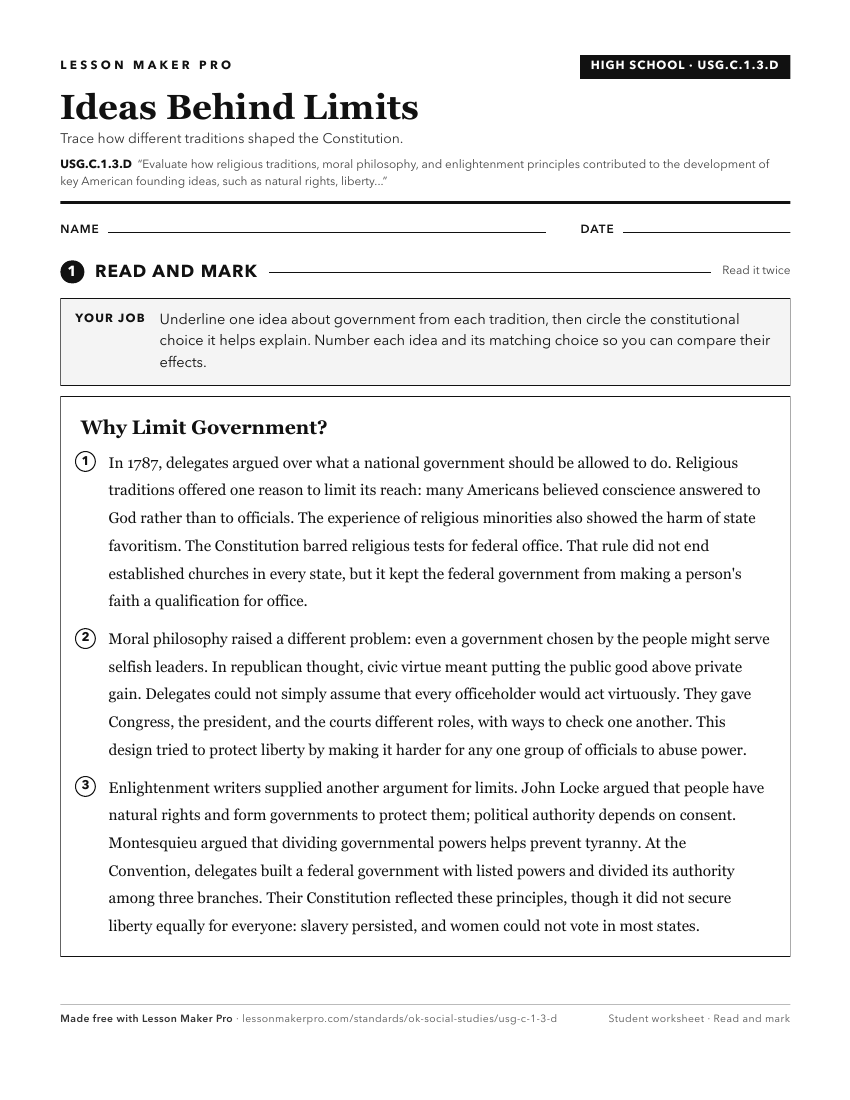
A ready-to-print activity worksheet aligned to USG.C.1.3.D, with an answer key for the teacher on its own page. No account needed.
PDF, US Letter, prints cleanly in black and white.
Download the worksheetKeep exploring
Related Standards
- USG.C.2.1
Evaluate the extent to which historical ideas and principles of human nature and authority have shaped the United States of America as a constitutional republic...
- USG.C.2.1.C
Analyze colonial ideas on liberty, the practice of self-government, and the influence of religious thought on foundational documents (e.g., Massachusetts Body o...
- 8.C.1.5.B
Describe the intellectual origins of American political thought as proposed by such Enlightenment philosophers as John Locke and his theory on natural rights.
- USG.C.6.3
Examine the traditions and historical documents which have contributed to the American concepts of rights and liberties (e.g., English Bill of Rights, Virginia ...
Turn this exact standard into a lesson
Grade, subject, topic, and the complete standard are prefilled. Create one free, no account needed.
Also for this standard:Make a WorksheetMake a QuizMake a Sub Lesson