Oklahoma Social Studies USG.C.3
Standard Cluster
Analyze the fundamental principles of the American republic, as established in the Constitution of the United States of America. Evaluate the necessity of a written constitution. Identify and describe the purposes for government as stated by the Framers in the Preamble to the Constitution of the United States of America. Analyze how the Constitution of the United States of America safeguards against authoritarianism by establishing enumerated powers, organizing government, and distributing powers among separate branches of government, the states, and the people. Explain why states have written constitutions and explain the relationship of state constitutions to the national constitution, including the guarantee “to every State in the Union a Republican form of Government” (Article IV, Section 4). Examine how the Constitution may be considered a “living document” due to its clearly defined and intentionally rigorous amendment process, which requires both state and federal participation. Analyze how the Framers designed a system of separated powers to prevent the concentration and potential abuse of power.. Describe and compare the scope of the powers vested to the Legislative Branch (Article 1), the Executive Branch (Article II), and the Judicial Branch (Article III) as related to the concept of separation of powers. Examine the necessity of a system of checks on government authority as explained by Madison in Federalist Paper No.51 and reflected by the claim “Ambition must be made to counteract ambition.” Explain how the checks and balances system provides each branch of government with individual powers to affect other branches, preventing any one branch from becoming too powerful. Examine historical and contemporary examples of the system of checks and balances to illustrate the intent of the Framers and evaluate the effectiveness of the system. Analyze the system of federalism as established by the Constitution of the United States of America. Define and identify the enumerated (expressed) powers found in Article I. Describe how the “general welfare” clause and “necessary and proper” clause have empowered Congress with implied powers. Identify powers denied to the national government versus those reserved to the states. Describe the reasons why the Framers established concurrent powers, comparing examples exercised by both the national and state governments. Explain how the Supremacy Clause (Article VI, Clause 2) establishes the Constitution of the United States of America and federal laws or treaties as the “supreme Law of the Land.” Evaluate changes that have occurred in the relationship between the states and the national government over time (e.g., cooperative federalism versus new federalism/devolution). Summarize and explain the relationships and responsibilities among the levels of government.. Explain how local, state, and national governments are involved in cooperatively shaping public policy and responding to public policy issues. Compare specific functions, organizations, and purposes of local and state governments, such as ensuring personal security and health regulations. Explain the differences among the types of local governments in Oklahoma (e.g., county, city) as well as their operational relationship with the state government. Describe how some state constitutions, such as Oklahoma’s, provide for more direct public involvement in the legislative process through such provisions as the initiative and referendum. Analyze the constitutional and legal status of Tribal governments within the federal system. Explain how the Constitution of the United States grants Congress authority over Indian affairs through the Commerce Clause and how the Supreme Court has defined Tribal Nations as “domestic dependent nations” possessing powers of self-government while operating under Federal Authority. Reference case: Cherokee Nation v. Georgia. Describe the trust relationship between the United States of America and Tribal governments, including the federal government’s legal obligations to protect Tribal lands, treaty rights, and resources. Students should understand that this relationship developed through treaties, legislation, and court decisions. Explain how Tribal governments exercise powers of self-government and participate in federal programs through legislation that allows Tribes to contract or compact with the federal government to administer services and programs. Key legislation teachers may reference: Indian Self-Determination and Education Assistance Act. This law allows tribes to operate programs that were previously run directly by federal agencies. Examine how Tribal governments enter into agreements with states under federal law, including the role of state constitutions and legislatures in authorizing such agreements. Key law: Indian Gaming Regulatory Act. Students should understand: Congress authorized state and tribal compacts, states must have legal authority to enter those agreements, some states require constitutional amendments or legislative approval. This is particularly relevant in Oklahoma. Describe how Tribal jurisdiction and authority have evolved through federal legislation and Supreme Court decisions affecting criminal jurisdiction, family law, religious freedom, and other areas. Examples: Legislation: Major Crimes Act, Indian Child Welfare Act Court decisions: McGirt v. Oklahoma, Haaland v. Brackeen.
Oklahoma Academic Standards for Social Studies (2026)
Cluster contents
Standards in This Cluster
USG.C.3 is a cluster heading. These are the individual standards under it.
- USG.C.3.1
Evaluate the necessity of a written constitution.
- USG.C.3.1.A
Identify and describe the purposes for government as stated by the Framers in the Preamble to the Constitution of the United States of America.
- USG.C.3.1.B
Analyze how the Constitution of the United States of America safeguards against authoritarianism by establishing enumerated powers, organizing government, and d...
- USG.C.3.1.C
Explain why states have written constitutions and explain the relationship of state constitutions to the national constitution, including the guarantee “to ever...
- USG.C.3.2
Examine how the Constitution may be considered a “living document” due to its clearly defined and intentionally rigorous amendment process, which requires both ...
- USG.C.3.3
Analyze how the Framers designed a system of separated powers to prevent the concentration and potential abuse of power.
- USG.C.3.3.A
Describe and compare the scope of the powers vested to the Legislative Branch (Article 1), the Executive Branch (Article II), and the Judicial Branch (Article I...
- USG.C.3.3.B
Examine the necessity of a system of checks on government authority as explained by Madison in Federalist Paper No.51 and reflected by the claim “Ambition must ...
- USG.C.3.3.C
Explain how the checks and balances system provides each branch of government with individual powers to affect other branches, preventing any one branch from be...
- USG.C.3.3.D
Examine historical and contemporary examples of the system of checks and balances to illustrate the intent of the Framers and evaluate the effectiveness of the ...
- USG.C.3.4
Analyze the system of federalism as established by the Constitution of the United States of America.
- USG.C.3.4.A
Define and identify the enumerated (expressed) powers found in Article I.
- USG.C.3.4.B
Describe how the “general welfare” clause and “necessary and proper” clause have empowered Congress with implied powers.
- USG.C.3.4.C
Identify powers denied to the national government versus those reserved to the states.
- USG.C.3.4.D
Describe the reasons why the Framers established concurrent powers, comparing examples exercised by both the national and state governments.
- USG.C.3.4.E
Explain how the Supremacy Clause (Article VI, Clause 2) establishes the Constitution of the United States of America and federal laws or treaties as the “suprem...
- USG.C.3.4.F
Evaluate changes that have occurred in the relationship between the states and the national government over time (e.g., cooperative federalism versus new federa...
- USG.C.3.5
Summarize and explain the relationships and responsibilities among the levels of government..
- USG.C.3.5.A
Explain how local, state, and national governments are involved in cooperatively shaping public policy and responding to public policy issues.
- USG.C.3.5.B
Compare specific functions, organizations, and purposes of local and state governments, such as ensuring personal security and health regulations.
- USG.C.3.5.C
Explain the differences among the types of local governments in Oklahoma (e.g., county, city) as well as their operational relationship with the state governmen...
- USG.C.3.5.D
Describe how some state constitutions, such as Oklahoma’s, provide for more direct public involvement in the legislative process through such provisions as the ...
- USG.C.3.6
Analyze the constitutional and legal status of Tribal governments within the federal system.
- USG.C.3.6.A
Explain how the Constitution of the United States grants Congress authority over Indian affairs through the Commerce Clause and how the Supreme Court has define...
- USG.C.3.6.B
Describe the trust relationship between the United States of America and Tribal governments, including the federal government’s legal obligations to protect Tri...
- USG.C.3.6.C
Explain how Tribal governments exercise powers of self-government and participate in federal programs through legislation that allows Tribes to contract or comp...
- USG.C.3.6.D
Examine how Tribal governments enter into agreements with states under federal law, including the role of state constitutions and legislatures in authorizing su...
- USG.C.3.6.E
Describe how Tribal jurisdiction and authority have evolved through federal legislation and Supreme Court decisions affecting criminal jurisdiction, family law,...
Teacher's field guide
What This Cluster Means
What Students Need to Do
- Students use the Preamble to explain what government is for and why a written constitution limits its powers. They trace how branches check each other, how amendments work, and how national, state, and local powers overlap. They explain Tribal self-government and federal duties to protect Tribal lands and rights.
What Mastery Looks Like
- Given a bill, a veto, and an override vote, students explain each branch’s role and how the veto limits Congress. They distinguish congressional, state, and shared powers, and explain when valid federal law controls a state rule. They can use Oklahoma’s constitution and a Tribal-state compact to explain who has authority to act.
Common Misconceptions
- Students may think the president makes laws alone or that any federal rule overrides state law, even when Congress lacks authority. Some treat Tribal governments as state agencies. Others assume a constitutional amendment needs only a vote in Congress.
How to Assess It
- Exit ticket: Congress passes a bill and the president vetoes it. Name the check being used, explain how Congress can respond, and give one reason this process limits power.
Lesson moves
Ways to Teach It
Give pairs cards for income tax, a veto, a city water notice, and a Tribal clinic; sort them by government and branch.
Read the Preamble and Federalist No. 51; ask which Preamble goal would be hardest to protect without checks on Congress.
Play three rounds with bill, veto, and override cards; require students to state the vote needed for an override.
Give students an Oklahoma ballot initiative summary and a Tribal gaming compact; have them mark who approves each and where that authority comes from.
Free download
Printable USG.C.3 Worksheet
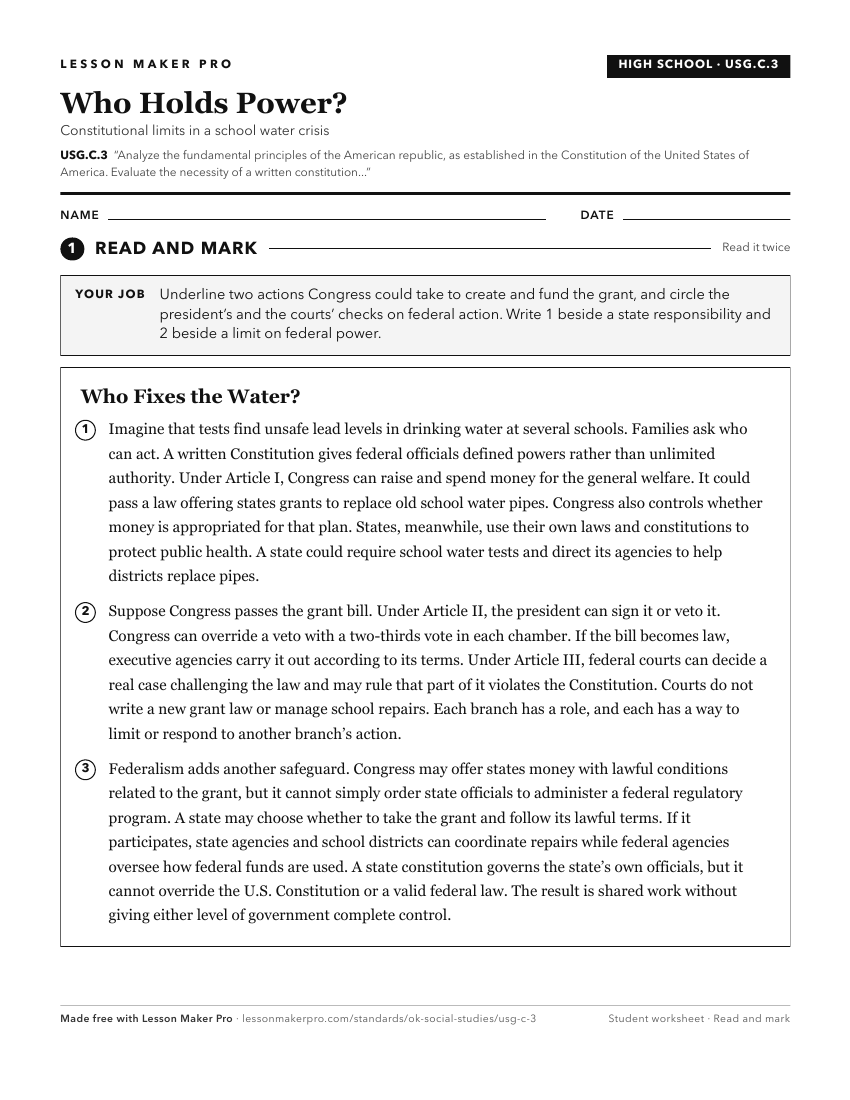
A ready-to-print activity worksheet aligned to USG.C.3, with an answer key for the teacher on its own page. No account needed.
PDF, US Letter, prints cleanly in black and white.
Download the worksheetKeep exploring
Related Standards
- USG.C.2.1
Evaluate the extent to which historical ideas and principles of human nature and authority have shaped the United States of America as a constitutional republic...
- 5.C.6.3
Analyze the structure and operations of government established in the Constitution of the United States of America.
- USG.C.1.3
Examine the founding principles of the United States of America’s constitutional republic.
- 8.C.4
Examine the key principles and structure of the United States of America’s government as established by the Constitution of the United States of America.
Turn this cluster into a lesson
Grade, subject, topic, and the complete cluster are prefilled. Create one free, no account needed.
Also for this cluster:Make a WorksheetMake a QuizMake a Sub Lesson