Oklahoma Social Studies USG.C.3.6.E
The Standard
- USG.C.3
- Analyze the fundamental principles of the American republic, as established in the Constitution of the United States of America.
- USG.C.3.6
- Analyze the constitutional and legal status of Tribal governments within the federal system.
Describe how Tribal jurisdiction and authority have evolved through federal legislation and Supreme Court decisions affecting criminal jurisdiction, family law, religious freedom, and other areas. Examples: Legislation: Major Crimes Act, Indian Child Welfare Act Court decisions: McGirt v. Oklahoma, Haaland v. Brackeen.
Oklahoma Academic Standards for Social Studies (2026) · USG.C.3.6
Teacher's field guide
What This Standard Means
What Students Need to Do
- Students explain how federal laws and court rulings affect tribal authority over crimes, child custody, and religious practice. They use the people, place, and issue in a case to identify which governments may act.
What Mastery Looks Like
- Students explain that McGirt recognized the Muscogee reservation had not been disestablished and connect that ruling to federal prosecution under the Major Crimes Act. They explain how ICWA gives tribes a role in child custody cases and how Haaland upheld the law.
Common Misconceptions
- Students may think McGirt created a new reservation or gave tribal courts sole authority over every crime there. They may think ICWA decides every child custody case automatically or that Haaland struck it down. Some assume federal law removes every restriction on Native religious ceremonies.
How to Assess It
- Exit ticket: A tribal member is accused of a major crime on Muscogee reservation land. Explain how McGirt and the Major Crimes Act affect prosecution, then name one ICWA requirement a court should check in a separate child custody case.
Lesson moves
Ways to Teach It
Give pairs four law and ruling cards to place on a timeline; have them label each card crime, child custody, or religious practice.
Ask students to write: Did McGirt create a new reservation? Use one fact from a short case summary to support your answer.
Play a jurisdiction match with case cards; teams choose a relevant law or ruling and explain their choice in one sentence.
Read the Muscogee Nation District Court jurisdiction page; list one case type it hears and explain why the case's location matters.
Free download
Printable USG.C.3.6.E Worksheet
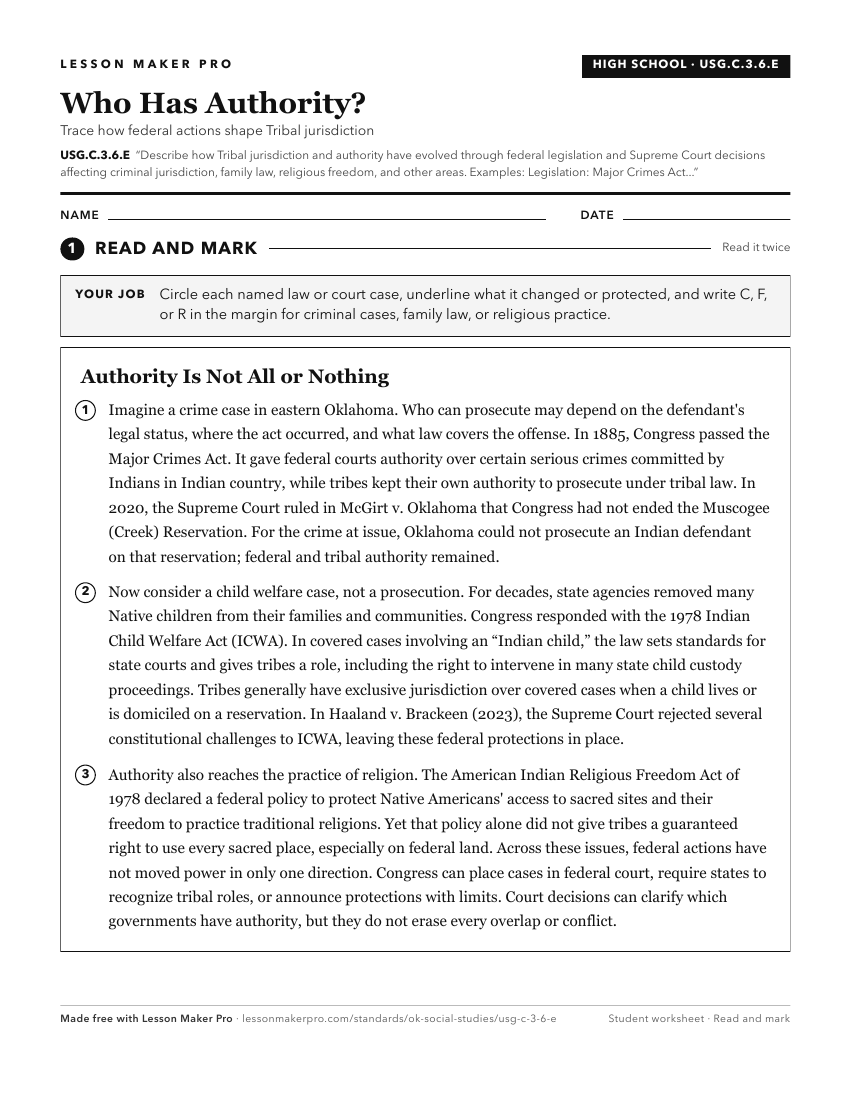
A ready-to-print activity worksheet aligned to USG.C.3.6.E, with an answer key for the teacher on its own page. No account needed.
PDF, US Letter, prints cleanly in black and white.
Download the worksheetKeep exploring
Related Standards
- OKH.C.8.3.E
Analyze major court decisions affecting jurisdiction and sovereignty between Tribal, state, and federal governments. Examples teachers may reference: McGirt v. ...
- OKH.C.8.3.D
Examine the structure and authority of modern Tribal governments, including constitutional or traditional governing systems and the powers exercised over Tribal...
- 8.C.4.3.B
Examine how early Supreme Court decisions, often referred to as the “Marshall Trilogy,” defined Tribal Nations as “domestic dependent nations,” recognizing limi...
- USH.C.7.2.B
Explain changes in Tribal self-determination gained through legislation, such as the Indian Civil Rights Act of 1968, Indian Self Determination and Education As...
Turn this exact standard into a lesson
Grade, subject, topic, and the complete standard are prefilled. Create one free, no account needed.
Also for this standard:Make a WorksheetMake a QuizMake a Sub Lesson