Oklahoma Social Studies OKH.C.8.3.E
The Standard
- OKH.C.8
- Investigate how post-war social, political, and economic events continued to transform the state of Oklahoma from the 1950s through the present.
- OKH.C.8.3
- Analyze the historical and contemporary relationship between the State of Oklahoma and Oklahoma’s thirty-nine federally recognized Tribal governments.
Analyze major court decisions affecting jurisdiction and sovereignty between Tribal, state, and federal governments. Examples teachers may reference: McGirt v. Oklahoma, Oklahoma v. Castro-Huerta. Students should understand how these rulings affect: criminal jurisdiction, state authority, tribal authority, citizens living within reservation boundaries.
Oklahoma Academic Standards for Social Studies (2026) · OKH.C.8.3
Teacher's field guide
What This Standard Means
What Students Need to Do
- Students compare which governments can prosecute crimes on reservation land after two court rulings. They use the accused person's and victim's status, the crime, and the location to sort tribal, state, and federal authority. They explain why a reservation address does not make someone a tribal citizen.
What Mastery Looks Like
- Students identify federal and tribal, rather than ordinary state, authority over a Native defendant's major crime on the Muscogee Reservation. They identify both state and federal authority when a non-Native defendant harms a Native victim there. They explain that the ruling recognized an existing reservation, rather than creating one.
Common Misconceptions
- Some students think the court created a new reservation or that tribal courts can prosecute everyone who lives inside its boundary. Others assume state courts handle every crime there, or that living there gives someone tribal citizenship.
How to Assess It
- Exit ticket: A Native defendant is accused of a major crime on the Muscogee Reservation. A non-Native defendant is accused of harming a Native person there. For each, name the governments that may prosecute and the ruling that supports your answer.
Lesson moves
Ways to Teach It
Give pairs a reservation map and four crime cards; have them sort each card under tribal, state, or federal authority, allowing overlaps.
Ask students to write two sentences: Did the court create a new reservation? Does living within its boundary make someone a tribal citizen?
Play jurisdiction bingo: read a crime, location, accused person, and victim; students cover the governments that may prosecute and explain one choice.
Locate downtown Tulsa on a Muscogee Reservation map, then ask why its location does not make every nearby resident a tribal citizen.
Free download
Printable OKH.C.8.3.E Worksheet
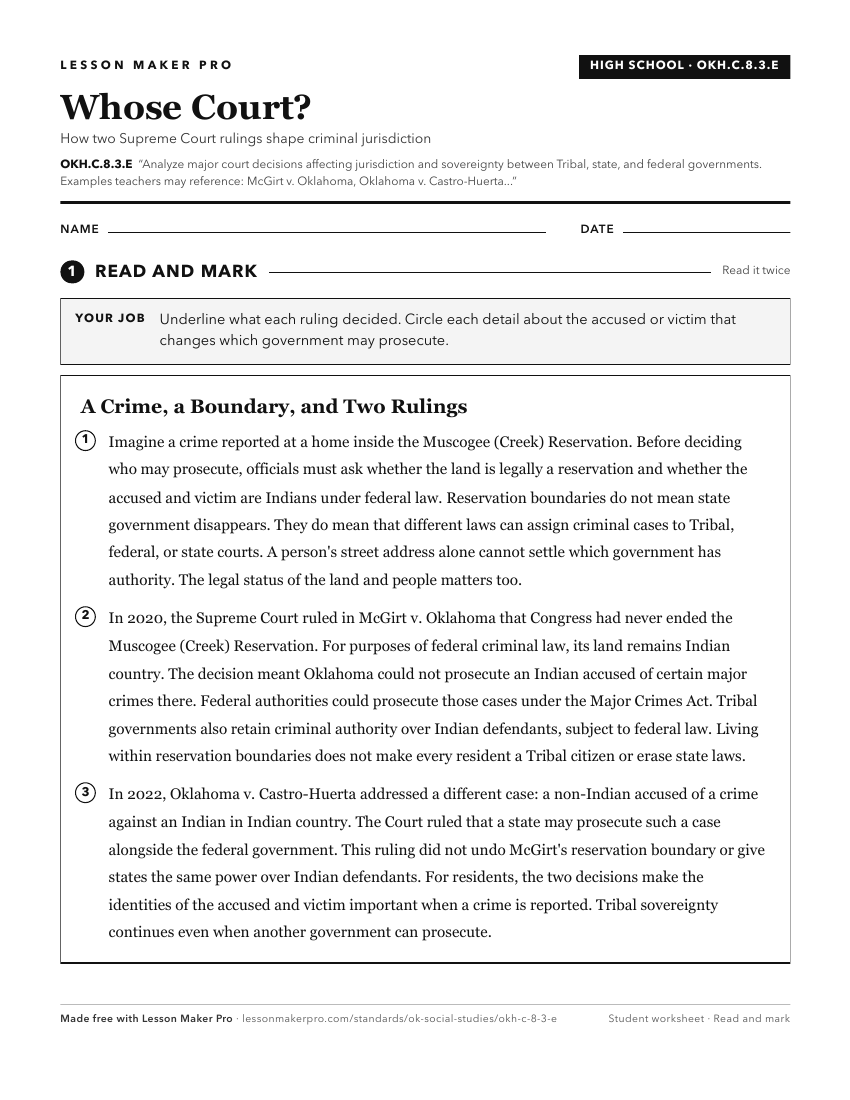
A ready-to-print activity worksheet aligned to OKH.C.8.3.E, with an answer key for the teacher on its own page. No account needed.
PDF, US Letter, prints cleanly in black and white.
Download the worksheetKeep exploring
Related Standards
- 8.C.8.3.B
Examine the Supreme Court’s Decision in Worcester v. Georgia and analyze the constitutional conflict between federal authority, state governments, and Tribal Na...
- USG.C.3.6.E
Describe how Tribal jurisdiction and authority have evolved through federal legislation and Supreme Court decisions affecting criminal jurisdiction, family law,...
- 8.C.4.3.B
Examine how early Supreme Court decisions, often referred to as the “Marshall Trilogy,” defined Tribal Nations as “domestic dependent nations,” recognizing limi...
- USG.C.3.6.D
Examine how Tribal governments enter into agreements with states under federal law, including the role of state constitutions and legislatures in authorizing su...
Turn this exact standard into a lesson
Grade, subject, topic, and the complete standard are prefilled. Create one free, no account needed.
Also for this standard:Make a WorksheetMake a QuizMake a Sub Lesson