Oklahoma Social Studies 8.C.8.3.B
The Standard
- 8.C.8
- Examine the political, economic and social transformations of the Jacksonian Era.
- 8.C.8.3
- Analyze the impact of President Andrew Jackson’s policies concerning American Indian Nations and their sovereignty during the early nineteenth century.
Examine the Supreme Court’s Decision in Worcester v. Georgia and analyze the constitutional conflict between federal authority, state governments, and Tribal Nations during the Jackson administration. Students should understand: Tribes were not originally considered states or foreign nations under the Constitution. In Cherokee Nation v. Georgia, the Supreme Court ruled the Cherokee Nation lacked standing as a foreign nation and described tribes as “domestic dependent Nations.”
Oklahoma Academic Standards for Social Studies (2026) · 8.C.8.3
Teacher's field guide
What This Standard Means
What Students Need to Do
- Students compare two Supreme Court rulings involving the Cherokee Nation. They explain why Georgia's laws in Cherokee territory raised questions about federal authority and Cherokee self-government during Jackson's presidency.
What Mastery Looks Like
- A student can explain why the Court dismissed the Cherokee Nation's first case but rejected Georgia's laws in the second. They can name the claims of Georgia, the federal government, and the Cherokee Nation without treating tribal sovereignty as statehood.
Common Misconceptions
- Students may think the Court called the Cherokee Nation a foreign country in the first case. They may also assume tribal sovereignty meant statehood, or that the second ruling stopped removal.
How to Assess It
- Exit ticket: In two sentences, explain why the Court dismissed the Cherokee Nation's first case but rejected Georgia's laws in Worcester.
Lesson moves
Ways to Teach It
Have pairs annotate a Cherokee territory map with three color-coded claims: Georgia's state law, federal treaty authority, and Cherokee self-government.
Ask students: Why could the Court deny the Cherokee Nation's first case yet reject Georgia's laws in the second?
Give teams four cards labeled 'not a foreign nation,' 'domestic dependent nation,' 'Georgia law invalid,' and 'federal treaty authority'; sort them by case.
Open the Cherokee Nation government's services page; ask students to find one service and compare that role with Georgia's 1832 claim of control.
Free download
Printable 8.C.8.3.B Worksheet
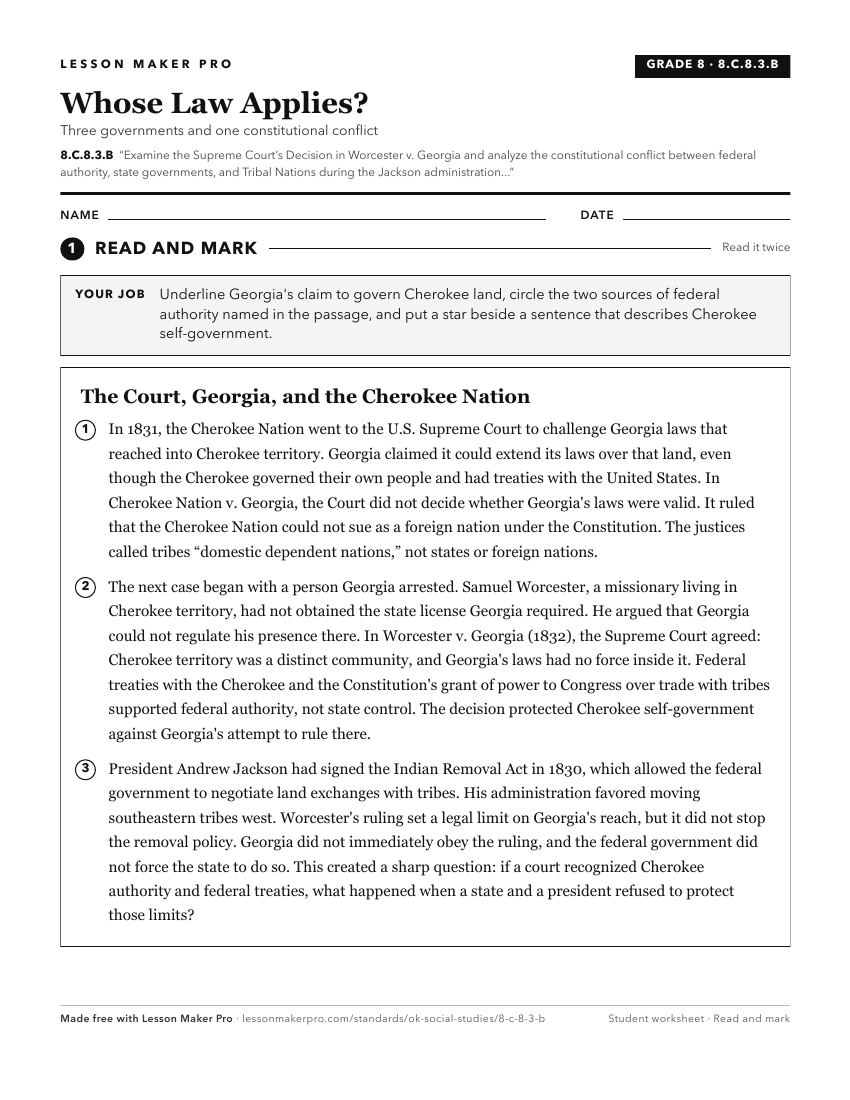
A ready-to-print activity worksheet aligned to 8.C.8.3.B, with an answer key for the teacher on its own page. No account needed.
PDF, US Letter, prints cleanly in black and white.
Download the worksheetKeep exploring
Related Standards
- OKH.C.8.3.E
Analyze major court decisions affecting jurisdiction and sovereignty between Tribal, state, and federal governments. Examples teachers may reference: McGirt v. ...
- USG.C.3.6.A
Explain how the Constitution of the United States grants Congress authority over Indian affairs through the Commerce Clause and how the Supreme Court has define...
- 8.C.4.3.B
Examine how early Supreme Court decisions, often referred to as the “Marshall Trilogy,” defined Tribal Nations as “domestic dependent nations,” recognizing limi...
- 8.C.8.3.C
Analyze how President Andrew Jackson supported state authority in conflicts with Tribal governments and how this position influenced federal policy toward India...
Turn this exact standard into a lesson
Grade, subject, topic, and the complete standard are prefilled. Create one free, no account needed.
Also for this standard:Make a WorksheetMake a QuizMake a Sub Lesson