Oklahoma Social Studies USG.C.3.6.A
The Standard
- USG.C.3
- Analyze the fundamental principles of the American republic, as established in the Constitution of the United States of America.
- USG.C.3.6
- Analyze the constitutional and legal status of Tribal governments within the federal system.
Explain how the Constitution of the United States grants Congress authority over Indian affairs through the Commerce Clause and how the Supreme Court has defined Tribal Nations as “domestic dependent nations” possessing powers of self-government while operating under Federal Authority. Reference case: Cherokee Nation v. Georgia.
Oklahoma Academic Standards for Social Studies (2026) · USG.C.3.6
Teacher's field guide
What This Standard Means
What Students Need to Do
- Students identify where the Constitution gives Congress authority to regulate commerce with Tribal Nations. They explain how the Supreme Court recognized tribal self-government while treating Tribal Nations as subject to federal authority, not as foreign countries.
What Mastery Looks Like
- A student can point to the part of the Commerce Clause that names tribes and explain Congress's role. They can explain why the Court refused to hear Cherokee Nation v. Georgia under its foreign-state jurisdiction without denying tribal self-government.
Common Misconceptions
- Students may think Tribal Nations are foreign countries or that federal authority means tribes cannot make their own laws. Some assume the Commerce Clause gives Congress control over every tribal decision, rather than authority to regulate commerce.
How to Assess It
- Give students the Commerce Clause and a short summary of Cherokee Nation v. Georgia. Ask: Who has authority to regulate trade with tribes, and why did the Court reject foreign-state jurisdiction without denying tribal self-government?
Lesson moves
Ways to Teach It
Give pairs printed Commerce Clause and Cherokee Nation v. Georgia excerpts; have them highlight Congress's role and the Court's ruling in different colors.
Ask students to write: How could the Court reject the Cherokee Nation's suit while still recognizing its power to govern its people?
Run a card sort: students match examples of tribal laws, congressional trade rules, and the jurisdiction ruling to their sources of authority.
Open a Tribal Nation's official website; students find a current tribal law or court and explain how it shows self-government.
Free download
Printable USG.C.3.6.A Worksheet
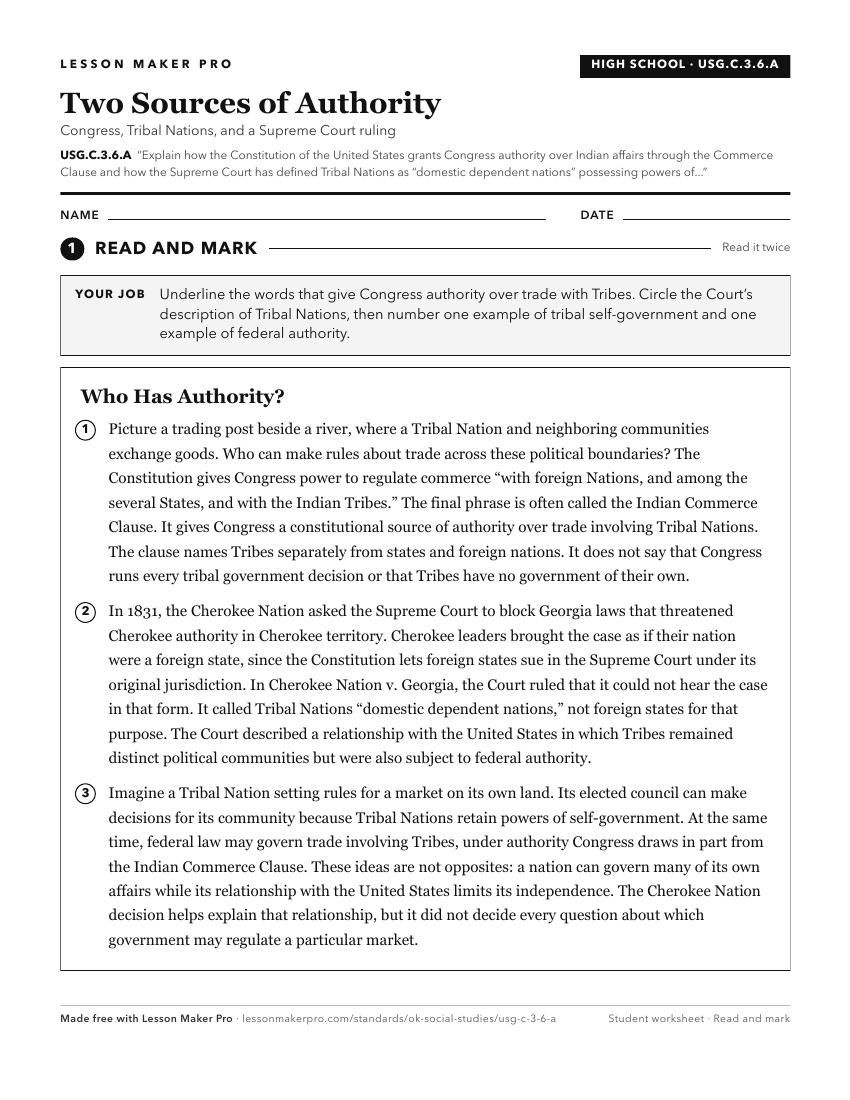
A ready-to-print activity worksheet aligned to USG.C.3.6.A, with an answer key for the teacher on its own page. No account needed.
PDF, US Letter, prints cleanly in black and white.
Download the worksheetKeep exploring
Related Standards
- 5.C.6.4.A
Describe how the Commerce Clause of the Constitution establishes a nation-to-nation relationship between the United States of America and Tribal governments.
- 8.C.4.3
Evaluate the significance of the Commerce Clause in establishing a constitutional relationship between American Indian Tribal Nations and the United States gove...
- 8.C.8.3.B
Examine the Supreme Court’s Decision in Worcester v. Georgia and analyze the constitutional conflict between federal authority, state governments, and Tribal Na...
- 8.C.4.3.A
Explain that the Constitution of the United States of America grants Congress authority to regulate commerce with Tribal Nations, forming the constitutional bas...
Turn this exact standard into a lesson
Grade, subject, topic, and the complete standard are prefilled. Create one free, no account needed.
Also for this standard:Make a WorksheetMake a QuizMake a Sub Lesson