Oklahoma Social Studies USG.C.3.3
Standard Cluster
- USG.C.3
- Analyze the fundamental principles of the American republic, as established in the Constitution of the United States of America.
Analyze how the Framers designed a system of separated powers to prevent the concentration and potential abuse of power.. Describe and compare the scope of the powers vested to the Legislative Branch (Article 1), the Executive Branch (Article II), and the Judicial Branch (Article III) as related to the concept of separation of powers. Examine the necessity of a system of checks on government authority as explained by Madison in Federalist Paper No.51 and reflected by the claim “Ambition must be made to counteract ambition.” Explain how the checks and balances system provides each branch of government with individual powers to affect other branches, preventing any one branch from becoming too powerful. Examine historical and contemporary examples of the system of checks and balances to illustrate the intent of the Framers and evaluate the effectiveness of the system.
Oklahoma Academic Standards for Social Studies (2026) · USG.C.3
Cluster contents
Standards in This Cluster
USG.C.3.3 is a cluster heading. These are the individual standards under it.
- USG.C.3.3.A
Describe and compare the scope of the powers vested to the Legislative Branch (Article 1), the Executive Branch (Article II), and the Judicial Branch (Article I...
- USG.C.3.3.B
Examine the necessity of a system of checks on government authority as explained by Madison in Federalist Paper No.51 and reflected by the claim “Ambition must ...
- USG.C.3.3.C
Explain how the checks and balances system provides each branch of government with individual powers to affect other branches, preventing any one branch from be...
- USG.C.3.3.D
Examine historical and contemporary examples of the system of checks and balances to illustrate the intent of the Framers and evaluate the effectiveness of the ...
Teacher's field guide
What This Cluster Means
What Students Need to Do
- Students compare the jobs of Congress, the president, and federal courts. They trace how each branch can limit another. They use Madison's argument and real events to judge whether those limits worked.
What Mastery Looks Like
- A student can match lawmaking and spending to Congress, enforcement and vetoes to the president, and constitutional rulings to federal courts. They can explain who checked whom in a real case and whether that check limited power.
Common Misconceptions
- Students may think the president makes laws alone or that a veto ends a bill for good. Some think courts can strike down a bill before it becomes law, or that a disagreement between branches means the system has failed.
How to Assess It
- Exit ticket: Congress overrides a presidential veto, then the Supreme Court strikes down the law. Name each branch's power and explain how these actions keep one branch from controlling the outcome.
Lesson moves
Ways to Teach It
Give groups cards labeled pass a law, veto, override, and rule a law unconstitutional; have them sort by branch and draw check arrows.
Read a short excerpt from Federalist 51, then ask: Why would Madison give each branch a way to block another branch?
Use scenario cards for a veto, Senate confirmation, impeachment, and court review; teams name the checking branch and earn a point for explaining how.
Compare Congress's 1973 War Powers veto override with the Supreme Court's 2023 student loan ruling; identify each check and judge its effectiveness.
Free download
Printable USG.C.3.3 Worksheet
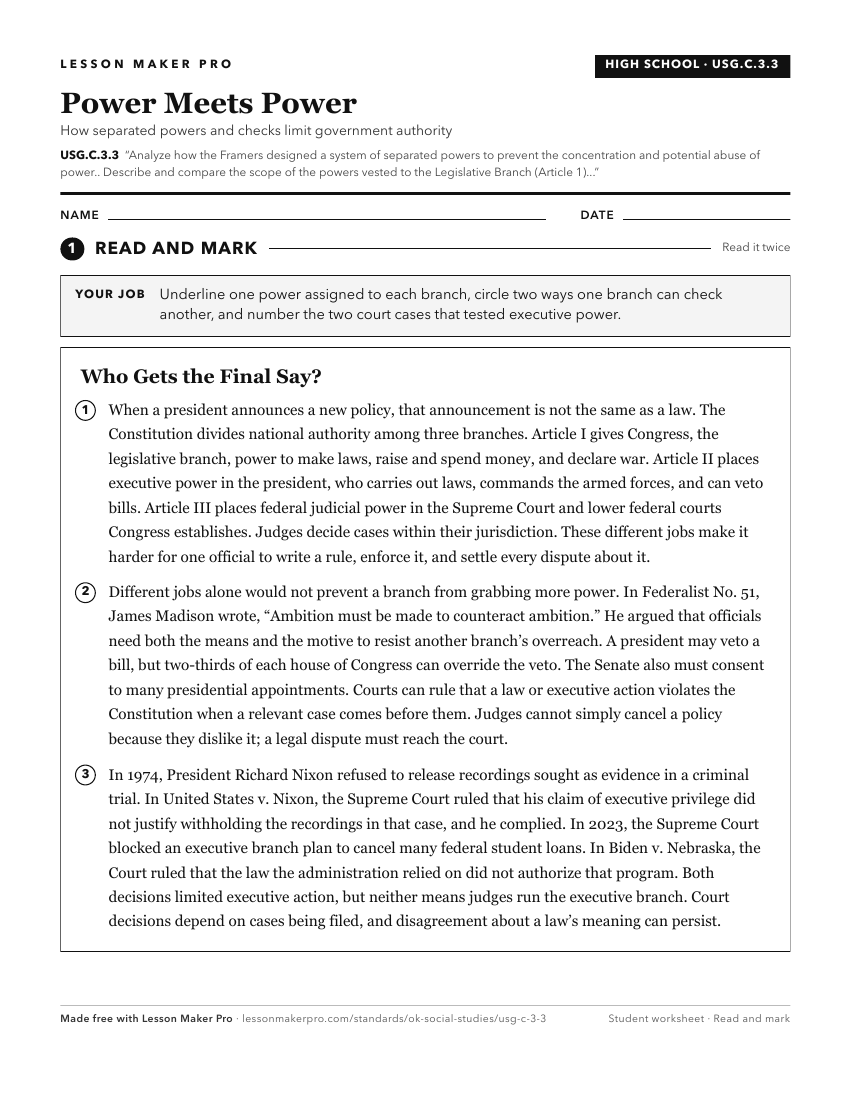
A ready-to-print activity worksheet aligned to USG.C.3.3, with an answer key for the teacher on its own page. No account needed.
PDF, US Letter, prints cleanly in black and white.
Download the worksheetKeep exploring
Related Standards
- 8.C.4.2.D
Analyze the system of checks and balances, explaining the Framers’ rationale for establishing such a system and describing how each branch of government can lim...
- 5.C.6.3.C
Examine the system of shared powers (federalism) between the federal and state levels of governments, explaining why the Framers assigned specific powers to eac...
- 8.C.4.2
Examine the structure and principles of the United States of America’s government established in the Constitution of the United States of America, focusing on t...
Turn this cluster into a lesson
Grade, subject, topic, and the complete cluster are prefilled. Create one free, no account needed.
Also for this cluster:Make a WorksheetMake a QuizMake a Sub Lesson