Oklahoma Social Studies USG.C.3.3.B
The Standard
- USG.C.3
- Analyze the fundamental principles of the American republic, as established in the Constitution of the United States of America.
- USG.C.3.3
- Analyze how the Framers designed a system of separated powers to prevent the concentration and potential abuse of power.
Examine the necessity of a system of checks on government authority as explained by Madison in Federalist Paper No.51 and reflected by the claim “Ambition must be made to counteract ambition.”
Oklahoma Academic Standards for Social Studies (2026) · USG.C.3.3
Teacher's field guide
What This Standard Means
What Students Need to Do
- Students explain why Madison thought officials need limits from other officials, not just rules on paper. They identify ways branches can block one another and explain how those checks limit government power.
What Mastery Looks Like
- A student can explain how a presidential veto checks Congress and how Congress can override it with a two-thirds vote in each chamber. They can use Madison's reasoning to explain why each branch needs the ability to resist the others.
Common Misconceptions
- Students may think each branch has identical powers or that a president can veto a court decision. Some assume officials will limit their own power without pressure from other branches.
How to Assess It
- Give students a short excerpt from Federalist 51 and this case: Congress passes a bill, then the president vetoes it. Ask who checked whom, what Congress could do next, and why Madison thought such checks were needed.
Lesson moves
Ways to Teach It
Give groups branch cards and bill cards; have Congress pass a bill, the president veto it, and both chambers vote on an override.
Read a paragraph from Federalist 51, then ask: Why might lawmakers and presidents resist each other's attempts to gain power?
Give pairs six scenario cards, including a veto and a court ruling; have them identify who checks whom on each card.
Read a short account of Truman's 1952 steel seizure; ask which branch stopped him and what power it used.
Free download
Printable USG.C.3.3.B Worksheet
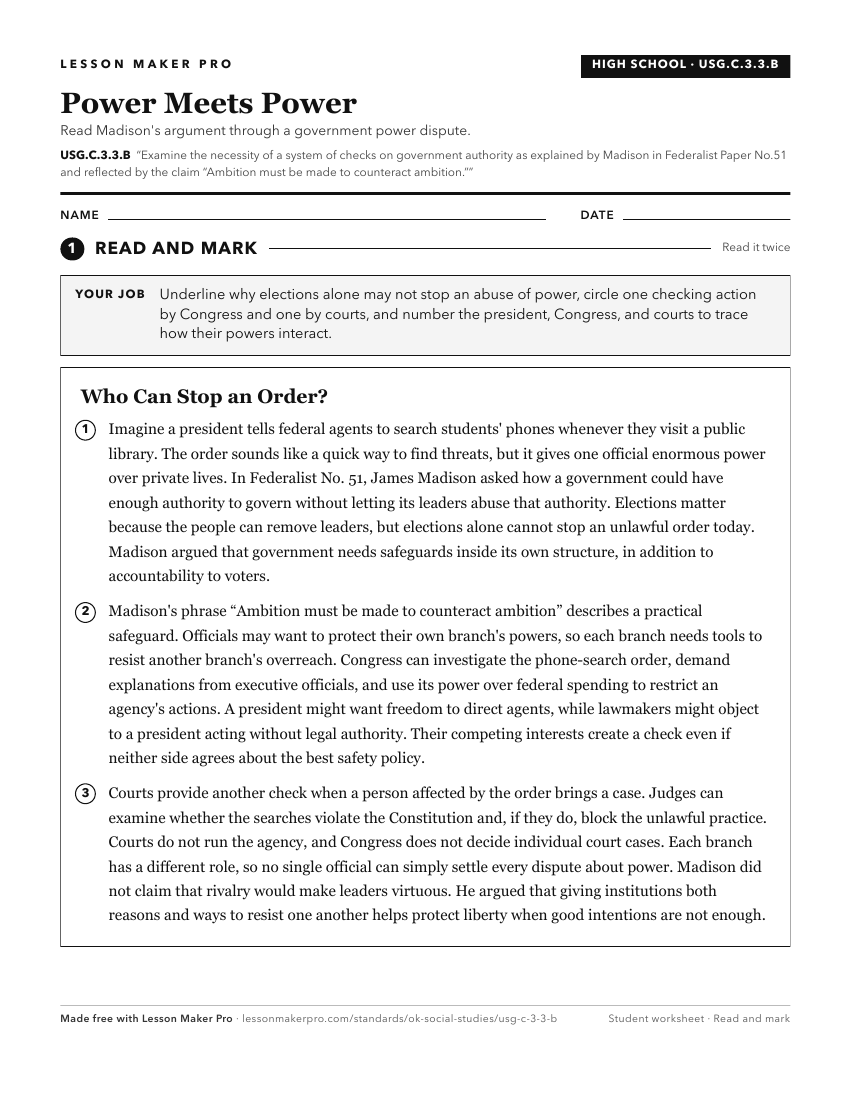
A ready-to-print activity worksheet aligned to USG.C.3.3.B, with an answer key for the teacher on its own page. No account needed.
PDF, US Letter, prints cleanly in black and white.
Download the worksheetKeep exploring
Related Standards
- 8.C.4.2.D
Analyze the system of checks and balances, explaining the Framers’ rationale for establishing such a system and describing how each branch of government can lim...
- USG.C.2.2.B
Compare concerns regarding centralized government as expressed in essays by the Anti-Federalists, such as Brutus Essay 1 and George Mason’s concerns regarding t...
- USG.C.3.3.D
Examine historical and contemporary examples of the system of checks and balances to illustrate the intent of the Framers and evaluate the effectiveness of the ...
- USG.C.4.4.B
Examine the Framers’ intent regarding the judiciary’s authority, including the principle of judicial review, as described by Hamilton in Federalist Paper No.78 ...
Turn this exact standard into a lesson
Grade, subject, topic, and the complete standard are prefilled. Create one free, no account needed.
Also for this standard:Make a WorksheetMake a QuizMake a Sub Lesson