Oklahoma Social Studies 8.C.4.2.D
The Standard
- 8.C.4
- Examine the key principles and structure of the United States of America’s government as established by the Constitution of the United States of America.
- 8.C.4.2
- Examine the structure and principles of the United States of America’s government established in the Constitution of the United States of America, focusing on the Framers’ intent to limit and disperse the powers of government in order to prevent abuse.
Analyze the system of checks and balances, explaining the Framers’ rationale for establishing such a system and describing how each branch of government can limit the power of other branches.
Oklahoma Academic Standards for Social Studies (2026) · 8.C.4.2
Teacher's field guide
What This Standard Means
What Students Need to Do
- Students explain why the Framers divided power among three branches. They identify how each branch can limit another branch's actions.
What Mastery Looks Like
- Given a veto, students can explain that Congress may override it with a two-thirds vote in each chamber. They can also explain how Senate confirmation limits presidential appointments and how courts can rule laws unconstitutional.
Common Misconceptions
- Students may think a veto ends a bill for good or that a simple majority can override it. They may think the president appoints judges without Senate approval or that courts write laws.
How to Assess It
- Give a three-row exit ticket: the president vetoes a bill, the president nominates a judge, and Congress passes an unconstitutional law. For each, students name a branch that can respond and its power, then explain why the Framers built in these checks.
Lesson moves
Ways to Teach It
Give pairs branch cards and power cards for veto, override, confirmation, and judicial review; have them match each check to the branch it limits.
Ask students to write three sentences answering: What might happen if the president could veto bills but Congress could never override a veto?
Play Who Checks Whom: read a veto, a judge nomination, or an unconstitutional law; teams hold up the branch that can respond.
Print a real presidential veto message; students highlight the vetoed bill and write how Congress could try to pass it anyway.
Free download
Printable 8.C.4.2.D Worksheet
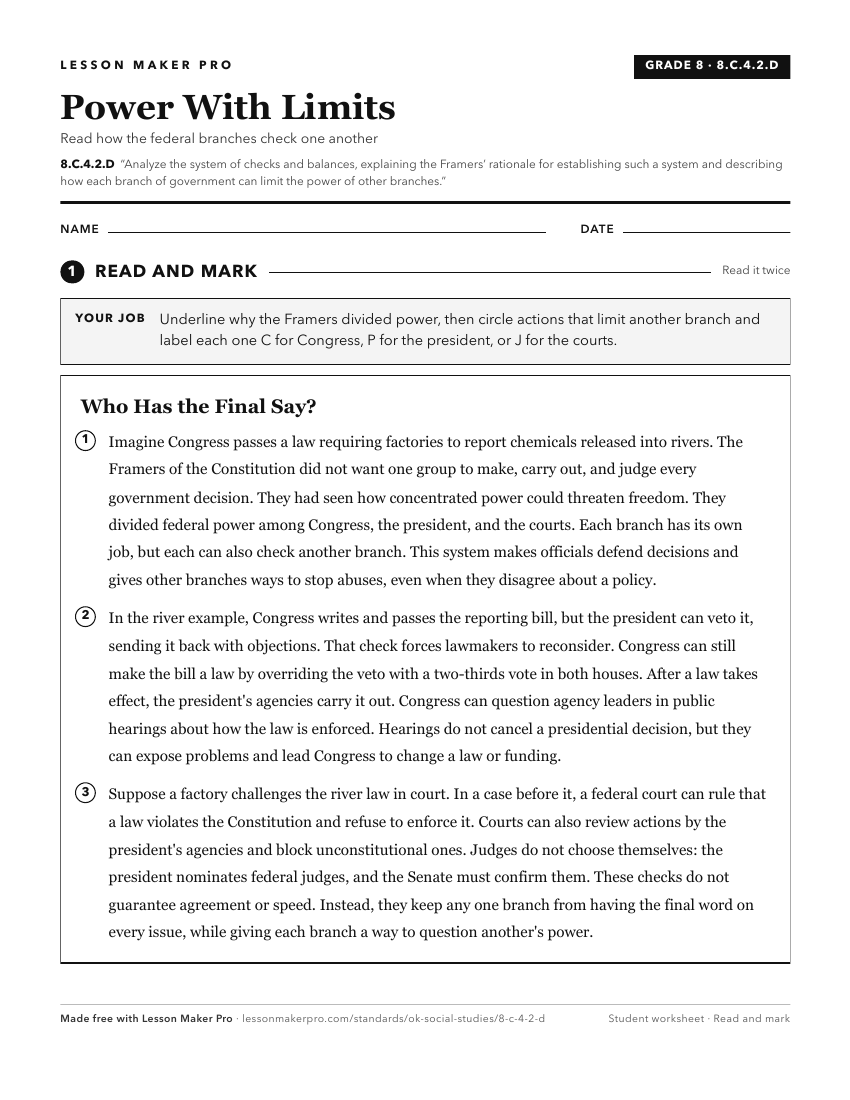
A ready-to-print activity worksheet aligned to 8.C.4.2.D, with an answer key for the teacher on its own page. No account needed.
PDF, US Letter, prints cleanly in black and white.
Download the worksheetKeep exploring
Related Standards
- 5.C.6.3.B
Describe the system of checks and balances, explaining how each branch of government can limit the power of other branches.
- USG.C.3.3.C
Explain how the checks and balances system provides each branch of government with individual powers to affect other branches, preventing any one branch from be...
- USG.C.3.3.D
Examine historical and contemporary examples of the system of checks and balances to illustrate the intent of the Framers and evaluate the effectiveness of the ...
- USG.C.3.3
Analyze how the Framers designed a system of separated powers to prevent the concentration and potential abuse of power.
Turn this exact standard into a lesson
Grade, subject, topic, and the complete standard are prefilled. Create one free, no account needed.
Also for this standard:Make a WorksheetMake a QuizMake a Sub Lesson