Oklahoma Social Studies 8.C.4.2
Standard Cluster
- 8.C.4
- Examine the key principles and structure of the United States of America’s government as established by the Constitution of the United States of America.
Examine the structure and principles of the United States of America’s government established in the Constitution of the United States of America, focusing on the Framers’ intent to limit and disperse the powers of government in order to prevent abuse. Examine the purpose of government, including its responsibilities to citizens, as expressed in the Preamble to the Constitution of the United States of America. Explain why the Framers of the Constitution of the United States of America separated governmental powers among three branches (separation of powers), comparing the qualifications, terms of office, and process for removal of members of Congress, the President, and federal judges. Identify the constitutional powers granted to Congress, the President, and the Supreme Court, using historical and contemporary examples. Analyze the system of checks and balances, explaining the Framers’ rationale for establishing such a system and describing how each branch of government can limit the power of other branches. Describe the concept of federalism (shared power) and identify specific types of powers (e.g., express, concurrent, reserved) exercised by the state versus national government, providing contemporary examples. Explain how the Supremacy Clause establishes the Constitution of the United States as the “supreme law of the Land” laying the foundation for the relationship between federal and state levels of authority.
Oklahoma Academic Standards for Social Studies (2026) · 8.C.4
Cluster contents
Standards in This Cluster
8.C.4.2 is a cluster heading. These are the individual standards under it.
- 8.C.4.2.A
Examine the purpose of government, including its responsibilities to citizens, as expressed in the Preamble to the Constitution of the United States of America.
- 8.C.4.2.B
Explain why the Framers of the Constitution of the United States of America separated governmental powers among three branches (separation of powers), comparing...
- 8.C.4.2.C
Identify the constitutional powers granted to Congress, the President, and the Supreme Court, using historical and contemporary examples.
- 8.C.4.2.D
Analyze the system of checks and balances, explaining the Framers’ rationale for establishing such a system and describing how each branch of government can lim...
- 8.C.4.2.E
Describe the concept of federalism (shared power) and identify specific types of powers (e.g., express, concurrent, reserved) exercised by the state versus nati...
- 8.C.4.2.F
Explain how the Supremacy Clause establishes the Constitution of the United States as the “supreme law of the Land” laying the foundation for the relationship b...
Teacher's field guide
What This Cluster Means
What Students Need to Do
- Students use the Preamble to explain what the government is meant to do for people. They compare who can serve in each branch, how long they serve, how they can be removed, and what powers they have. They identify national, state, and shared powers and explain how branches and levels of government limit one another.
What Mastery Looks Like
- A student can name a branch's power and show how another branch can limit it. They compare eligibility, terms, and removal for Congress, the president, and federal judges, including judges' lack of fixed terms. They sort federal, state, and shared powers and explain when a valid federal law takes priority over state law.
Common Misconceptions
- Students may think presidents can fire federal judges or that judges have four-year terms. They may confuse a presidential veto with the power to make laws. They may think federal law erases all state law, even when both laws can operate together.
How to Assess It
- Exit ticket: Congress passes a bill, and the president vetoes it. Name the power each branch used, explain one way Congress can respond, and say why the Framers gave Congress that option.
Lesson moves
Ways to Teach It
Give pairs a three-branch diagram and cards labeled veto, override, impeachment, and judicial review; connect each card to the branches it affects.
Ask students to write: Why can Congress override a veto, and what abuse might that prevent?
Run a matching relay with House, Senate, president, and federal judge cards plus separate cards for eligibility, term length, and removal.
Display a state driver's license and a U.S. passport; ask which level issues each and name a tax both levels can collect.
Free download
Printable 8.C.4.2 Worksheet
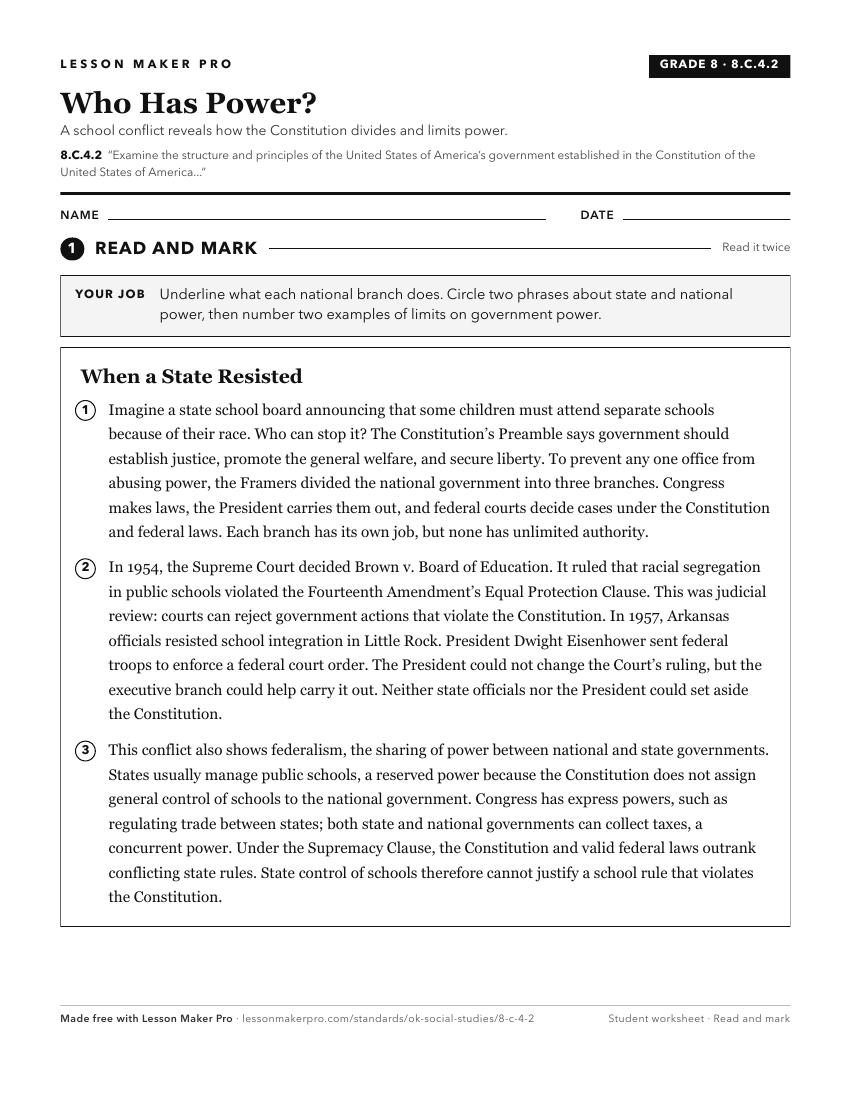
A ready-to-print activity worksheet aligned to 8.C.4.2, with an answer key for the teacher on its own page. No account needed.
PDF, US Letter, prints cleanly in black and white.
Download the worksheetKeep exploring
Related Standards
- 4.P.2.1.C
Examine the principles of the Constitution of the United States of America, including how laws are made in a democratic society and are used to protect individu...
- 5.C.6.3
Analyze the structure and operations of government established in the Constitution of the United States of America.
- 5.P.2.1.C
Examine the principles of the Constitution of the United States of America, including how laws are made in a democratic society and are used to protect individu...
- 8.C.4
Examine the key principles and structure of the United States of America’s government as established by the Constitution of the United States of America.
Turn this cluster into a lesson
Grade, subject, topic, and the complete cluster are prefilled. Create one free, no account needed.
Also for this cluster:Make a WorksheetMake a QuizMake a Sub Lesson