Oklahoma Social Studies 8.C.4.2.B
The Standard
- 8.C.4
- Examine the key principles and structure of the United States of America’s government as established by the Constitution of the United States of America.
- 8.C.4.2
- Examine the structure and principles of the United States of America’s government established in the Constitution of the United States of America, focusing on the Framers’ intent to limit and disperse the powers of government in order to prevent abuse.
Explain why the Framers of the Constitution of the United States of America separated governmental powers among three branches (separation of powers), comparing the qualifications, terms of office, and process for removal of members of Congress, the President, and federal judges.
Oklahoma Academic Standards for Social Studies (2026) · 8.C.4.2
Teacher's field guide
What This Standard Means
What Students Need to Do
- Students explain why lawmaking, enforcing laws, and judging cases belong to separate branches. They compare the requirements, terms, and removal rules for House members, senators, the president, and federal judges.
What Mastery Looks Like
- Students give the House and Senate age, citizenship, and state residency rules, along with their two- and six-year terms. They give the president’s requirements and four-year term, and know the Constitution sets no qualifications or fixed term for federal judges. They distinguish expulsion by a member’s own chamber from impeachment by the House and removal after conviction by the Senate.
Common Misconceptions
- Students often give House members and senators the same term. Some think federal judges run for election or must meet a constitutional age requirement. Others think impeachment alone removes a president or judge, or that Congress removes its members through impeachment.
How to Assess It
- Give students a four-row exit ticket labeled House, Senate, president, and federal judge. Have them fill in qualifications, term, and removal method, then explain in one sentence why these jobs have different powers.
Lesson moves
Ways to Teach It
Give pairs office and rule cards; have them build a three-branch chart showing each office’s qualifications, term, and removal process.
Ask students to write why House members face voters every two years while federal judges have no fixed term.
Play four corners with House, Senate, president, and judge; read clues such as “nine years a citizen” and “no fixed term.”
Show the mock headline “President impeached”; have students name who votes next and explain why impeachment alone does not remove the president.
Free download
Printable 8.C.4.2.B Worksheet
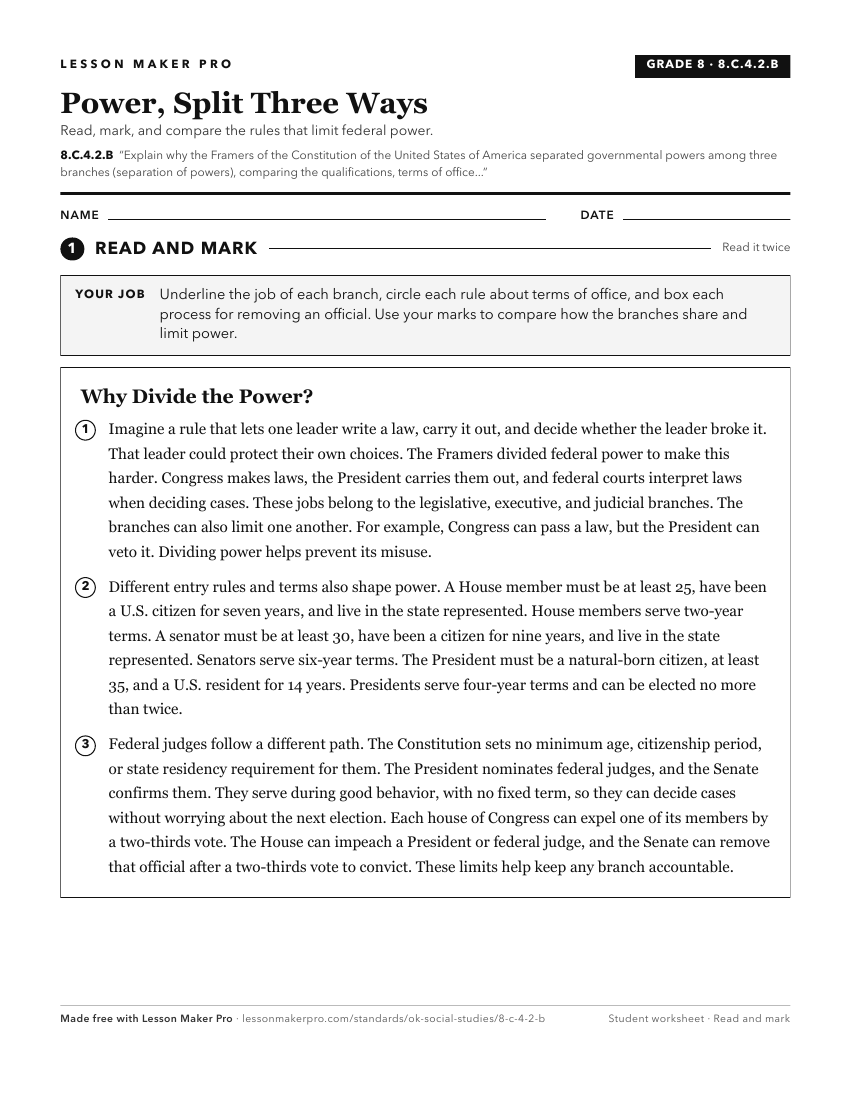
A ready-to-print activity worksheet aligned to 8.C.4.2.B, with an answer key for the teacher on its own page. No account needed.
PDF, US Letter, prints cleanly in black and white.
Download the worksheetKeep exploring
Related Standards
- 8.C.4.2.D
Analyze the system of checks and balances, explaining the Framers’ rationale for establishing such a system and describing how each branch of government can lim...
- USG.C.3.3.A
Describe and compare the scope of the powers vested to the Legislative Branch (Article 1), the Executive Branch (Article II), and the Judicial Branch (Article I...
- 5.C.6.3.A
Explain why the Framers separated government’s powers into different branches, identify the three branches of the United States of America’s government (legisla...
- USG.C.3.3
Analyze how the Framers designed a system of separated powers to prevent the concentration and potential abuse of power.
Turn this exact standard into a lesson
Grade, subject, topic, and the complete standard are prefilled. Create one free, no account needed.
Also for this standard:Make a WorksheetMake a QuizMake a Sub Lesson