Oklahoma Social Studies 5.C.6.3
Standard Cluster
- 5.C.6
- Describe the structure and responsibilities of the United States of America’s system of government and the role of the individual citizen, as provided in the Constitution of the United States of America.
Analyze the structure and operations of government established in the Constitution of the United States of America. Explain why the Framers separated government’s powers into different branches, identify the three branches of the United States of America’s government (legislative, executive, judicial), and describe each branch’s basic function. Describe the system of checks and balances, explaining how each branch of government can limit the power of other branches. Examine the system of shared powers (federalism) between the federal and state levels of governments, explaining why the Framers assigned specific powers to each level. Explain how the Constitution of the United States of America establishes a process for making laws, including specific roles for Congress, the President, and the Supreme Court.
Oklahoma Academic Standards for Social Studies (2026) · 5.C.6
Cluster contents
Standards in This Cluster
5.C.6.3 is a cluster heading. These are the individual standards under it.
- 5.C.6.3.A
Explain why the Framers separated government’s powers into different branches, identify the three branches of the United States of America’s government (legisla...
- 5.C.6.3.B
Describe the system of checks and balances, explaining how each branch of government can limit the power of other branches.
- 5.C.6.3.C
Examine the system of shared powers (federalism) between the federal and state levels of governments, explaining why the Framers assigned specific powers to eac...
- 5.C.6.3.D
Explain how the Constitution of the United States of America establishes a process for making laws, including specific roles for Congress, the President, and th...
Teacher's field guide
What This Cluster Means
What Students Need to Do
- Students identify who makes, carries out, and interprets federal laws. They explain why those jobs are split and trace a bill through Congress and the president. They describe how branches limit each other and why some powers belong to states while others belong to the federal government.
What Mastery Looks Like
- A student can name Congress as the lawmaker, the president as the enforcer, and the Supreme Court as a court that decides cases about the Constitution. They can explain a veto, an override, and court review of a challenged law. They can explain why the federal government controls currency while states set school requirements.
Common Misconceptions
- Students may think the president makes laws alone or that the Supreme Court approves every new law. They may think a veto ends a bill permanently, missing Congress's power to override it. Some assume states have no say over schools.
How to Assess It
- Exit ticket: Congress passes a bill about U.S. coins, and the president vetoes it. Explain how Congress could respond, what the Supreme Court could do if the law is challenged, and why coins are a federal matter.
Lesson moves
Ways to Teach It
Give pairs cards for veto, override, court review, schools, currency, and taxes; sort checks by branch and powers by government level.
Ask students to write: What might happen if one person could write, enforce, and judge every law?
Run a checks game: read a veto or challenged-law card, then have teams name the branch that can respond and how.
Compare state school standards with a dollar bill; students write why states set school requirements while the federal government controls currency.
Free download
Printable 5.C.6.3 Worksheet
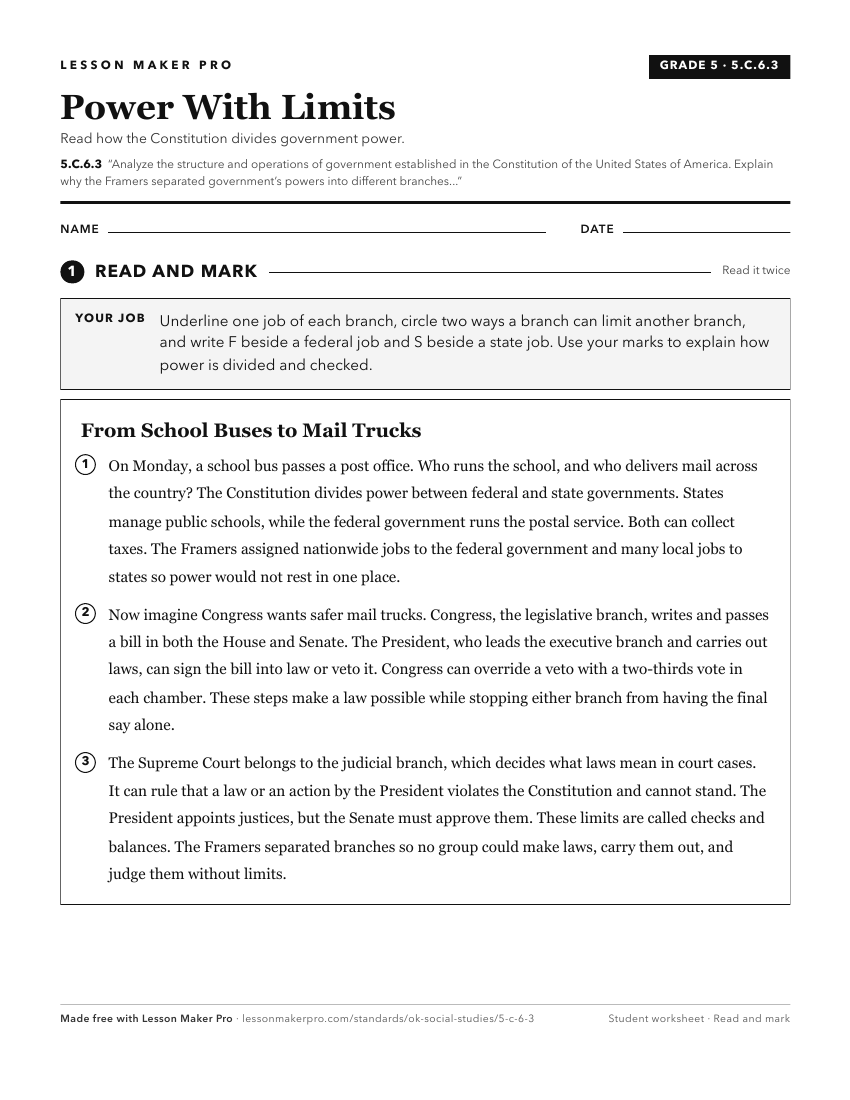
A ready-to-print activity worksheet aligned to 5.C.6.3, with an answer key for the teacher on its own page. No account needed.
PDF, US Letter, prints cleanly in black and white.
Download the worksheetKeep exploring
Related Standards
- USG.C.3
Analyze the fundamental principles of the American republic, as established in the Constitution of the United States of America.
- USG.C.3.4
Analyze the system of federalism as established by the Constitution of the United States of America.
- 8.C.4
Examine the key principles and structure of the United States of America’s government as established by the Constitution of the United States of America.
- 8.C.4.2
Examine the structure and principles of the United States of America’s government established in the Constitution of the United States of America, focusing on t...
Turn this cluster into a lesson
Grade, subject, topic, and the complete cluster are prefilled. Create one free, no account needed.
Also for this cluster:Make a WorksheetMake a QuizMake a Sub Lesson