Oklahoma Social Studies USG.C.3.4
Standard Cluster
- USG.C.3
- Analyze the fundamental principles of the American republic, as established in the Constitution of the United States of America.
Analyze the system of federalism as established by the Constitution of the United States of America. Define and identify the enumerated (expressed) powers found in Article I. Describe how the “general welfare” clause and “necessary and proper” clause have empowered Congress with implied powers. Identify powers denied to the national government versus those reserved to the states. Describe the reasons why the Framers established concurrent powers, comparing examples exercised by both the national and state governments. Explain how the Supremacy Clause (Article VI, Clause 2) establishes the Constitution of the United States of America and federal laws or treaties as the “supreme Law of the Land.” Evaluate changes that have occurred in the relationship between the states and the national government over time (e.g., cooperative federalism versus new federalism/devolution).
Oklahoma Academic Standards for Social Studies (2026) · USG.C.3
Cluster contents
Standards in This Cluster
USG.C.3.4 is a cluster heading. These are the individual standards under it.
- USG.C.3.4.A
Define and identify the enumerated (expressed) powers found in Article I.
- USG.C.3.4.B
Describe how the “general welfare” clause and “necessary and proper” clause have empowered Congress with implied powers.
- USG.C.3.4.C
Identify powers denied to the national government versus those reserved to the states.
- USG.C.3.4.D
Describe the reasons why the Framers established concurrent powers, comparing examples exercised by both the national and state governments.
- USG.C.3.4.E
Explain how the Supremacy Clause (Article VI, Clause 2) establishes the Constitution of the United States of America and federal laws or treaties as the “suprem...
- USG.C.3.4.F
Evaluate changes that have occurred in the relationship between the states and the national government over time (e.g., cooperative federalism versus new federa...
Teacher's field guide
What This Cluster Means
What Students Need to Do
- Students sort powers as listed, implied, shared, reserved to states, or denied to the federal government. They explain why a valid federal law takes priority over a conflicting state law. They compare joint federal-state programs with efforts to give states more control.
What Mastery Looks Like
- They find Congress's power to tax and regulate interstate trade in Article I. They explain how general welfare spending and necessary-and-proper laws extend Congress's reach, but not without limits. They identify export taxes as barred to Congress, school rules as a state matter, and taxation as shared because both governments need revenue.
Common Misconceptions
- Students may think any federal law beats any state law, even if Congress lacks authority to pass it. Some read the necessary and proper clause as permission to pass any law. Others think states cannot tax because Congress can.
How to Assess It
- Exit ticket: Label each power as listed, implied, shared, reserved, or denied: declaring war, creating a national bank, both governments collecting taxes, running public schools, and taxing exports. Then state what happens when a valid federal law conflicts with a state law.
Lesson moves
Ways to Teach It
Give pairs five power cards: declaring war, creating a national bank, both governments taxing, running schools, and taxing exports; have them sort the cards.
Ask why both governments levy taxes, then compare state choices under a highway grant with fixed federal rules and a flexible block grant.
Read 'create a national bank' and 'tax exports'; teams label each on mini whiteboards and point to its constitutional basis.
Print federal and higher state minimum wage posters; students identify the required wage and explain why federal law does not erase the higher state rate.
Free download
Printable USG.C.3.4 Worksheet
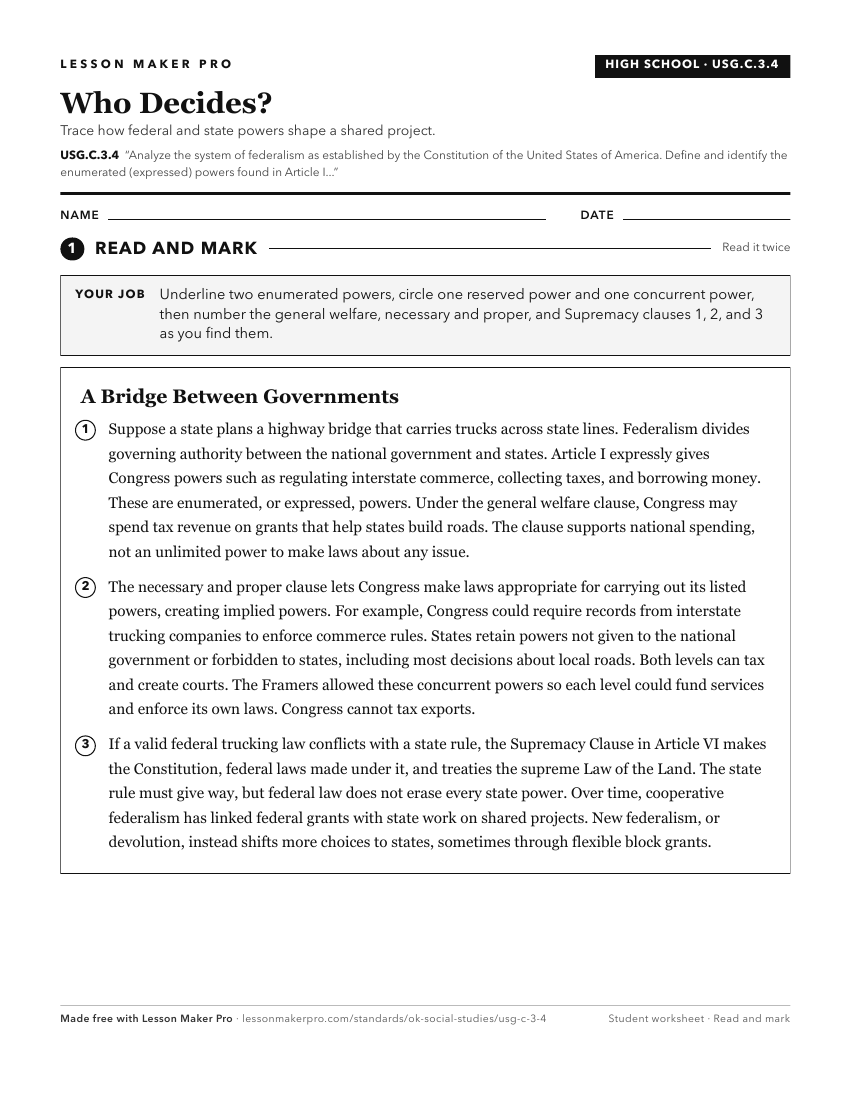
A ready-to-print activity worksheet aligned to USG.C.3.4, with an answer key for the teacher on its own page. No account needed.
PDF, US Letter, prints cleanly in black and white.
Download the worksheetKeep exploring
Related Standards
- 5.C.6.3
Analyze the structure and operations of government established in the Constitution of the United States of America.
- USG.C.3
Analyze the fundamental principles of the American republic, as established in the Constitution of the United States of America.
- USH.C.1.1.B
Analyze the Constitution’s concepts of federalism, separation of powers, and the system of checks and balances to changing relationships in American politics as...
- 8.C.4
Examine the key principles and structure of the United States of America’s government as established by the Constitution of the United States of America.
Turn this cluster into a lesson
Grade, subject, topic, and the complete cluster are prefilled. Create one free, no account needed.
Also for this cluster:Make a WorksheetMake a QuizMake a Sub Lesson