Oklahoma Social Studies 8.C.4
Standard Cluster
Examine the key principles and structure of the United States of America’s government as established by the Constitution of the United States of America. Analyze the need for a written constitution, tracing the foundation of self-government established in the Mayflower Compact, including its responsibilities to citizens as expressed in the Preamble to the Constitution of the United States of America. Examine the structure and principles of the United States of America’s government established in the Constitution of the United States of America, focusing on the Framers’ intent to limit and disperse the powers of government in order to prevent abuse. Examine the purpose of government, including its responsibilities to citizens, as expressed in the Preamble to the Constitution of the United States of America. Explain why the Framers of the Constitution of the United States of America separated governmental powers among three branches (separation of powers), comparing the qualifications, terms of office, and process for removal of members of Congress, the President, and federal judges. Identify the constitutional powers granted to Congress, the President, and the Supreme Court, using historical and contemporary examples. Analyze the system of checks and balances, explaining the Framers’ rationale for establishing such a system and describing how each branch of government can limit the power of other branches. Describe the concept of federalism (shared power) and identify specific types of powers (e.g., express, concurrent, reserved) exercised by the state versus national government, providing contemporary examples. Explain how the Supremacy Clause establishes the Constitution of the United States as the “supreme law of the Land” laying the foundation for the relationship between federal and state levels of authority. Evaluate the significance of the Commerce Clause in establishing a constitutional relationship between American Indian Tribal Nations and the United States government. Explain that the Constitution of the United States of America grants Congress authority to regulate commerce with Tribal Nations, forming the constitutional basis for federal authority in American Indian affairs. Examine how early Supreme Court decisions, often referred to as the “Marshall Trilogy,” defined Tribal Nations as “domestic dependent nations,” recognizing limited sovereignty while placing Tribal governments under the authority and protection of the United States of America. Explain that Tribal governments retain powers of internal self-government, including making and enforcing laws, determining citizenship, and managing lands and natural resources, while operating within a constitutional framework in which Congress holds authority over American Indian affairs. Examine the steps of the legislative process. Describe the constitutional roles of Congress and the President to produce necessary legislation in order to meet public needs. Trace the basic steps of the legislative process using contemporary examples. Analyze the rights and liberties guaranteed to all citizens in the Bill of Rights. Explain the Constitutional amendment process, using the Bill of Rights as an example. Describe the influence of James Madison and the Virginia Declaration of Rights to the development of the Bill of Rights, including the significance of the Virginia Statute for Religious Freedom as a forerunner of the First Amendment. Examine individual rights, liberties, and protections of due process guaranteed by the Bill of Rights. Explain how the Bill of Rights protects individuals from abuse by the national government with most of its provisions being applied to the states through the 14th Amendment. Describe how the Bill of Rights and the United States of America’s judicial system uphold the rule of law guaranteeing fair and equal application of the law and the accountability of all persons under it. Explain the importance of an independent judicial system to the interpretation and defense of citizens’ rights and liberties. Define civic virtue and explain the individual’s duties and responsibilities. Describe the right to vote and public service as the cornerstones of a constitutional republic. Examine other political rights and responsibilities of citizens, such as engaging in informed civil discourse and non-violent protest,, serving on juries, and participating in political campaigns. Identify responsibilities of both citizens and residents of the United States of America, including obedience to the law, registering for military service, and paying taxes.
Oklahoma Academic Standards for Social Studies (2026)
Cluster contents
Standards in This Cluster
8.C.4 is a cluster heading. These are the individual standards under it.
- 8.C.4.1
Analyze the need for a written constitution, tracing the foundation of self-government established in the Mayflower Compact, including its responsibilities to c...
- 8.C.4.2
Examine the structure and principles of the United States of America’s government established in the Constitution of the United States of America, focusing on t...
- 8.C.4.2.A
Examine the purpose of government, including its responsibilities to citizens, as expressed in the Preamble to the Constitution of the United States of America.
- 8.C.4.2.B
Explain why the Framers of the Constitution of the United States of America separated governmental powers among three branches (separation of powers), comparing...
- 8.C.4.2.C
Identify the constitutional powers granted to Congress, the President, and the Supreme Court, using historical and contemporary examples.
- 8.C.4.2.D
Analyze the system of checks and balances, explaining the Framers’ rationale for establishing such a system and describing how each branch of government can lim...
- 8.C.4.2.E
Describe the concept of federalism (shared power) and identify specific types of powers (e.g., express, concurrent, reserved) exercised by the state versus nati...
- 8.C.4.2.F
Explain how the Supremacy Clause establishes the Constitution of the United States as the “supreme law of the Land” laying the foundation for the relationship b...
- 8.C.4.3
Evaluate the significance of the Commerce Clause in establishing a constitutional relationship between American Indian Tribal Nations and the United States gove...
- 8.C.4.3.A
Explain that the Constitution of the United States of America grants Congress authority to regulate commerce with Tribal Nations, forming the constitutional bas...
- 8.C.4.3.B
Examine how early Supreme Court decisions, often referred to as the “Marshall Trilogy,” defined Tribal Nations as “domestic dependent nations,” recognizing limi...
- 8.C.4.3.C
Explain that Tribal governments retain powers of internal self-government, including making and enforcing laws, determining citizenship, and managing lands and ...
- 8.C.4.4
Examine the steps of the legislative process.
- 8.C.4.4.A
Describe the constitutional roles of Congress and the President to produce necessary legislation in order to meet public needs.
- 8.C.4.4.B
Trace the basic steps of the legislative process using contemporary examples.
- 8.C.4.5
Analyze the rights and liberties guaranteed to all citizens in the Bill of Rights.
- 8.C.4.5.A
Explain the Constitutional amendment process, using the Bill of Rights as an example.
- 8.C.4.5.B
Describe the influence of James Madison and the Virginia Declaration of Rights to the development of the Bill of Rights, including the significance of the Virgi...
- 8.C.4.5.C
Examine individual rights, liberties, and protections of due process guaranteed by the Bill of Rights.
- 8.C.4.5.D
Explain how the Bill of Rights protects individuals from abuse by the national government with most of its provisions being applied to the states through the 14...
- 8.C.4.5.E
Describe how the Bill of Rights and the United States of America’s judicial system uphold the rule of law guaranteeing fair and equal application of the law and...
- 8.C.4.5.F
Explain the importance of an independent judicial system to the interpretation and defense of citizens’ rights and liberties.
- 8.C.4.6
Define civic virtue and explain the individual’s duties and responsibilities.
- 8.C.4.6.A
Describe the right to vote and public service as the cornerstones of a constitutional republic.
- 8.C.4.6.B
Examine other political rights and responsibilities of citizens, such as engaging in informed civil discourse and non-violent protest,, serving on juries, and p...
- 8.C.4.6.C
Identify responsibilities of both citizens and residents of the United States of America, including obedience to the law, registering for military service, and ...
Teacher's field guide
What This Cluster Means
What Students Need to Do
- Students explain why the Mayflower Compact and Constitution set government rules in writing. They map each branch's job, federal and state powers, and Congress's authority alongside Tribal self-government. They trace bills and amendments, apply rights to cases, and identify civic duties.
What Mastery Looks Like
- They compare office terms and removal rules, then trace a bill through a veto and a court challenge. They sort federal, state, and Tribal powers, and explain why valid federal law takes priority over state law. Given a protest case, they name a protected right, explain how it applies to states, and suggest a lawful civic response.
Common Misconceptions
- Students may think the president makes laws alone or that a state can override any federal law. Some think Tribal governments are state departments, rather than governments that govern their own citizens and lands. Others assume the Bill of Rights always applied to states or that voting is legally required.
How to Assess It
- Exit ticket: Congress passes a law restricting peaceful protest, and a state enforces it. Name one check on the law, one right at stake, and why that right applies to the state.
Lesson moves
Ways to Teach It
Give pairs cards for levying taxes, vetoing bills, deciding cases, and setting Tribal citizenship; sort them under Congress, president, courts, states, or Tribal Nations.
Compare excerpts from the Virginia Declaration of Rights and Virginia Statute for Religious Freedom; write which First Amendment protection each helped shape.
Run a school lunch bill relay through committee, both chambers, a presidential veto, an override vote, and a court challenge.
Find a current bill on Congress.gov; record its latest action and write a two-sentence message to a representative about it.
Free download
Printable 8.C.4 Worksheet
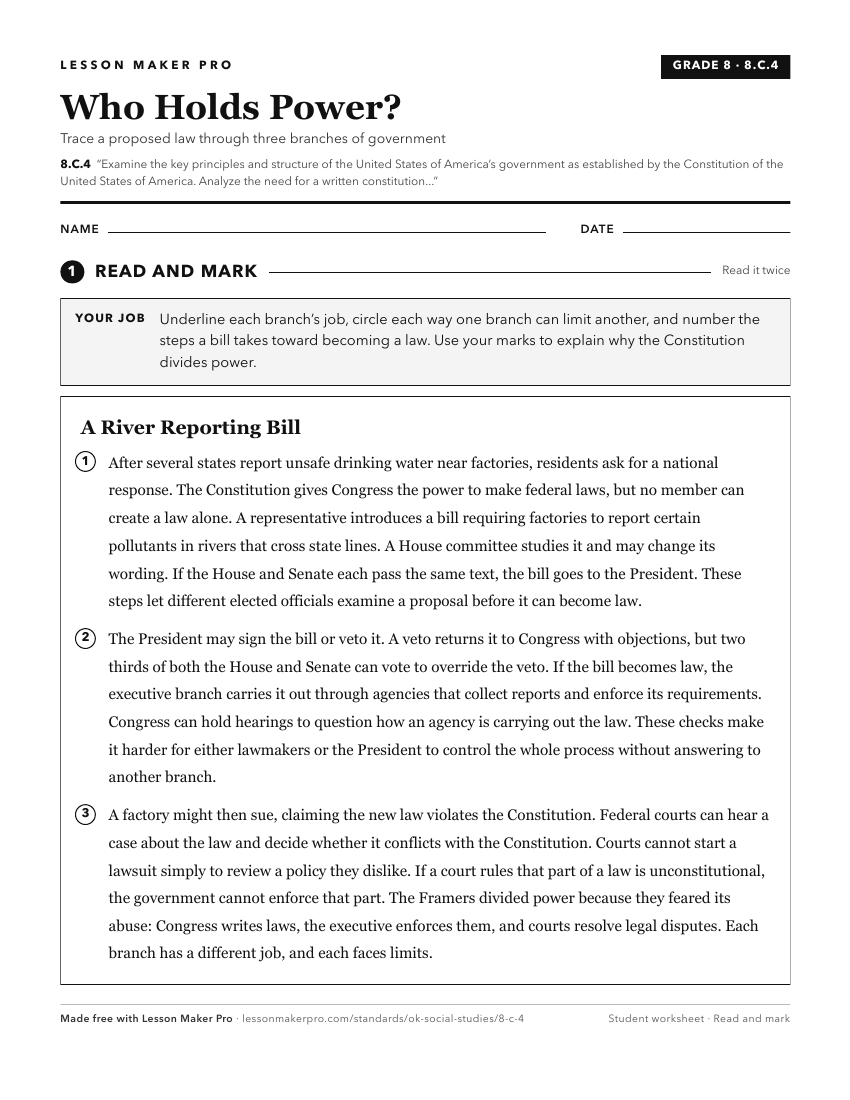
A ready-to-print activity worksheet aligned to 8.C.4, with an answer key for the teacher on its own page. No account needed.
PDF, US Letter, prints cleanly in black and white.
Download the worksheetKeep exploring
Related Standards
- 5.C.6.3
Analyze the structure and operations of government established in the Constitution of the United States of America.
- USG.C.3
Analyze the fundamental principles of the American republic, as established in the Constitution of the United States of America.
- USG.C.1.3
Examine the founding principles of the United States of America’s constitutional republic.
Turn this cluster into a lesson
Grade, subject, topic, and the complete cluster are prefilled. Create one free, no account needed.
Also for this cluster:Make a WorksheetMake a QuizMake a Sub Lesson