Oklahoma Social Studies 8.C.4.3.C
The Standard
- 8.C.4
- Examine the key principles and structure of the United States of America’s government as established by the Constitution of the United States of America.
- 8.C.4.3
- Evaluate the significance of the Commerce Clause in establishing a constitutional relationship between American Indian Tribal Nations and the United States government.
Explain that Tribal governments retain powers of internal self-government, including making and enforcing laws, determining citizenship, and managing lands and natural resources, while operating within a constitutional framework in which Congress holds authority over American Indian affairs.
Oklahoma Academic Standards for Social Studies (2026) · 8.C.4.3
Teacher's field guide
What This Standard Means
What Students Need to Do
- Students identify decisions tribal governments make for their own communities, such as setting citizenship rules, enforcing laws, and managing land and resources. They explain that Congress makes federal laws about American Indian affairs but does not handle every tribal decision.
What Mastery Looks Like
- Given a situation, students can name who makes the decision and explain why. They can describe tribal self-government without treating a tribe as a branch of state government.
Common Misconceptions
- Students may think Congress writes every tribal rule or that tribal governments answer to state governments. They may assume tribal citizenship depends only on where a person lives.
How to Assess It
- Exit ticket: A tribal nation sets citizenship rules and manages a forest on its land. Who makes those decisions, and who makes federal laws about American Indian affairs?
Lesson moves
Ways to Teach It
Give pairs cards labeled tribal citizenship, tribal court ruling, tribal forest plan, and federal law; have them sort the cards by decision-maker.
Ask students to write two sentences answering: How can a tribe set fishing rules while Congress makes federal laws about American Indian affairs?
Read six decision scenarios aloud; students hold up tribe or Congress cards and give one reason for each choice.
Open the Cherokee Nation citizenship webpage; have students identify who sets citizenship rules and compare that role with Congress's federal lawmaking authority.
Free download
Printable 8.C.4.3.C Worksheet
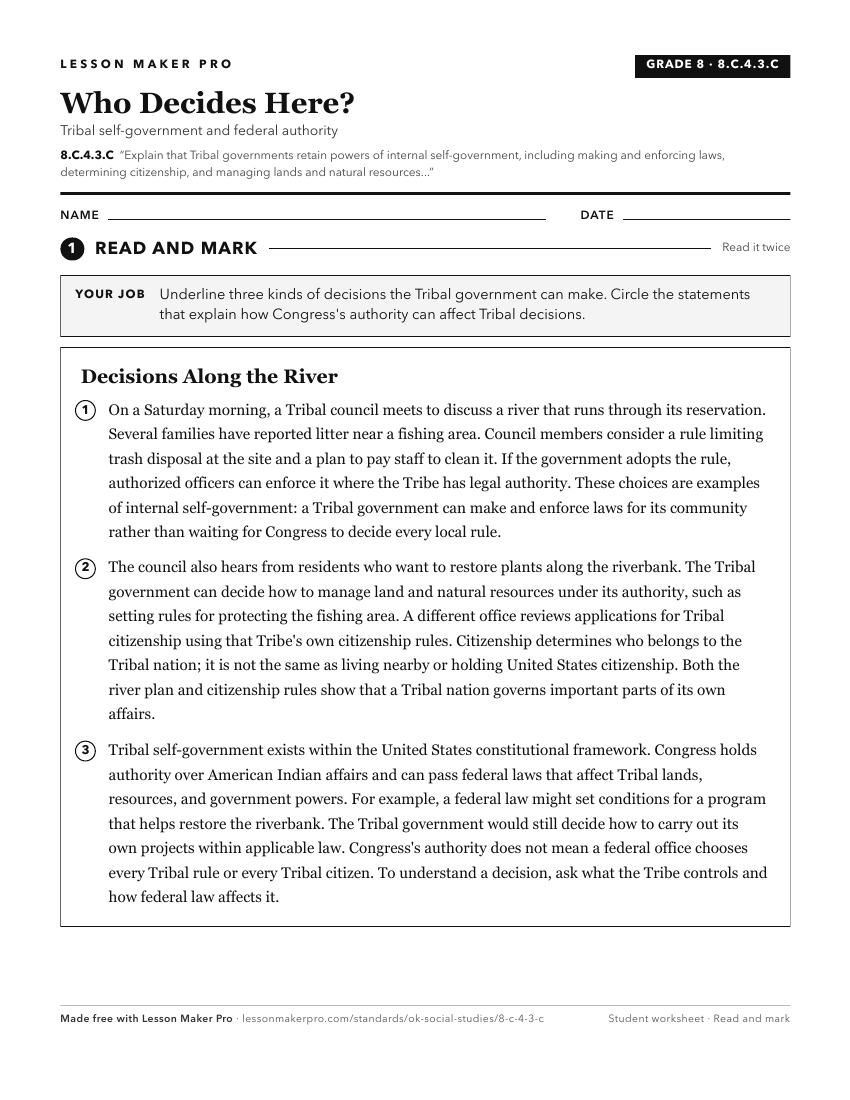
A ready-to-print activity worksheet aligned to 8.C.4.3.C, with an answer key for the teacher on its own page. No account needed.
PDF, US Letter, prints cleanly in black and white.
Download the worksheetKeep exploring
Related Standards
- USG.C.3.6.C
Explain how Tribal governments exercise powers of self-government and participate in federal programs through legislation that allows Tribes to contract or comp...
- 5.C.6.4.B
Explain that Tribal governments possess powers, including the authority to determine Tribal citizenship, make and enforce laws, manage lands and natural resourc...
- 3.C.1.2
Describe how American Indian Tribal governments are also based upon written constitutions and exercise the right to govern themselves (sovereignty) by making la...
- 2.C.1.5
Explain how American Indian Nations are self-governing people who make decisions through Tribal representatives in order to meet the needs of their citizens and...
Turn this exact standard into a lesson
Grade, subject, topic, and the complete standard are prefilled. Create one free, no account needed.
Also for this standard:Make a WorksheetMake a QuizMake a Sub Lesson