Oklahoma Social Studies 8.C.4.6
Standard Cluster
- 8.C.4
- Examine the key principles and structure of the United States of America’s government as established by the Constitution of the United States of America.
Define civic virtue and explain the individual’s duties and responsibilities. Describe the right to vote and public service as the cornerstones of a constitutional republic. Examine other political rights and responsibilities of citizens, such as engaging in informed civil discourse and non-violent protest,, serving on juries, and participating in political campaigns. Identify responsibilities of both citizens and residents of the United States of America, including obedience to the law, registering for military service, and paying taxes.
Oklahoma Academic Standards for Social Studies (2026) · 8.C.4
Cluster contents
Standards in This Cluster
8.C.4.6 is a cluster heading. These are the individual standards under it.
- 8.C.4.6.A
Describe the right to vote and public service as the cornerstones of a constitutional republic.
- 8.C.4.6.B
Examine other political rights and responsibilities of citizens, such as engaging in informed civil discourse and non-violent protest,, serving on juries, and p...
- 8.C.4.6.C
Identify responsibilities of both citizens and residents of the United States of America, including obedience to the law, registering for military service, and ...
Teacher's field guide
What This Cluster Means
What Students Need to Do
- Students describe civic virtue as acting for the good of their community. They sort voting, campaigning, respectful debate, peaceful protest, public service, jury duty, taxes, following laws, and Selective Service registration into rights, choices, and legal duties. They explain who is allowed or required to do each, and how voting and public service support a constitutional republic.
What Mastery Looks Like
- Given a scenario, students distinguish an eligible citizen's right to vote from a resident's duty to pay taxes. They explain that summoned, eligible citizens serve on juries and that eligible men ages 18 to 25 register for Selective Service. They can name a respectful way to address a community problem.
Common Misconceptions
- Students may think noncitizen residents can vote in federal elections or serve on juries. They may think peaceful protest is illegal or that only citizens pay taxes. Some confuse Selective Service registration with joining the military.
How to Assess It
- Exit ticket: An eligible citizen votes, a resident pays taxes, a summoned citizen serves on a jury, and neighbors protest peacefully. Label each action as a right or legal duty, then explain how voting and public service help a republic.
Lesson moves
Ways to Teach It
Give pairs citizen and resident role cards; have them sort voting, jury duty, taxes, protest, and Selective Service registration by eligibility.
Ask students to write two sentences on whether a peaceful protest or a school board speech best addresses a bus route change.
Read role cards aloud; students hold up CAN, MUST, or CANNOT for voting, taxes, jury duty, and Selective Service registration.
Print a city council agenda with a public comment slot; have students draft a respectful comment about one listed issue.
Free download
Printable 8.C.4.6 Worksheet
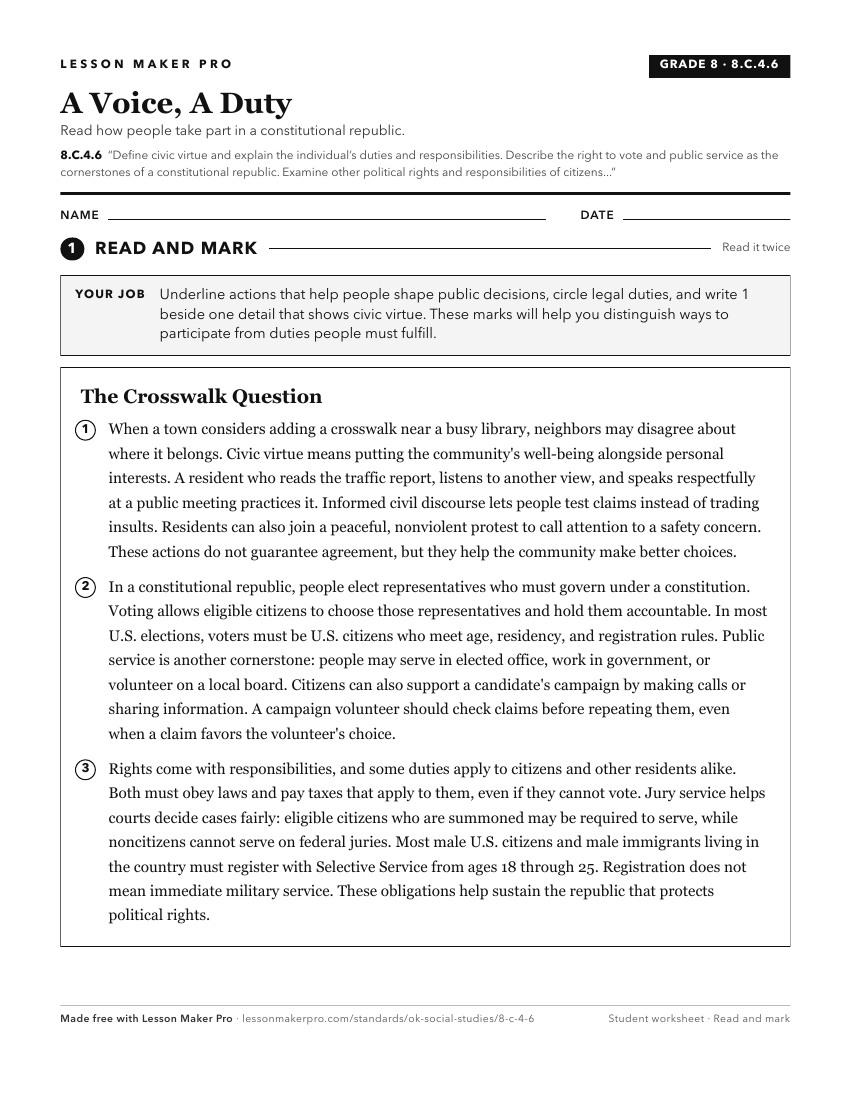
A ready-to-print activity worksheet aligned to 8.C.4.6, with an answer key for the teacher on its own page. No account needed.
PDF, US Letter, prints cleanly in black and white.
Download the worksheetKeep exploring
Related Standards
- 4.C.1.3
Explain the concept of civic virtue and responsibilities of citizenship.
- 1.C.1.3
Define the concept of civic duty, identifying characteristics of responsible citizenship (e.g., respect for laws, voting, and volunteerism).
- USG.C.8.2
Define civic virtue and explain the individual’s duty and responsibility to participate in civic life.
- 3.C.1.4
Define the concepts of civic virtue and examine the responsibilities of citizens.
Turn this cluster into a lesson
Grade, subject, topic, and the complete cluster are prefilled. Create one free, no account needed.
Also for this cluster:Make a WorksheetMake a QuizMake a Sub Lesson