Oklahoma Social Studies 3.C.1.4
Standard Cluster
- 3.C.1
- Analyze the purpose of government and traits of responsible citizens.
Define the concepts of civic virtue and examine the responsibilities of citizens. Examine why civility, cooperation, self-reliance, and respect for the law are important civic traits that support our communities, state, nation, and Tribes. Explain the importance of voting in elections and running for public office to the preservation of a constitutional republic. Describe how citizens can serve their community through jury duty and community service. Explain how military service is one of many ways that Oklahomans express their patriotism and sense of duty, exemplified by the Buffalo Soldiers, Native Code Talkers, and the 45th Infantry.
Oklahoma Academic Standards for Social Studies (2026) · 3.C.1
Cluster contents
Standards in This Cluster
3.C.1.4 is a cluster heading. These are the individual standards under it.
- 3.C.1.4.A
Examine why civility, cooperation, self-reliance, and respect for the law are important civic traits that support our communities, state, nation, and Tribes.
- 3.C.1.4.B
Explain the importance of voting in elections and running for public office to the preservation of a constitutional republic.
- 3.C.1.4.C
Describe how citizens can serve their community through jury duty and community service.
- 3.C.1.4.D
Explain how military service is one of many ways that Oklahomans express their patriotism and sense of duty, exemplified by the Buffalo Soldiers, Native Code Ta...
Teacher's field guide
What This Cluster Means
What Students Need to Do
- Students explain civic virtue as habits that help people live and work together. They give examples of civility, cooperation, self-reliance, and following laws in communities, Tribes, the state, and the nation. They describe ways citizens serve and take part in government.
What Mastery Looks Like
- A student explains that voting chooses representatives and running for office gives people a way to lead in a constitutional republic. They describe jury duty and community service as ways to help. They name the Buffalo Soldiers, Native Code Talkers, and 45th Infantry as examples of military service.
Common Misconceptions
- Students may think self-reliance means never asking for help, or that civic virtue means only obeying laws. They may think children can serve on juries, everyone must join the military, or voting is the only way to take part.
How to Assess It
- Exit ticket: A neighborhood needs a safer park. Name two civic traits that would help, one way to serve now, and one way an adult could take part through an election. Explain each choice.
Lesson moves
Ways to Teach It
Have two volunteers run for class representative, give one promise each, and hold a paper-ballot vote to choose who presents a class request.
Ask: If classmates disagree about a playground rule, how could civility, cooperation, self-reliance, and respect for the rule help?
Give pairs cards showing jury duty, park cleanup, the Buffalo Soldiers, Native Code Talkers, and 45th Infantry to sort by type of service.
Find a local town or Tribal council meeting notice; students write one question they would ask about a community need.
Free download
Printable 3.C.1.4 Worksheet
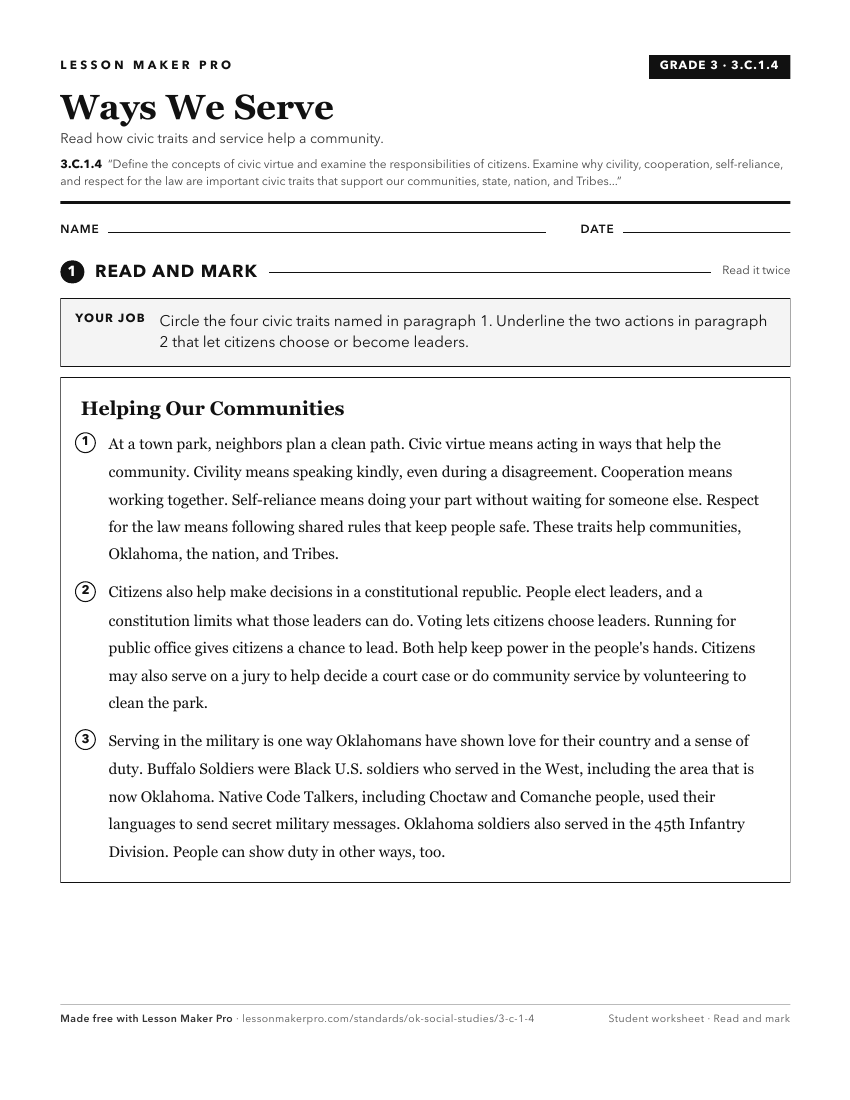
A ready-to-print activity worksheet aligned to 3.C.1.4, with an answer key for the teacher on its own page. No account needed.
PDF, US Letter, prints cleanly in black and white.
Download the worksheetKeep exploring
Related Standards
- 8.C.4.6
Define civic virtue and explain the individual’s duties and responsibilities.
- 4.C.1.3
Explain the concept of civic virtue and responsibilities of citizenship.
- 1.C.1.3
Define the concept of civic duty, identifying characteristics of responsible citizenship (e.g., respect for laws, voting, and volunteerism).
- USG.C.8.2
Define civic virtue and explain the individual’s duty and responsibility to participate in civic life.
Turn this cluster into a lesson
Grade, subject, topic, and the complete cluster are prefilled. Create one free, no account needed.
Also for this cluster:Make a WorksheetMake a QuizMake a Sub Lesson