Oklahoma Social Studies USG.C.8.2
Standard Cluster
- USG.C.8
- Evaluate the significance of civic participation in order to ensure the preservation of constitutional government.
Define civic virtue and explain the individual’s duty and responsibility to participate in civic life. Distinguish among the civic life, political life, and private life of citizens. Examine how components of civil society (e.g., active communities, individual self-reliance, ethics, religion) contribute to the maintenance of limited government in a representative and democratic republic. Explain how civic virtue and a shared American civic identity are achieved through the deliberation about the meaning and application of our Founding documents. Describe the right to vote as a cornerstone of a constitutional republic and the most direct way for citizens to participate in government. Examine other political rights and responsibilities of citizens, including registering to vote, running for office, serving on juries, and participating in political campaigns. Identify responsibilities of both citizens and residents of the United States of America, including obedience of the law, registration for the selective service, and payment of state and federal taxes prior to the annual deadline.
Oklahoma Academic Standards for Social Studies (2026) · USG.C.8
Cluster contents
Standards in This Cluster
USG.C.8.2 is a cluster heading. These are the individual standards under it.
- USG.C.8.2.A
Distinguish among the civic life, political life, and private life of citizens.
- USG.C.8.2.B
Examine how components of civil society (e.g., active communities, individual self-reliance, ethics, religion) contribute to the maintenance of limited governme...
- USG.C.8.2.C
Explain how civic virtue and a shared American civic identity are achieved through the deliberation about the meaning and application of our Founding documents.
- USG.C.8.2.D
Describe the right to vote as a cornerstone of a constitutional republic and the most direct way for citizens to participate in government.
- USG.C.8.2.E
Examine other political rights and responsibilities of citizens, including registering to vote, running for office, serving on juries, and participating in poli...
- USG.C.8.2.F
Identify responsibilities of both citizens and residents of the United States of America, including obedience of the law, registration for the selective service...
Teacher's field guide
What This Cluster Means
What Students Need to Do
- Students tell civic, political, and private actions apart and explain civic virtue as serving the public good. They identify voting and other rights, plus duties that apply to citizens or residents. They use founding documents to discuss shared civic principles and how community groups help keep government limited.
What Mastery Looks Like
- A student can explain why voting gives eligible citizens a direct say in government, while volunteer groups can solve problems outside government. They match voter registration, campaigning, running for office, jury service, taxes, and Selective Service registration to the people and conditions involved. They cite a founding document when discussing how neighbors with different beliefs can agree on civic rules.
Common Misconceptions
- Students may treat volunteering at a food bank as the same kind of action as voting, or call religious belief a government duty. Some assume every resident can vote or serve on a jury, and that Selective Service registration applies to everyone. Others think only citizens have to pay taxes.
How to Assess It
- Exit ticket: Sort voting in a federal election, volunteering at a food bank, and practicing a religion into political, civic, and private life. Then name one duty citizens and residents share and explain how the First Amendment protects public disagreement.
Lesson moves
Ways to Teach It
Give pairs cards labeled voting, food pantry shift, and family dinner to place on a political, civic, or private life mat.
Read the First Amendment together, then ask, "How can neighbors with different beliefs work together while keeping government power limited?"
Play profile match: students pair age and citizenship cards with voting, running for office, jury service, taxes, and Selective Service rules.
Compare a local food bank flyer with a city council agenda; list one problem volunteers address and one decision elected officials make.
Free download
Printable USG.C.8.2 Worksheet
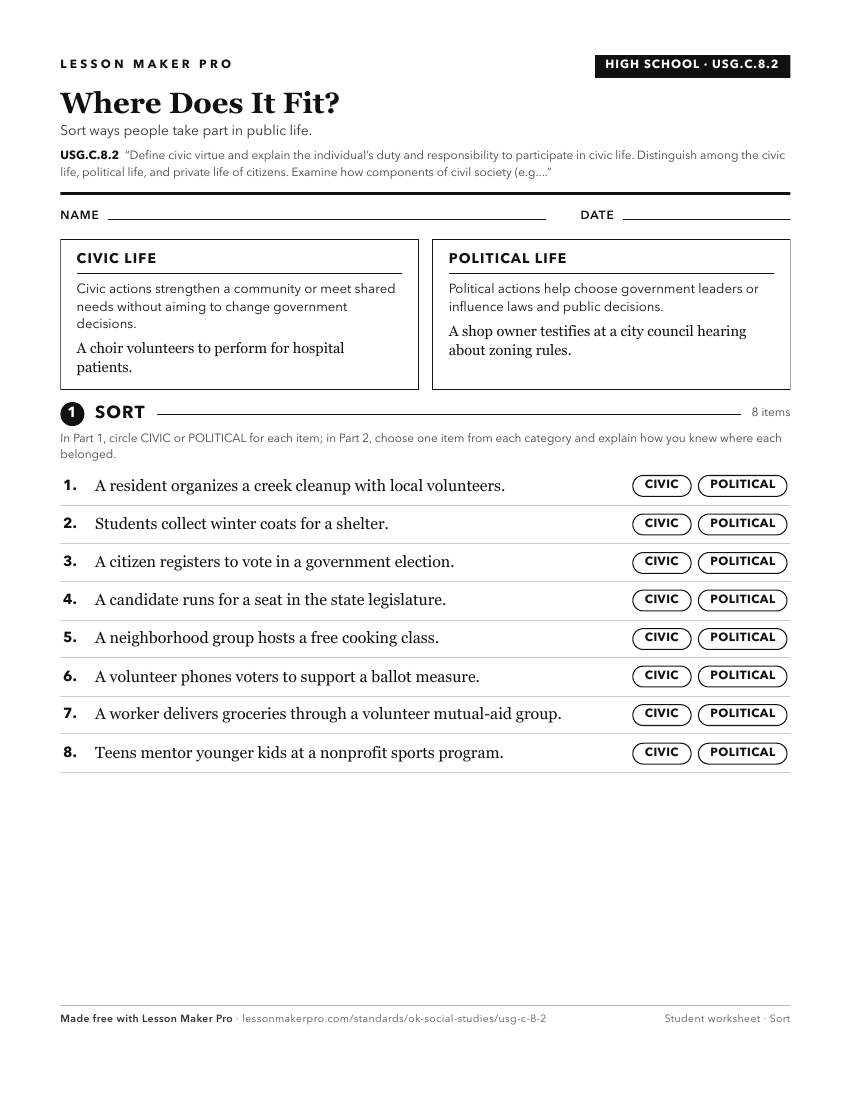
A ready-to-print activity worksheet aligned to USG.C.8.2, with an answer key for the teacher on its own page. No account needed.
PDF, US Letter, prints cleanly in black and white.
Download the worksheetKeep exploring
Related Standards
- 8.C.4.6
Define civic virtue and explain the individual’s duties and responsibilities.
- 4.C.1.3
Explain the concept of civic virtue and responsibilities of citizenship.
- 1.C.1.3
Define the concept of civic duty, identifying characteristics of responsible citizenship (e.g., respect for laws, voting, and volunteerism).
- 3.C.1.4
Define the concepts of civic virtue and examine the responsibilities of citizens.
Turn this cluster into a lesson
Grade, subject, topic, and the complete cluster are prefilled. Create one free, no account needed.
Also for this cluster:Make a WorksheetMake a QuizMake a Sub Lesson