Oklahoma Social Studies USG.C.3.1
Standard Cluster
- USG.C.3
- Analyze the fundamental principles of the American republic, as established in the Constitution of the United States of America.
Evaluate the necessity of a written constitution. Identify and describe the purposes for government as stated by the Framers in the Preamble to the Constitution of the United States of America. Analyze how the Constitution of the United States of America safeguards against authoritarianism by establishing enumerated powers, organizing government, and distributing powers among separate branches of government, the states, and the people. Explain why states have written constitutions and explain the relationship of state constitutions to the national constitution, including the guarantee “to every State in the Union a Republican form of Government” (Article IV, Section 4).
Oklahoma Academic Standards for Social Studies (2026) · USG.C.3
Cluster contents
Standards in This Cluster
USG.C.3.1 is a cluster heading. These are the individual standards under it.
- USG.C.3.1.A
Identify and describe the purposes for government as stated by the Framers in the Preamble to the Constitution of the United States of America.
- USG.C.3.1.B
Analyze how the Constitution of the United States of America safeguards against authoritarianism by establishing enumerated powers, organizing government, and d...
- USG.C.3.1.C
Explain why states have written constitutions and explain the relationship of state constitutions to the national constitution, including the guarantee “to ever...
Teacher's field guide
What This Cluster Means
What Students Need to Do
- Students explain why governments put their powers and limits in writing. They match the Preamble's goals to public actions and show how listed powers, branches, states, and voters limit authority. They explain why states have constitutions, why those rules must follow the U.S. Constitution, and why states must have representative governments.
What Mastery Looks Like
- A student can name a Preamble goal without treating it as permission for a leader to act alone. They can use Congress's power to tax and the president's veto to show how written rules divide authority. They can explain that a state constitution sets up state government but cannot override federal protections.
Common Misconceptions
- Students may treat the Preamble as a list of powers rather than goals. They may think a president can make laws alone or that a state constitution can override the U.S. Constitution. They may mistake a republican form of government for rule by the Republican Party.
How to Assess It
- Exit ticket: A president cancels a state's elections to keep order. Name the Preamble goal the president might cite, explain why it does not grant that power, and identify a constitutional limit on the decision.
Lesson moves
Ways to Teach It
Hand pairs a printed Constitution; use three highlighters to mark a Preamble goal, Congress's power to tax, and the president's veto.
Ask: 'Does a promise to keep order let a president cancel state elections?' Write two sentences using a written constitutional limit.
Run a power-sort race: place tax bills, vetoes, court rulings, school rules, and voting under Congress, president, courts, states, or people.
Print your state's constitution's election rules and the Fourteenth Amendment; have students mark one state rule and one federal limit.
Free download
Printable USG.C.3.1 Worksheet
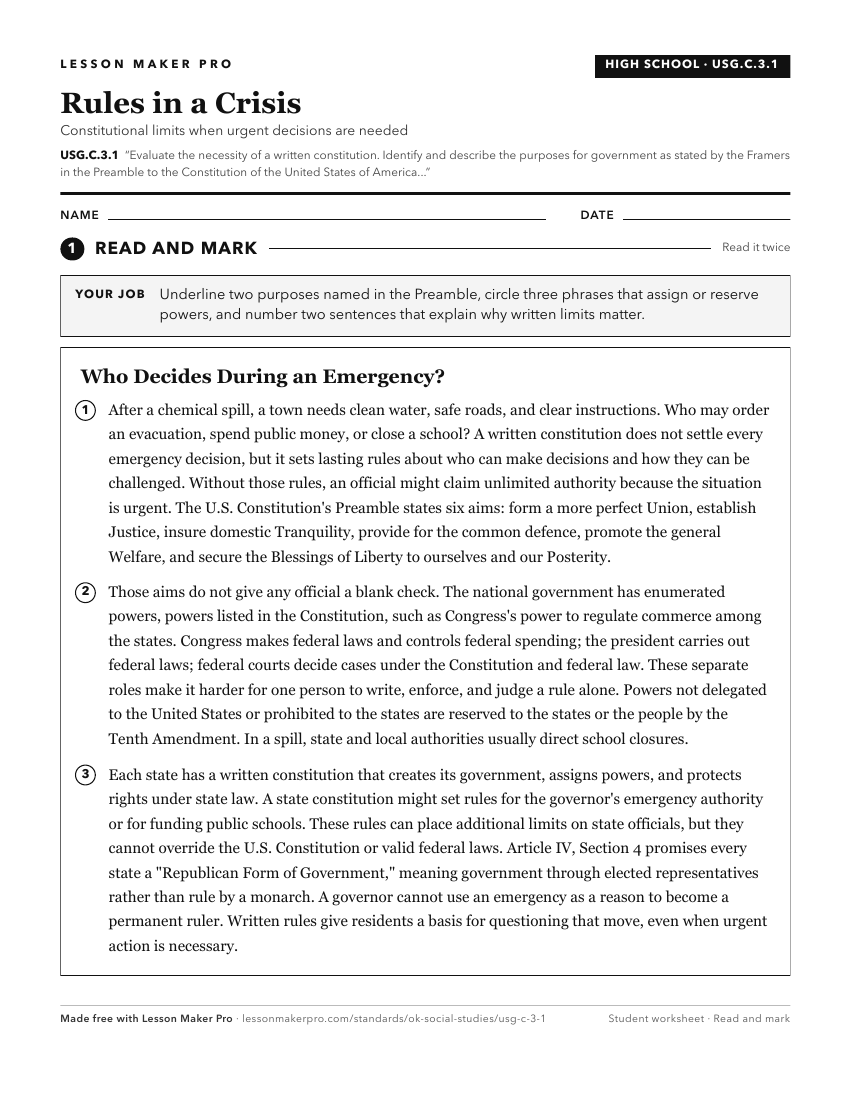
A ready-to-print activity worksheet aligned to USG.C.3.1, with an answer key for the teacher on its own page. No account needed.
PDF, US Letter, prints cleanly in black and white.
Download the worksheetKeep exploring
Related Standards
- USG.C.2.1
Evaluate the extent to which historical ideas and principles of human nature and authority have shaped the United States of America as a constitutional republic...
- 8.C.4.1
Analyze the need for a written constitution, tracing the foundation of self-government established in the Mayflower Compact, including its responsibilities to c...
- MWH.C.3.1.E
Analyze government's source of authority under a constitutional monarchy by explaining how and why powers are limited by a written or unwritten constitution (e....
- USG.C.8
Evaluate the significance of civic participation in order to ensure the preservation of constitutional government.
Turn this cluster into a lesson
Grade, subject, topic, and the complete cluster are prefilled. Create one free, no account needed.
Also for this cluster:Make a WorksheetMake a QuizMake a Sub Lesson