Oklahoma Social Studies USG.C.8
Standard Cluster
Evaluate the significance of civic participation in order to ensure the preservation of constitutional government. Explain the constitutional and legal provisions that establish and affect citizenship, including the naturalization process and the concept of dual citizenship as it applies to Tribal citizens. Define civic virtue and explain the individual’s duty and responsibility to participate in civic life. Distinguish among the civic life, political life, and private life of citizens. Examine how components of civil society (e.g., active communities, individual self-reliance, ethics, religion) contribute to the maintenance of limited government in a representative and democratic republic. Explain how civic virtue and a shared American civic identity are achieved through the deliberation about the meaning and application of our Founding documents. Describe the right to vote as a cornerstone of a constitutional republic and the most direct way for citizens to participate in government. Examine other political rights and responsibilities of citizens, including registering to vote, running for office, serving on juries, and participating in political campaigns. Identify responsibilities of both citizens and residents of the United States of America, including obedience of the law, registration for the selective service, and payment of state and federal taxes prior to the annual deadline. Analyze how our system of government provides citizens with opportunities to monitor and influence government as a means to hold elected officials accountable. Explain how the Constitution protects the individual’s ability to engage in informed public discourse as a means to monitor government officials and institutions. Identify legal methods to advocate and influence policy (e.g., voting, peaceful protests, petitioning, contacting government officials, use of the Freedom of Information Act).
Oklahoma Academic Standards for Social Studies (2026)
Cluster contents
Standards in This Cluster
USG.C.8 is a cluster heading. These are the individual standards under it.
- USG.C.8.1
Explain the constitutional and legal provisions that establish and affect citizenship, including the naturalization process and the concept of dual citizenship ...
- USG.C.8.2
Define civic virtue and explain the individual’s duty and responsibility to participate in civic life.
- USG.C.8.2.A
Distinguish among the civic life, political life, and private life of citizens.
- USG.C.8.2.B
Examine how components of civil society (e.g., active communities, individual self-reliance, ethics, religion) contribute to the maintenance of limited governme...
- USG.C.8.2.C
Explain how civic virtue and a shared American civic identity are achieved through the deliberation about the meaning and application of our Founding documents.
- USG.C.8.2.D
Describe the right to vote as a cornerstone of a constitutional republic and the most direct way for citizens to participate in government.
- USG.C.8.2.E
Examine other political rights and responsibilities of citizens, including registering to vote, running for office, serving on juries, and participating in poli...
- USG.C.8.2.F
Identify responsibilities of both citizens and residents of the United States of America, including obedience of the law, registration for the selective service...
- USG.C.8.3
Analyze how our system of government provides citizens with opportunities to monitor and influence government as a means to hold elected officials accountable.
- USG.C.8.3.A
Explain how the Constitution protects the individual’s ability to engage in informed public discourse as a means to monitor government officials and institution...
- USG.C.8.3.B
Identify legal methods to advocate and influence policy (e.g., voting, peaceful protests, petitioning, contacting government officials, use of the Freedom of In...
Teacher's field guide
What This Cluster Means
What Students Need to Do
- Students explain how the Fourteenth Amendment and naturalization establish U.S. citizenship, while tribal citizenship can coexist with it. They sort civic, political, and private actions. They explain how voting, public debate, and community groups help check government power.
What Mastery Looks Like
- A student can outline the naturalization application, interview, and oath, and explain that tribal nations set their own citizenship rules. They can distinguish voting and jury eligibility from tax duties and Selective Service registration rules. They can use the First Amendment to explain why people may criticize officials, protest peacefully, and petition the government.
Common Misconceptions
- Students may think tribal citizenship is foreign citizenship or that naturalized citizens cannot vote. They may treat voting as mandatory but required taxes as optional. Some confuse joining a neighborhood group with campaigning for a candidate.
How to Assess It
- Exit ticket: A tribal citizen who is also a U.S. citizen wants to check federal spending and change a policy. Explain their two citizenships, name a records request they could file, and identify one protected way to speak up.
Lesson moves
Ways to Teach It
Sort cards marked 'run a food pantry,' 'canvass for a candidate,' and 'choose a religion' into civic, political, and private life.
Read the First Amendment, then ask: Can criticizing an elected official show civic virtue and strengthen a shared American identity? Explain.
Match case cards to voting, jury service, taxes, or Selective Service registration; include a naturalized citizen and an 18-year-old male resident.
Use a city council agenda to draft an email about one vote, then locate the city's public records request form.
Free download
Printable USG.C.8 Worksheet
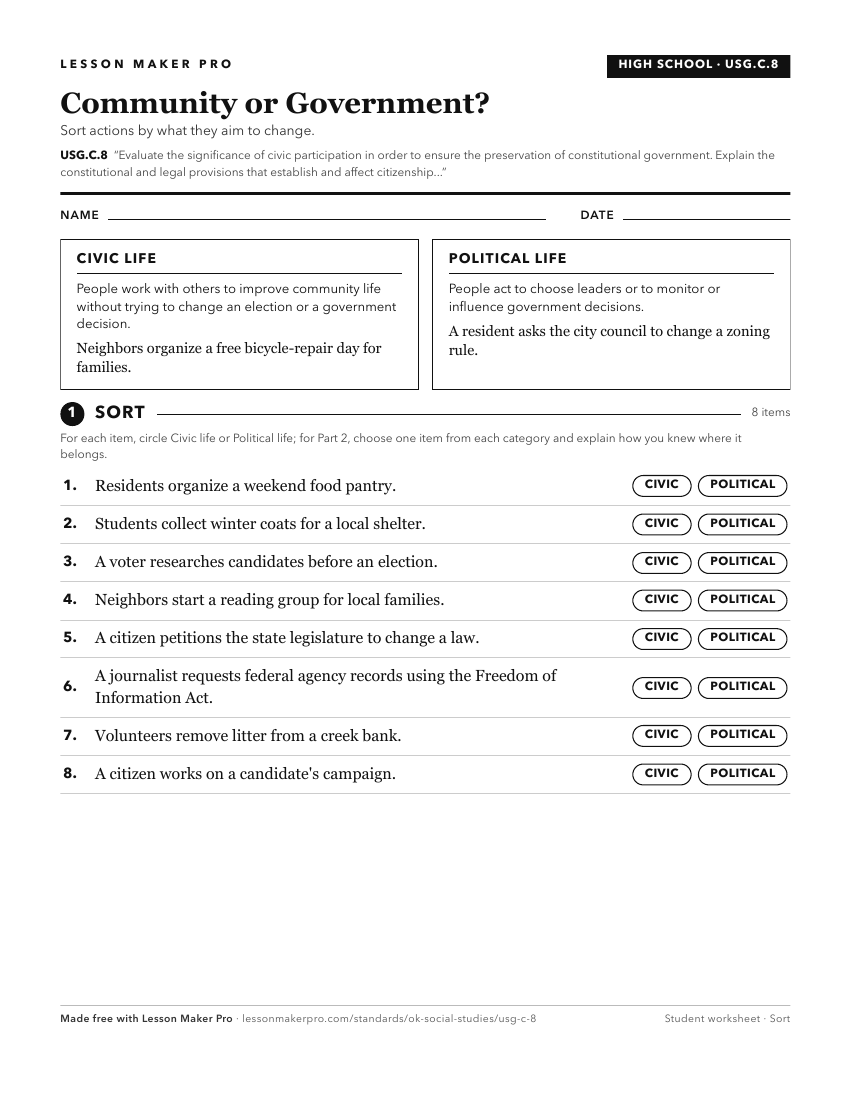
A ready-to-print activity worksheet aligned to USG.C.8, with an answer key for the teacher on its own page. No account needed.
PDF, US Letter, prints cleanly in black and white.
Download the worksheetKeep exploring
Related Standards
- OKH.P.1.1.A
Evaluate the impact of perspectives, civil discourse, and democratic principles on addressing civic issues.
- E.P.1.1.A
Evaluate the impact of perspectives, civil discourse, and democratic principles on addressing civic issues.
- 4.C.1.3.B
Analyze how fulfilling one’s civic responsibilities (e.g., voting, jury and military service, paying taxes) is necessary for the health and continuity of a cons...
- MWH.P.1.1.A
Evaluate the impact of perspectives, civil discourse, and democratic principles on addressing civic issues.
Turn this cluster into a lesson
Grade, subject, topic, and the complete cluster are prefilled. Create one free, no account needed.
Also for this cluster:Make a WorksheetMake a QuizMake a Sub Lesson