Oklahoma Social Studies USG.C.8.1
The Standard
- USG.C.8
- Evaluate the significance of civic participation in order to ensure the preservation of constitutional government.
Explain the constitutional and legal provisions that establish and affect citizenship, including the naturalization process and the concept of dual citizenship as it applies to Tribal citizens.
Oklahoma Academic Standards for Social Studies (2026) · USG.C.8
Teacher's field guide
What This Standard Means
What Students Need to Do
- Students explain how U.S. citizenship can come through birth or naturalization, including an application, interview, and oath. They explain how the 1924 law affected Native Americans born in the United States. They also explain how a person can be a citizen of both the United States and a tribal nation.
What Mastery Looks Like
- Given a short case, a student can tell whether someone became a U.S. citizen at birth or through naturalization. They can explain that the 1924 law extended U.S. citizenship to Native Americans born in the United States without ending tribal citizenship. They can name the tribal nation as the authority over its own citizenship rules.
Common Misconceptions
- Students may think every tribal citizen had to naturalize to become a U.S. citizen, or that the 1924 law ended tribal citizenship. Others assume U.S. citizenship automatically makes someone a tribal citizen, though each tribal nation sets its own rules.
How to Assess It
- Exit ticket: Why can a tribal citizen born in the United States hold both citizenships, and who sets the rules for each? Name the 1924 law and two steps in naturalization.
Lesson moves
Ways to Teach It
Give pairs four printed cards labeled Fourteenth Amendment, 1924 law, naturalization law, and tribal citizenship rules; have them sort the cards by governing authority.
Ask students to write: Why does U.S. citizenship not cancel a person's citizenship in a tribal nation?
Read short case cards aloud; students hold up Birth or Naturalization cards, then identify any tribal citizenship stated in the case.
Show a U.S. passport FAQ and a tribal nation's public enrollment page; students note who sets eligibility for each document.
Free download
Printable USG.C.8.1 Worksheet
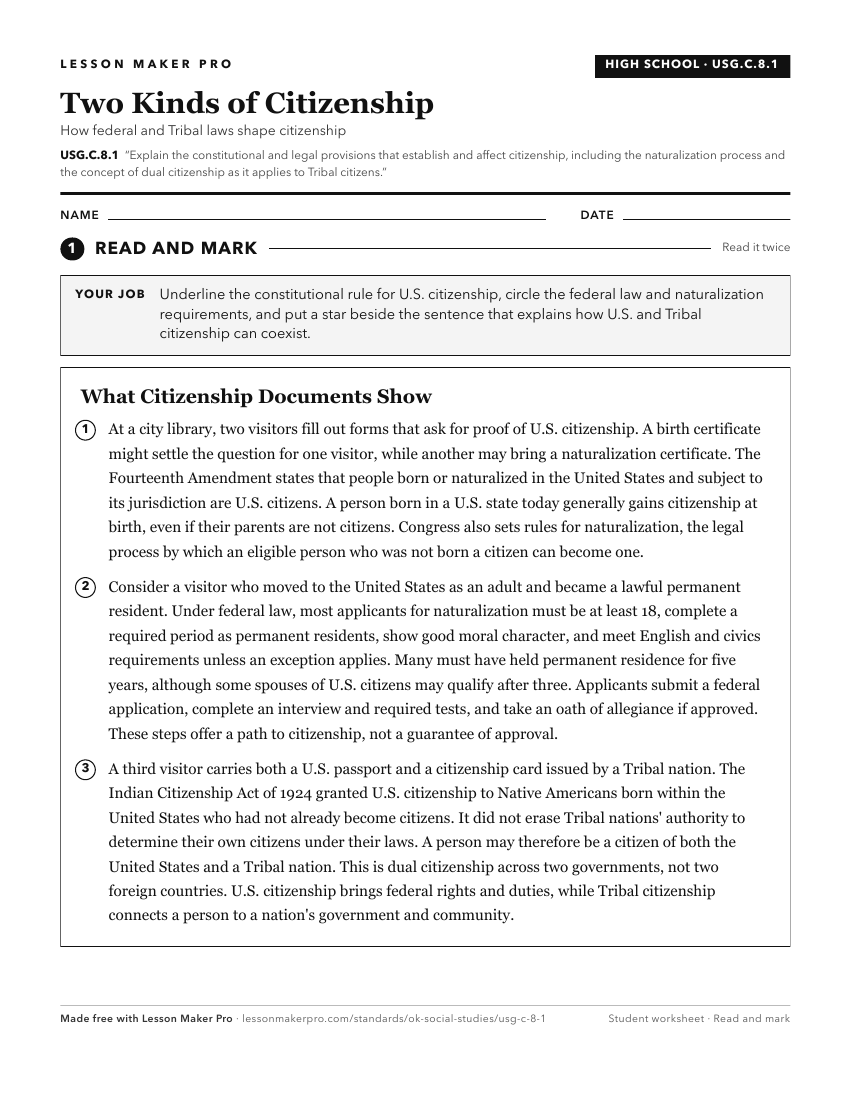
A ready-to-print activity worksheet aligned to USG.C.8.1, with an answer key for the teacher on its own page. No account needed.
PDF, US Letter, prints cleanly in black and white.
Download the worksheetKeep exploring
Related Standards
- 5.C.6.4.B
Explain that Tribal governments possess powers, including the authority to determine Tribal citizenship, make and enforce laws, manage lands and natural resourc...
- 4.C.1.2
Analyze the historical development of American Indian citizenship and constitutional rights in the United States of America. Examine how tribal sovereignty and ...
- 5.C.6.4
Analyze the historical development of American Indian Citizenship and constitutional rights in the United States of America, including the passage of the Indian...
- 6.C.5.1.C
Analyze the historical development of American Indian citizenship and constitutional rights in the United States of America, including the passage of the Indian...
Turn this exact standard into a lesson
Grade, subject, topic, and the complete standard are prefilled. Create one free, no account needed.
Also for this standard:Make a WorksheetMake a QuizMake a Sub Lesson