Oklahoma Social Studies 6.C.5.1.C
The Standard
- 6.C.5
- Analyze why and how humans develop rules, laws, and governments, including the role of citizens in government.
- 6.C.5.1
- Compare systems of governments.
Analyze the historical development of American Indian citizenship and constitutional rights in the United States of America, including the passage of the Indian Citizenship Act of 1924. Examine how tribal sovereignty and United States of America citizenship function within the United States of America. Compare the rights and responsibilities of tribal citizenship with those of state and national citizenship, including the role of laws such as the Indian Civil Rights Act of 1968.
Oklahoma Academic Standards for Social Studies (2026) · 6.C.5.1
Teacher's field guide
What This Standard Means
What Students Need to Do
- Students trace changes in American Indian citizenship, including what changed in 1924 and why voting barriers remained. They explain how someone can be both a tribal citizen and a U.S. citizen. They compare tribal, state, and federal rules for membership, voting, and individual rights.
What Mastery Looks Like
- A student can explain that some American Indians were U.S. citizens before 1924, and that the 1924 law did not guarantee access to the ballot in every state. They can identify a tribal nation as the authority for its membership rules. They can explain that the 1968 law requires tribal governments to respect certain individual rights.
Common Misconceptions
- Some students think no American Indians had U.S. citizenship before 1924. Others think the 1924 law immediately ended state voting barriers. They may think tribal citizenship replaces U.S. citizenship or that the 1968 law ended tribal self-government.
How to Assess It
- Exit ticket: A tribal citizen born in the United States lives in Oklahoma in 1925. Explain who sets their tribal membership rules, what the 1924 law means for their U.S. citizenship, why voting might still be blocked, and one right protected by the 1968 law.
Lesson moves
Ways to Teach It
Give pairs cards marked 'some citizens before 1924,' '1924 citizenship law,' and '1968 rights law' to arrange and annotate.
Ask: How could a tribal citizen be a U.S. citizen in 1925 but still be blocked from voting in a state election?
Play a matching game with scenario cards about tribal membership, state voting, and tribal courts, paired with cards naming the rules that apply.
Project a tribal nation's public citizenship requirements beside Oklahoma's voter eligibility page; have students circle who sets each rule.
Free download
Printable 6.C.5.1.C Worksheet
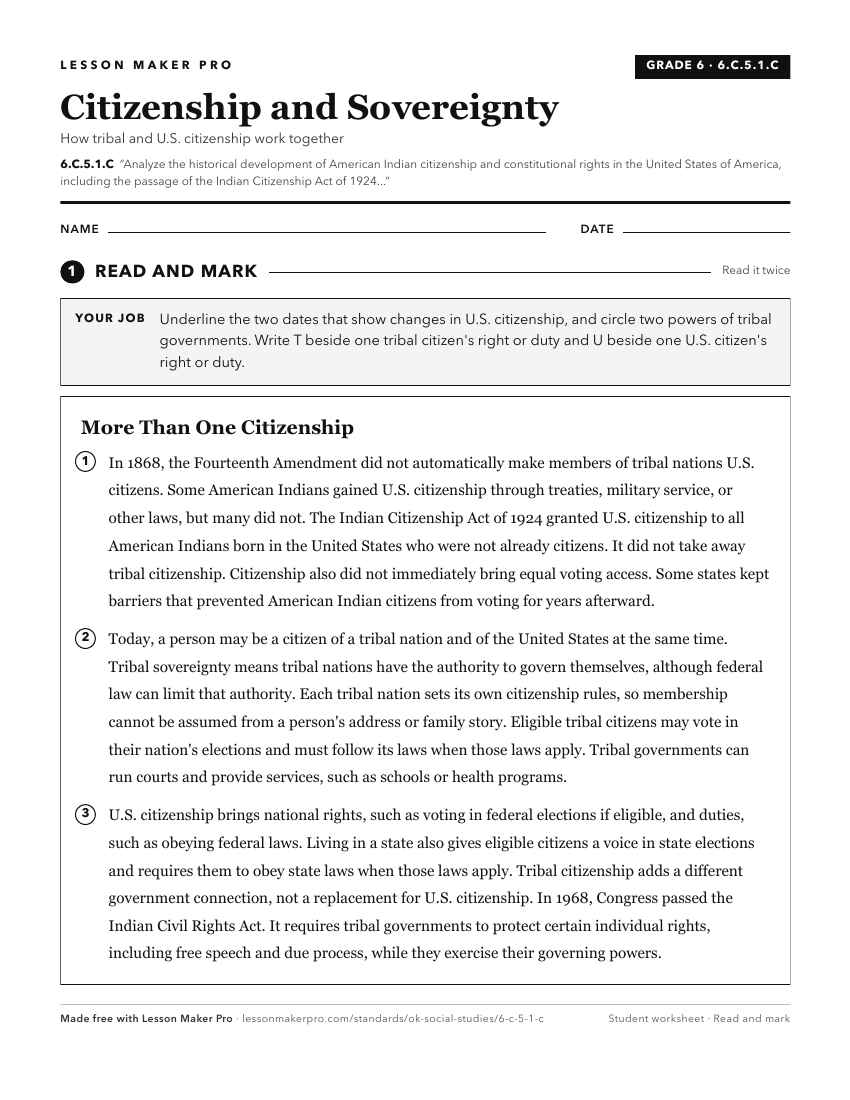
A ready-to-print activity worksheet aligned to 6.C.5.1.C, with an answer key for the teacher on its own page. No account needed.
PDF, US Letter, prints cleanly in black and white.
Download the worksheetKeep exploring
Related Standards
- USG.C.8.1
Explain the constitutional and legal provisions that establish and affect citizenship, including the naturalization process and the concept of dual citizenship ...
- USH.C.4.1.H
Assess the effects of the Indian Citizenship Act of 1924 on the status of Tribal citizens with regards to dual citizenship, the divided Tribal reaction regardin...
- 4.C.1.2
Analyze the historical development of American Indian citizenship and constitutional rights in the United States of America. Examine how tribal sovereignty and ...
- 5.C.6.4
Analyze the historical development of American Indian Citizenship and constitutional rights in the United States of America, including the passage of the Indian...
Turn this exact standard into a lesson
Grade, subject, topic, and the complete standard are prefilled. Create one free, no account needed.
Also for this standard:Make a WorksheetMake a QuizMake a Sub Lesson