Oklahoma Social Studies 5.C.6.4
Standard Cluster
- 5.C.6
- Describe the structure and responsibilities of the United States of America’s system of government and the role of the individual citizen, as provided in the Constitution of the United States of America.
Analyze the historical development of American Indian Citizenship and constitutional rights in the United States of America, including the passage of the Indian Citizenship Act of 1924. Examine how Tribal sovereignty and United States of America citizenship function within the United States of America. Describe how the Commerce Clause of the Constitution establishes a nation-to-nation relationship between the United States of America and Tribal governments. Explain that Tribal governments possess powers, including the authority to determine Tribal citizenship, make and enforce laws, manage lands and natural resources, and provide for the needs of Tribal citizens.
Oklahoma Academic Standards for Social Studies (2026) · 5.C.6
Cluster contents
Standards in This Cluster
5.C.6.4 is a cluster heading. These are the individual standards under it.
- 5.C.6.4.A
Describe how the Commerce Clause of the Constitution establishes a nation-to-nation relationship between the United States of America and Tribal governments.
- 5.C.6.4.B
Explain that Tribal governments possess powers, including the authority to determine Tribal citizenship, make and enforce laws, manage lands and natural resourc...
Teacher's field guide
What This Cluster Means
What Students Need to Do
- Trace how U.S. citizenship changed for American Indians, including the 1924 law and later voting barriers. Explain how someone can be both a U.S. citizen and a Tribal citizen. Use the Indian Commerce Clause to explain government-to-government relations and name powers held by Tribal governments.
What Mastery Looks Like
- A student can explain that some American Indians were U.S. citizens before 1924 and that voting barriers continued afterward. They can explain that the Indian Commerce Clause names Tribes separately from states, supporting government-to-government dealings. They can give examples of Tribal authority, including setting citizenship rules, making laws, managing land, and providing services.
Common Misconceptions
- Some students think no American Indians were U.S. citizens before 1924 or that the law ended all voting barriers. Others think U.S. citizenship replaces Tribal citizenship or that the federal government sets every Tribe’s citizenship rules.
How to Assess It
- Use this exit ticket: “After the 1924 law, can someone be both a U.S. and Tribal citizen? Who sets Tribal citizenship rules, and what does the Indian Commerce Clause say about Tribes?”
Lesson moves
Ways to Teach It
Have pairs arrange three cards, some citizens before 1924, the 1924 citizenship law, and later voting barriers, on a paper timeline.
Ask: “If someone is both a U.S. and Tribal citizen, which government decides their Tribal citizenship, and why?”
Play a card sort with cases on Tribal citizenship, U.S. citizenship, Tribal laws, and federal trade; teams name the government involved.
Use a Cherokee Nation government services webpage; students find two services and name the Tribal authority used to provide them.
Free download
Printable 5.C.6.4 Worksheet
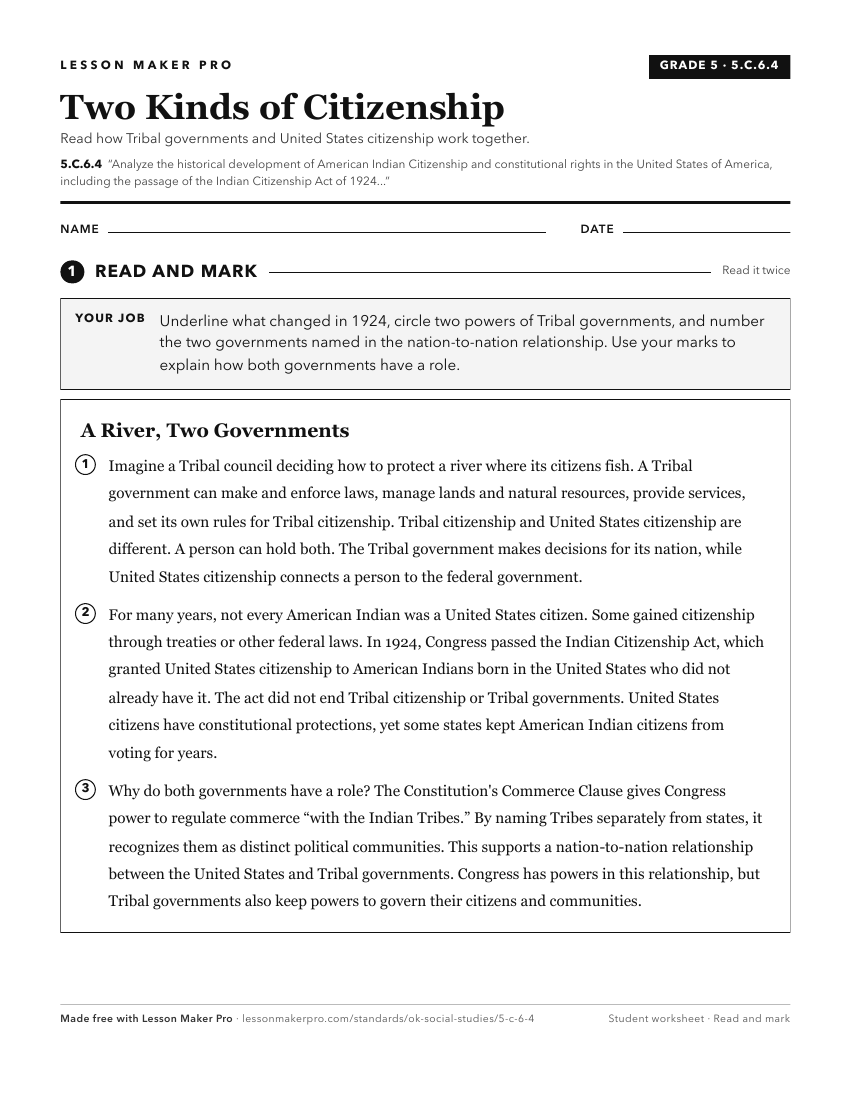
A ready-to-print activity worksheet aligned to 5.C.6.4, with an answer key for the teacher on its own page. No account needed.
PDF, US Letter, prints cleanly in black and white.
Download the worksheetKeep exploring
Related Standards
- USG.C.8.1
Explain the constitutional and legal provisions that establish and affect citizenship, including the naturalization process and the concept of dual citizenship ...
- USH.C.4.1.H
Assess the effects of the Indian Citizenship Act of 1924 on the status of Tribal citizens with regards to dual citizenship, the divided Tribal reaction regardin...
- 4.C.1.2
Analyze the historical development of American Indian citizenship and constitutional rights in the United States of America. Examine how tribal sovereignty and ...
- 6.C.5.1.C
Analyze the historical development of American Indian citizenship and constitutional rights in the United States of America, including the passage of the Indian...
Turn this cluster into a lesson
Grade, subject, topic, and the complete cluster are prefilled. Create one free, no account needed.
Also for this cluster:Make a WorksheetMake a QuizMake a Sub Lesson