Oklahoma Social Studies USH.C.4.1.H
The Standard
- USH.C.4
- Analyze the cycles of economic boom and bust of the 1920s and 1930s on the transformation of the United States of America’s government and society.
- USH.C.4.1
- Examine the transformations between the World Wars.
Assess the effects of the Indian Citizenship Act of 1924 on the status of Tribal citizens with regards to dual citizenship, the divided Tribal reaction regarding sovereignty concerns, and efforts by some states to deny voting rights.
Oklahoma Academic Standards for Social Studies (2026) · USH.C.4.1
Teacher's field guide
What This Standard Means
What Students Need to Do
- Explain that the 1924 law gave U.S. citizenship to Native Americans born in the United States who did not already have it. Describe why some tribal citizens welcomed the change while others worried about tribal sovereignty. Explain how states could still block Native people from voting.
What Mastery Looks Like
- A student can explain that U.S. citizenship did not end tribal citizenship. They can name a state voting barrier, such as Arizona's use of guardianship rules, and give a reason for each side of the debate over the law.
Common Misconceptions
- Students may think no Native Americans had U.S. citizenship before 1924. They may also think the law ended tribal citizenship or gave every Native citizen immediate access to the ballot.
How to Assess It
- Exit ticket: A tribal citizen gained U.S. citizenship in 1924 but was barred from voting in Arizona in 1928. Explain how both could be true, whether tribal citizenship ended, and why tribal citizens might disagree about the law.
Lesson moves
Ways to Teach It
Give pairs cards for the 1924 law, tribal membership, and Arizona's 1928 voting ruling; sort them under federal, tribal, or state authority.
Ask partners: Why might one tribal citizen welcome U.S. citizenship while another worries about tribal sovereignty? Have each partner give one reason.
Play claim repair: teams correct 'No Native Americans were citizens before 1924' and 'Citizenship ended state voting barriers' on mini whiteboards.
Compare today's Arizona voter registration eligibility page with a printed summary of Arizona's 1928 ruling; circle how voting rules changed.
Free download
Printable USH.C.4.1.H Worksheet
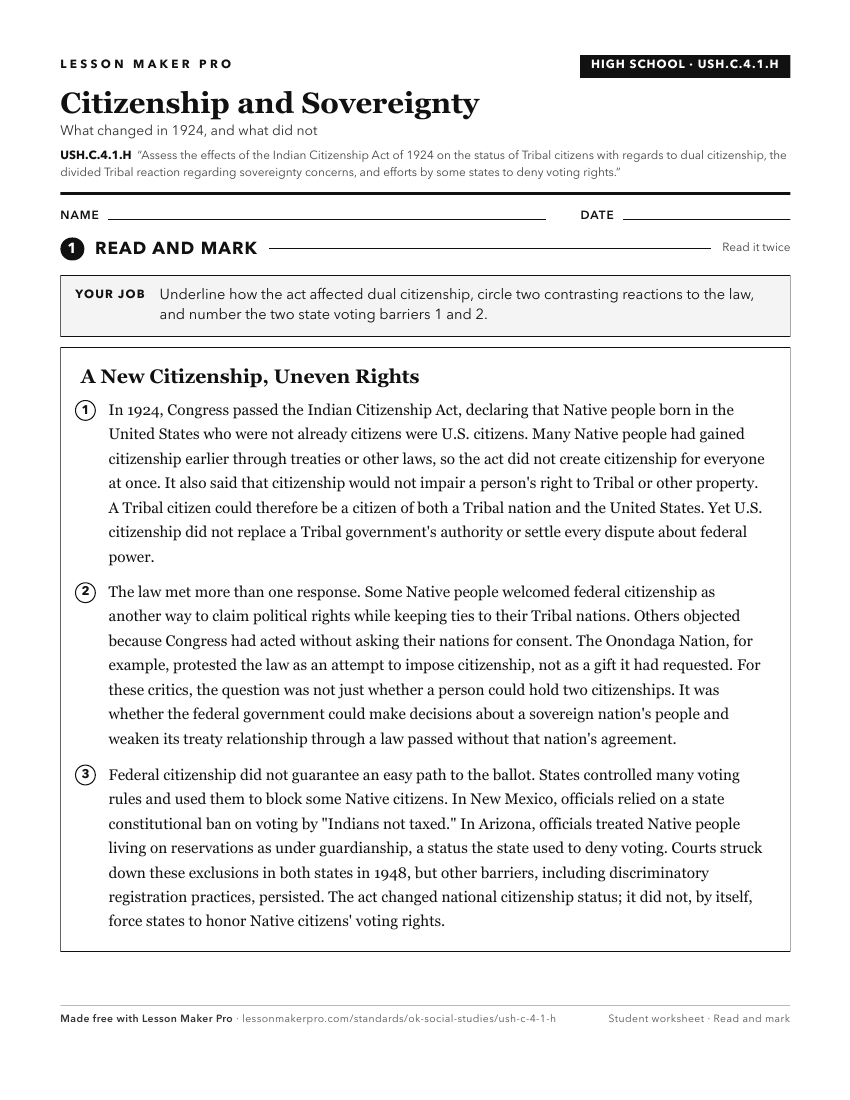
A ready-to-print activity worksheet aligned to USH.C.4.1.H, with an answer key for the teacher on its own page. No account needed.
PDF, US Letter, prints cleanly in black and white.
Download the worksheetKeep exploring
Related Standards
- USG.C.8.1
Explain the constitutional and legal provisions that establish and affect citizenship, including the naturalization process and the concept of dual citizenship ...
- 5.C.6.4
Analyze the historical development of American Indian Citizenship and constitutional rights in the United States of America, including the passage of the Indian...
- OKH.C.6.2.C
Explain the justification for passage of the Indian Citizenship Act of 1924 and the concept of dual citizenship.
- 6.C.5.1.C
Analyze the historical development of American Indian citizenship and constitutional rights in the United States of America, including the passage of the Indian...
Turn this exact standard into a lesson
Grade, subject, topic, and the complete standard are prefilled. Create one free, no account needed.
Also for this standard:Make a WorksheetMake a QuizMake a Sub Lesson