Oklahoma Social Studies USG.C.3.5
Standard Cluster
- USG.C.3
- Analyze the fundamental principles of the American republic, as established in the Constitution of the United States of America.
Summarize and explain the relationships and responsibilities among the levels of government.. Explain how local, state, and national governments are involved in cooperatively shaping public policy and responding to public policy issues. Compare specific functions, organizations, and purposes of local and state governments, such as ensuring personal security and health regulations. Explain the differences among the types of local governments in Oklahoma (e.g., county, city) as well as their operational relationship with the state government. Describe how some state constitutions, such as Oklahoma’s, provide for more direct public involvement in the legislative process through such provisions as the initiative and referendum.
Oklahoma Academic Standards for Social Studies (2026) · USG.C.3
Cluster contents
Standards in This Cluster
USG.C.3.5 is a cluster heading. These are the individual standards under it.
- USG.C.3.5.A
Explain how local, state, and national governments are involved in cooperatively shaping public policy and responding to public policy issues.
- USG.C.3.5.B
Compare specific functions, organizations, and purposes of local and state governments, such as ensuring personal security and health regulations.
- USG.C.3.5.C
Explain the differences among the types of local governments in Oklahoma (e.g., county, city) as well as their operational relationship with the state governmen...
- USG.C.3.5.D
Describe how some state constitutions, such as Oklahoma’s, provide for more direct public involvement in the legislative process through such provisions as the ...
Teacher's field guide
What This Cluster Means
What Students Need to Do
- Students identify what city, county, state, and national governments do and explain when they work together. They compare Oklahoma city and county services and explain how state law affects local decisions. They also explain how voters use initiatives to propose laws and referendums to put passed laws to a vote.
What Mastery Looks Like
- Students can explain why a city handles a city street while a county handles a county road. They can trace a tornado response from local responders to state coordination and federal aid. They can tell whether a ballot question is an initiative or a referendum.
Common Misconceptions
- Students may think counties operate independently of the state or that federal agencies run local police departments. They may confuse city police with county sheriffs or assume initiatives and referendums both propose new laws.
How to Assess It
- Ask: “A tornado damages roads in an Oklahoma town. Name one job each for local, state, and national government, and explain how two of them would work together.”
Lesson moves
Ways to Teach It
Give groups cards labeled city street repair, county road repair, state highway patrol, and FEMA aid; have them sort the cards by level of government.
Ask pairs: “After a tornado, who coordinates a local shelter, who coordinates state aid, and when might FEMA help?” Have them defend their answers.
Read two ballot scenarios, one proposing a new Oklahoma law and one challenging a passed law; students label each initiative or referendum and explain why.
Show photos of a city pothole and a county road washout; students choose which Oklahoma office to contact and draft a short report.
Free download
Printable USG.C.3.5 Worksheet
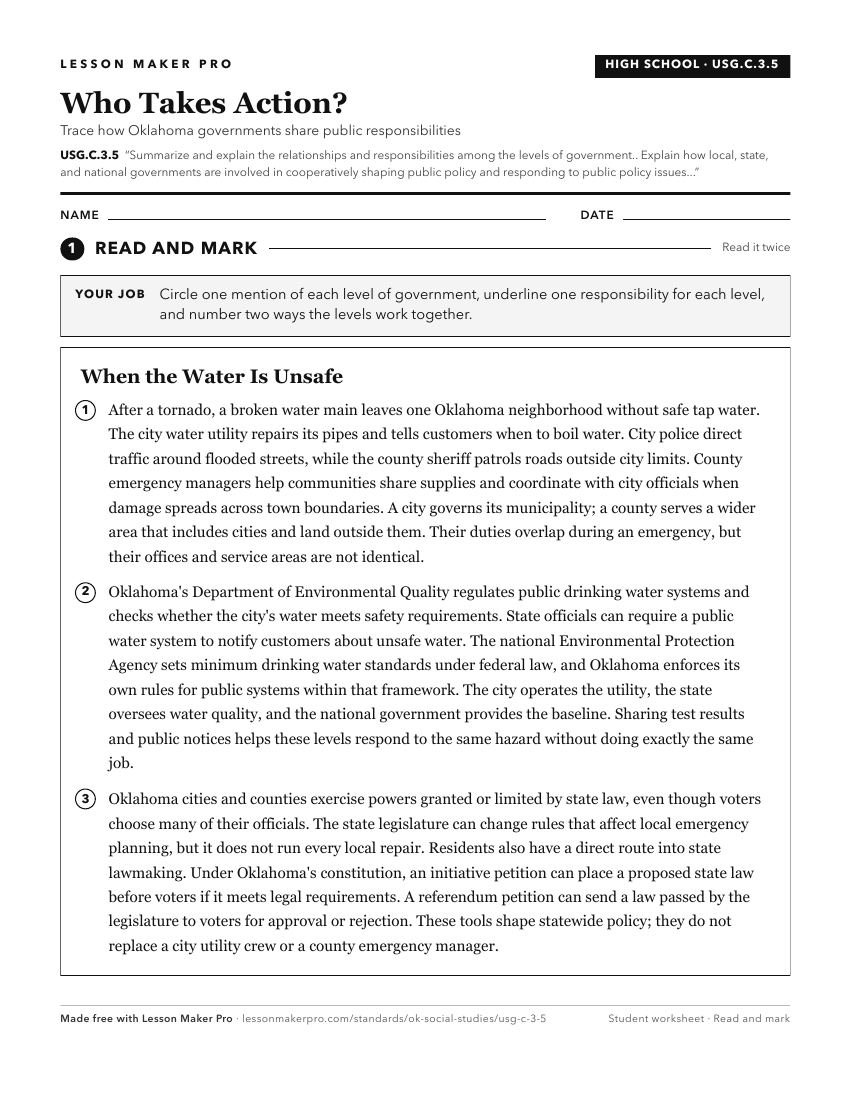
A ready-to-print activity worksheet aligned to USG.C.3.5, with an answer key for the teacher on its own page. No account needed.
PDF, US Letter, prints cleanly in black and white.
Download the worksheetKeep exploring
Related Standards
- 7.P.2.1.B
Compare the powers and responsibilities of the United States of America’s government to other forms of government, including the roles and rights of citizens.
- 5.C.6.3.C
Examine the system of shared powers (federalism) between the federal and state levels of governments, explaining why the Framers assigned specific powers to eac...
- 3.C.1.1.D
Identify basic responsibilities of state and local governments (e.g., public safety, education, public works) and explain how taxes pay for services provided by...
- 2.C.1.4
Explain that local, state, national, and Tribal governments exist to represent the needs of the people, make and enforce laws, and help resolve conflicts.
Turn this cluster into a lesson
Grade, subject, topic, and the complete cluster are prefilled. Create one free, no account needed.
Also for this cluster:Make a WorksheetMake a QuizMake a Sub Lesson