Oklahoma Social Studies USG.C.3.6
Standard Cluster
- USG.C.3
- Analyze the fundamental principles of the American republic, as established in the Constitution of the United States of America.
Analyze the constitutional and legal status of Tribal governments within the federal system. Explain how the Constitution of the United States grants Congress authority over Indian affairs through the Commerce Clause and how the Supreme Court has defined Tribal Nations as “domestic dependent nations” possessing powers of self-government while operating under Federal Authority. Reference case: Cherokee Nation v. Georgia. Describe the trust relationship between the United States of America and Tribal governments, including the federal government’s legal obligations to protect Tribal lands, treaty rights, and resources. Students should understand that this relationship developed through treaties, legislation, and court decisions. Explain how Tribal governments exercise powers of self-government and participate in federal programs through legislation that allows Tribes to contract or compact with the federal government to administer services and programs. Key legislation teachers may reference: Indian Self-Determination and Education Assistance Act. This law allows tribes to operate programs that were previously run directly by federal agencies. Examine how Tribal governments enter into agreements with states under federal law, including the role of state constitutions and legislatures in authorizing such agreements. Key law: Indian Gaming Regulatory Act. Students should understand: Congress authorized state and tribal compacts, states must have legal authority to enter those agreements, some states require constitutional amendments or legislative approval. This is particularly relevant in Oklahoma. Describe how Tribal jurisdiction and authority have evolved through federal legislation and Supreme Court decisions affecting criminal jurisdiction, family law, religious freedom, and other areas. Examples: Legislation: Major Crimes Act, Indian Child Welfare Act Court decisions: McGirt v. Oklahoma, Haaland v. Brackeen.
Oklahoma Academic Standards for Social Studies (2026) · USG.C.3
Cluster contents
Standards in This Cluster
USG.C.3.6 is a cluster heading. These are the individual standards under it.
- USG.C.3.6.A
Explain how the Constitution of the United States grants Congress authority over Indian affairs through the Commerce Clause and how the Supreme Court has define...
- USG.C.3.6.B
Describe the trust relationship between the United States of America and Tribal governments, including the federal government’s legal obligations to protect Tri...
- USG.C.3.6.C
Explain how Tribal governments exercise powers of self-government and participate in federal programs through legislation that allows Tribes to contract or comp...
- USG.C.3.6.D
Examine how Tribal governments enter into agreements with states under federal law, including the role of state constitutions and legislatures in authorizing su...
- USG.C.3.6.E
Describe how Tribal jurisdiction and authority have evolved through federal legislation and Supreme Court decisions affecting criminal jurisdiction, family law,...
Teacher's field guide
What This Cluster Means
What Students Need to Do
- Students explain how the Indian Commerce Clause gives Congress authority in Tribal affairs. They explain why Tribes govern themselves but also operate within federal law. They trace federal duties to protect Tribal lands, treaty rights, and resources through treaties, laws, and court rulings.
What Mastery Looks Like
- A student can explain how a Tribe uses a contract or compact to run federal services. They can explain why Class III gaming needs a state-Tribal compact and why a state may need legislative approval. They can use McGirt v. Oklahoma to discuss criminal jurisdiction and Haaland v. Brackeen to discuss protections for Native children.
Common Misconceptions
- Students may treat Tribes as state agencies or assume federal authority ends Tribal self-government. Some mistake the federal trust duty for permission to ignore treaty rights. Others assume states control all reservation crimes or that every type of Tribal gaming needs a state compact.
How to Assess It
- Exit ticket: A Tribe plans to run a federal clinic and open Class III gaming in Oklahoma. Name the law behind each plan and explain why the gaming plan needs a state compact.
Lesson moves
Ways to Teach It
Give pairs cards labeled treaty promise, Indian Commerce Clause, and Cherokee Nation v. Georgia; sort them as treaty, Constitution, or court ruling.
Ask: Why can a Tribe run a federal clinic but need a state compact for Class III gaming? Write a two-sentence answer.
Play a jurisdiction sort: match the Major Crimes Act, McGirt v. Oklahoma, and the Indian Child Welfare Act to criminal or child-custody scenarios.
Put an Oklahoma gaming compact beside a state authorization excerpt; students identify who signs, who approves, and why state law matters.
Free download
Printable USG.C.3.6 Worksheet
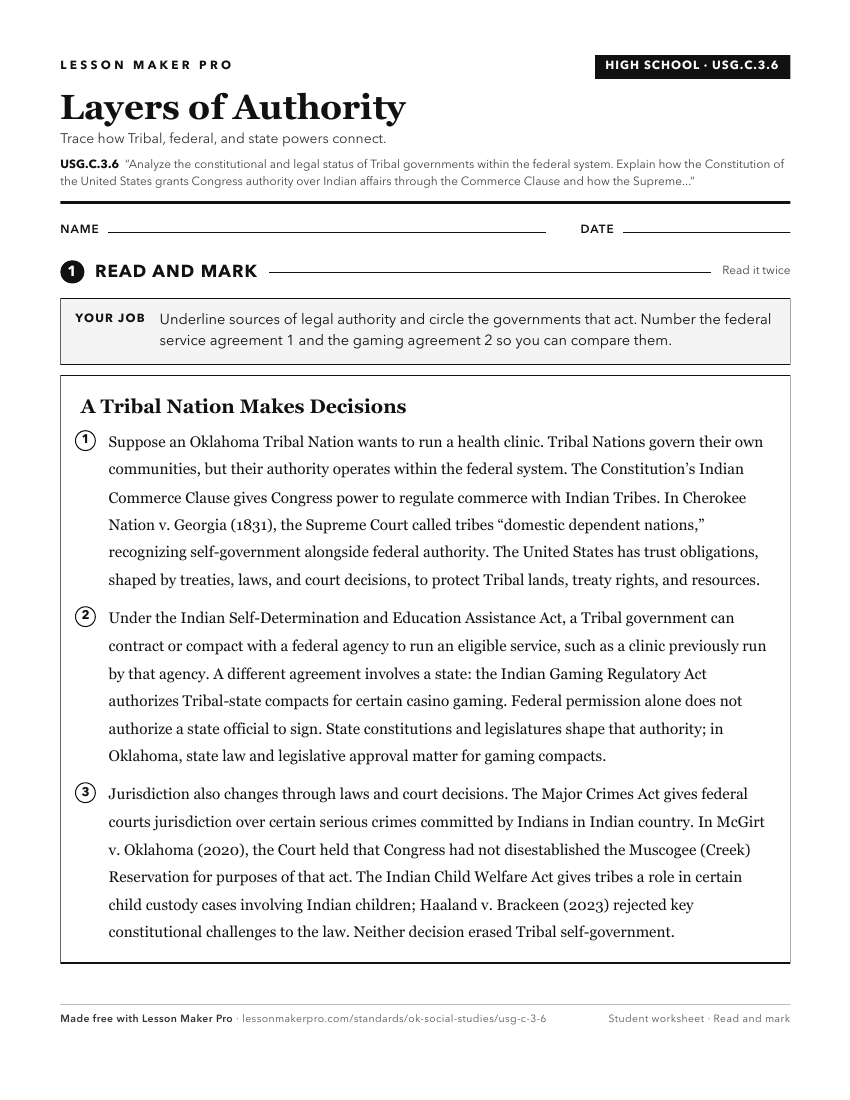
A ready-to-print activity worksheet aligned to USG.C.3.6, with an answer key for the teacher on its own page. No account needed.
PDF, US Letter, prints cleanly in black and white.
Download the worksheetKeep exploring
Related Standards
- OKH.C.8.3
Analyze the historical and contemporary relationship between the State of Oklahoma and Oklahoma’s thirty-nine federally recognized Tribal governments.
- OKH.C.8.3.D
Examine the structure and authority of modern Tribal governments, including constitutional or traditional governing systems and the powers exercised over Tribal...
- 8.C.4.3
Evaluate the significance of the Commerce Clause in establishing a constitutional relationship between American Indian Tribal Nations and the United States gove...
- 8.C.4.3.C
Explain that Tribal governments retain powers of internal self-government, including making and enforcing laws, determining citizenship, and managing lands and ...
Turn this cluster into a lesson
Grade, subject, topic, and the complete cluster are prefilled. Create one free, no account needed.
Also for this cluster:Make a WorksheetMake a QuizMake a Sub Lesson