Oklahoma Social Studies OKH.C.8.3
Standard Cluster
- OKH.C.8
- Investigate how post-war social, political, and economic events continued to transform the state of Oklahoma from the 1950s through the present.
Analyze the historical and contemporary relationship between the State of Oklahoma and Oklahoma’s thirty-nine federally recognized Tribal governments. Explain how Tribal governments in Indian Territory were altered or disestablished by congressional acts prior to Oklahoma statehood, including the effects of allotment policies and the dissolution of many tribal governing institutions. Key context teachers could reference: Dawes Act, Curtis Act, Oklahoma Statehood. Describe concerns expressed by Tribal citizens during the transition to statehood, including the loss of land, self-government and legal jurisdiction. Explain how federal legislation in the twentieth century supported the reorganization or strengthening of Tribal governments and self-determination. Examples teachers may reference: Indian Reorganization Act, Oklahoma Indian Welfare Act, Indian Self-Determination and Education Assistance Act. Examine the structure and authority of modern Tribal governments, including constitutional or traditional governing systems and the powers exercised over Tribal citizens, lands, and resources. Analyze major court decisions affecting jurisdiction and sovereignty between Tribal, state, and federal governments. Examples teachers may reference: McGirt v. Oklahoma, Oklahoma v. Castro-Huerta. Students should understand how these rulings affect: criminal jurisdiction, state authority, tribal authority, citizens living within reservation boundaries. Explain the ongoing role of Tribal governments in preserving Native cultures, languages, and community institutions.
Oklahoma Academic Standards for Social Studies (2026) · OKH.C.8
Cluster contents
Standards in This Cluster
OKH.C.8.3 is a cluster heading. These are the individual standards under it.
- OKH.C.8.3.A
Explain how Tribal governments in Indian Territory were altered or disestablished by congressional acts prior to Oklahoma statehood, including the effects of al...
- OKH.C.8.3.B
Describe concerns expressed by Tribal citizens during the transition to statehood, including the loss of land, self-government and legal jurisdiction.
- OKH.C.8.3.C
Explain how federal legislation in the twentieth century supported the reorganization or strengthening of Tribal governments and self-determination. Examples te...
- OKH.C.8.3.D
Examine the structure and authority of modern Tribal governments, including constitutional or traditional governing systems and the powers exercised over Tribal...
- OKH.C.8.3.E
Analyze major court decisions affecting jurisdiction and sovereignty between Tribal, state, and federal governments. Examples teachers may reference: McGirt v. ...
- OKH.C.8.3.F
Explain the ongoing role of Tribal governments in preserving Native cultures, languages, and community institutions.
Teacher's field guide
What This Cluster Means
What Students Need to Do
- Students trace how allotment led to land loss and how the Curtis Act weakened tribal courts before statehood. They explain how later laws supported Tribal self-government and how Tribal governments support languages and communities. They compare Tribal, state, and federal authority after McGirt and Castro-Huerta.
What Mastery Looks Like
- Students can explain why Tribal citizens feared losing land, self-government, and legal authority at statehood. They can name a current Tribal governing body and a service it provides. They can explain that McGirt affirmed the Muscogee reservation, while Castro-Huerta allowed state prosecution of non-Native defendants accused of harming Native people there.
Common Misconceptions
- Students may think statehood ended all Tribal governments or that allotment protected Tribal land from sale. They may think McGirt gave Tribal governments sole authority over every reservation crime, overlooking the state's role under Castro-Huerta.
How to Assess It
- Give an exit ticket: “Name one effect of the Curtis Act on Tribal government, one effect of the Oklahoma Indian Welfare Act, and one power a Tribal government holds today.”
Lesson moves
Ways to Teach It
Place printed event cards for allotment, the Curtis Act, statehood, and the Oklahoma Indian Welfare Act on a rope timeline; attach one effect label to each.
Ask partners, “Why might Tribal citizens worry about statehood?” Have them cite one land loss fact and one change to governing powers.
Give pairs four reservation crime cards naming offenders and victims; students mark possible Tribal, state, and federal courts using McGirt and Castro-Huerta summaries.
Use the Cherokee Nation website to locate the Tribal Council, one Cherokee language program, and one service offered to citizens.
Free download
Printable OKH.C.8.3 Worksheet
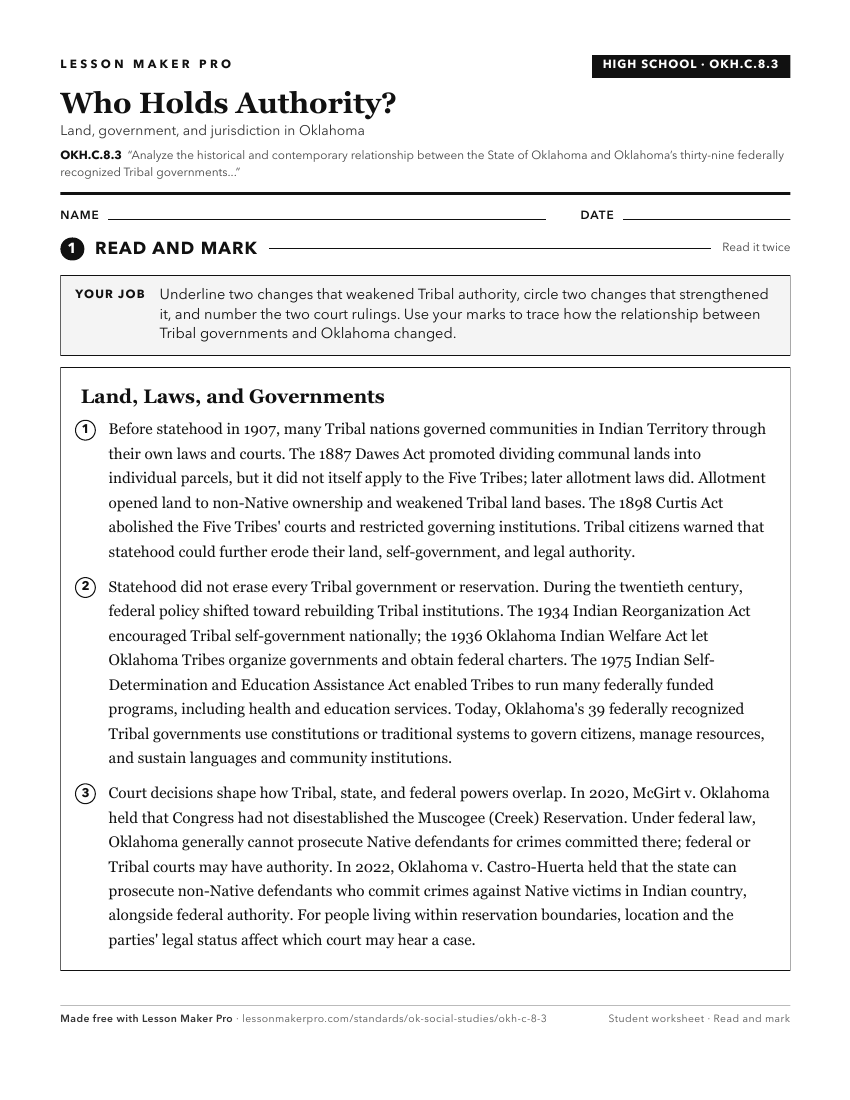
A ready-to-print activity worksheet aligned to OKH.C.8.3, with an answer key for the teacher on its own page. No account needed.
PDF, US Letter, prints cleanly in black and white.
Download the worksheetKeep exploring
Related Standards
- 3.C.3
Analyze the significant historical events and people contributing to the development of Oklahoma.
- USH.C.4.3.F
Explain how the Indian Reorganization Act intended to reverse federal policy by restoring lands to Tribal trust status and endorsing Tribal constitutions, which...
- USG.C.3.6
Analyze the constitutional and legal status of Tribal governments within the federal system.
- 3.C.3.1.E
Explain that today Oklahoma is the home to thirty-nine American Indian Nations with unique traditions and ways of life, by comparing Tribal cultures.
Turn this cluster into a lesson
Grade, subject, topic, and the complete cluster are prefilled. Create one free, no account needed.
Also for this cluster:Make a WorksheetMake a QuizMake a Sub Lesson