Oklahoma Social Studies 3.C.3
Standard Cluster
Analyze the significant historical events and people contributing to the development of Oklahoma. Examine the state’s earliest peoples and the significance of their interactions. Describe the cause-effect relationship between historic events by creating basic timelines and drawing basic conclusions about key events in Oklahoma’s past. Describe how prior to European exploration of the region, American Indian cultures (e.g., Moundbuilders, Wichita, Caddo) traded goods using well-developed systems of intertribal trade routes. Examine reasons for early explorations (e.g., Coronado, Washington Irving, George Catlin) into present-day Oklahoma and summarize observations regarding the land, people, and resources. Describe the experiences of forced removals and relocation of American Indians to Indian Territory, explaining significant changes to American Indian cultures and ways of life. Explain that today Oklahoma is the home to thirty-nine American Indian Nations with unique traditions and ways of life, by comparing Tribal cultures. Describe the development of the state and its resources. Explain the importance of the cattle industry to the early economy, including the influence of Hispanic ranching traditions (e.g.,vaqueros, lasso, corral) and how cattle trails, such as the Great Western and Chisholm Trails became major transportation routes. Describe continued migration by various newcomers to the region, such as the Boomer Movement, identifying different points of view held by American Indians and settlers regarding the settling of Native lands. Explain how many African Americans migrated to Oklahoma, considering it an opportunity where farming communities, businesses, and schools could grow (e.g., historic Black towns, Tulsa’s Greenwood District). Describe the commemoration of Statehood Day, November 16, as the joining of Indian and Oklahoma Territories and admission of Oklahoma to the United States of America in 1907. Describe challenges faced by citizens during the Dust Bowl, focusing on how Oklahomans adapted to harsh environmental conditions and survived economic hardships. Identify when and under what circumstances the student’s community was founded and describe the different groups of people who have influenced its growth and development. Describe how individuals have contributed to the development of Oklahoma by describing the achievements of notable citizens in the fields of Science and Medicine (e.g., Shannon Lucid, Thomas Stafford, Dr. Nazih Zuhdi) Technology (e.g., Sequoyah, Wiley Post) the Arts (e.g., Maria Tallchief, The Kiowa Six, Will Rogers, Woody Guthrie, Enoch Kelly Haney) Politics (e.g., Standing Bear, Clara Luper, Carl Albert, Wilma Mankiller) Sports (e.g., Bill Pickett, Jim Thorpe, Mickey Mantle, Shannon Miller).
Oklahoma Academic Standards for Social Studies (2026)
Cluster contents
Standards in This Cluster
3.C.3 is a cluster heading. These are the individual standards under it.
- 3.C.3.1
Examine the state’s earliest peoples and the significance of their interactions.
- 3.C.3.1.A
Describe the cause-effect relationship between historic events by creating basic timelines and drawing basic conclusions about key events in Oklahoma’s past.
- 3.C.3.1.B
Describe how prior to European exploration of the region, American Indian cultures (e.g., Moundbuilders, Wichita, Caddo) traded goods using well-developed syste...
- 3.C.3.1.C
Examine reasons for early explorations (e.g., Coronado, Washington Irving, George Catlin) into present-day Oklahoma and summarize observations regarding the lan...
- 3.C.3.1.D
Describe the experiences of forced removals and relocation of American Indians to Indian Territory, explaining significant changes to American Indian cultures a...
- 3.C.3.1.E
Explain that today Oklahoma is the home to thirty-nine American Indian Nations with unique traditions and ways of life, by comparing Tribal cultures.
- 3.C.3.2
Describe the development of the state and its resources.
- 3.C.3.2.A
Explain the importance of the cattle industry to the early economy, including the influence of Hispanic ranching traditions (e.g.,vaqueros, lasso, corral) and h...
- 3.C.3.2.B
Describe continued migration by various newcomers to the region, such as the Boomer Movement, identifying different points of view held by American Indians and ...
- 3.C.3.2.C
Explain how many African Americans migrated to Oklahoma, considering it an opportunity where farming communities, businesses, and schools could grow (e.g., hist...
- 3.C.3.2.D
Describe the commemoration of Statehood Day, November 16, as the joining of Indian and Oklahoma Territories and admission of Oklahoma to the United States of Am...
- 3.C.3.2.E
Describe challenges faced by citizens during the Dust Bowl, focusing on how Oklahomans adapted to harsh environmental conditions and survived economic hardships...
- 3.C.3.2.F
Identify when and under what circumstances the student’s community was founded and describe the different groups of people who have influenced its growth and de...
- 3.C.3.3
Describe how individuals have contributed to the development of Oklahoma by describing the achievements of notable citizens in the fields of
- 3.C.3.3.A
Science and Medicine (e.g., Shannon Lucid, Thomas Stafford, Dr. Nazih Zuhdi)
- 3.C.3.3.B
Technology (e.g., Sequoyah, Wiley Post)
- 3.C.3.3.C
the Arts (e.g., Maria Tallchief, The Kiowa Six, Will Rogers, Woody Guthrie, Enoch Kelly Haney)
- 3.C.3.3.D
Politics (e.g., Standing Bear, Clara Luper, Carl Albert, Wilma Mankiller)
- 3.C.3.3.E
Sports (e.g., Bill Pickett, Jim Thorpe, Mickey Mantle, Shannon Miller).
Teacher's field guide
What This Cluster Means
What Students Need to Do
- Students put key events in Oklahoma’s past in order and explain what changed. They compare the experiences of American Indian nations, settlers, and Black communities. They connect Oklahoma’s people and resources to their own community.
What Mastery Looks Like
- A student places early trade, forced removals, cattle trails, statehood, and the Dust Bowl on a timeline. They explain who benefited or faced harm from one change. They name a person and a group that helped shape Oklahoma or their community.
Common Misconceptions
- Students may think all American Indian nations have the same traditions or that they disappeared after statehood. They may confuse forced removal with a choice to move. Some think the Dust Bowl was caused only by a lack of rain.
How to Assess It
- Exit ticket: Put early trade, forced removals, cattle trails, statehood, and the Dust Bowl in order. Choose one event and write how it changed people’s lives.
Lesson moves
Ways to Teach It
Using two printed historical maps, trace an intertribal trade route and the Chisholm Trail in different colors; label what moved along each.
Read short accounts of land settlement from a tribal history and a settler diary, then ask, “How did their views differ?”
Match cards for forced removal, cattle trails, Black towns, statehood, and the Dust Bowl to changes people faced; explain one match.
Give students a printed community history page; have them find its founding date and one group that helped it grow.
Free download
Printable 3.C.3 Worksheet
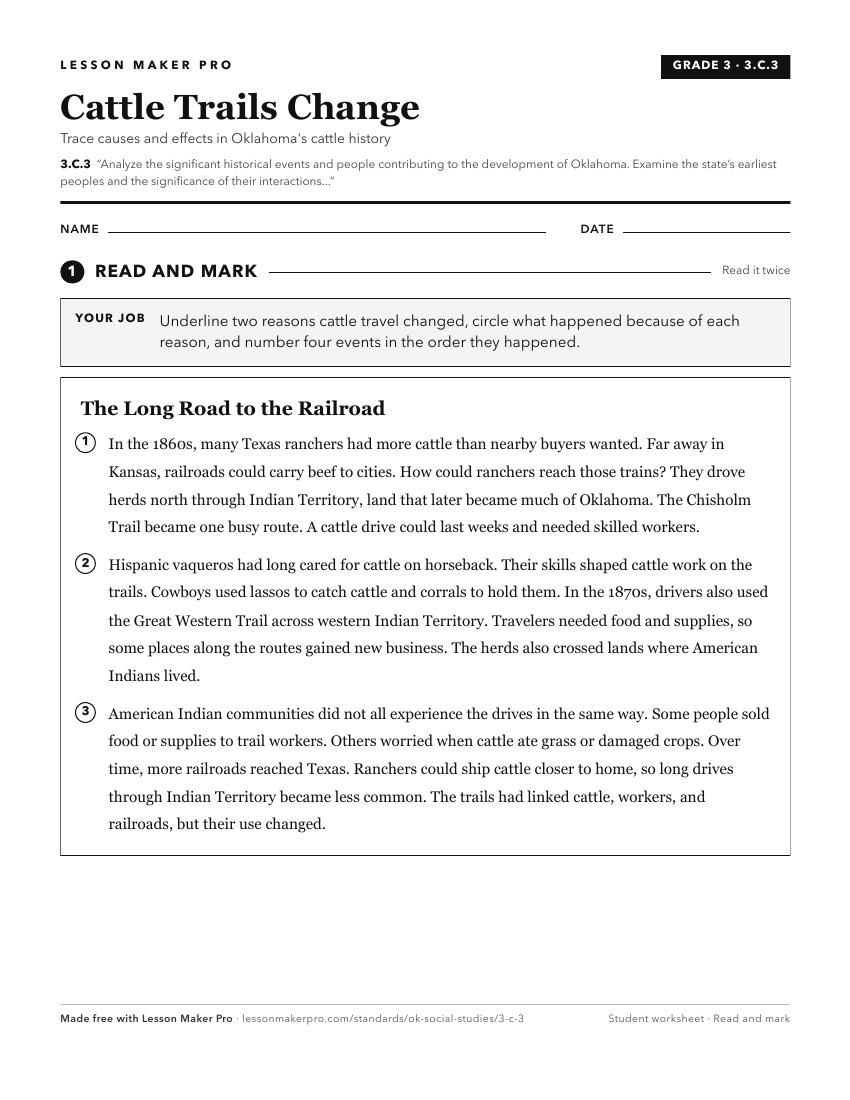
A ready-to-print activity worksheet aligned to 3.C.3, with an answer key for the teacher on its own page. No account needed.
PDF, US Letter, prints cleanly in black and white.
Download the worksheetKeep exploring
Related Standards
Turn this cluster into a lesson
Grade, subject, topic, and the complete cluster are prefilled. Create one free, no account needed.
Also for this cluster:Make a WorksheetMake a QuizMake a Sub Lesson