Oklahoma Social Studies 3.C.3.1
Standard Cluster
- 3.C.3
- Analyze the significant historical events and people contributing to the development of Oklahoma.
Examine the state’s earliest peoples and the significance of their interactions. Describe the cause-effect relationship between historic events by creating basic timelines and drawing basic conclusions about key events in Oklahoma’s past. Describe how prior to European exploration of the region, American Indian cultures (e.g., Moundbuilders, Wichita, Caddo) traded goods using well-developed systems of intertribal trade routes. Examine reasons for early explorations (e.g., Coronado, Washington Irving, George Catlin) into present-day Oklahoma and summarize observations regarding the land, people, and resources. Describe the experiences of forced removals and relocation of American Indians to Indian Territory, explaining significant changes to American Indian cultures and ways of life. Explain that today Oklahoma is the home to thirty-nine American Indian Nations with unique traditions and ways of life, by comparing Tribal cultures.
Oklahoma Academic Standards for Social Studies (2026) · 3.C.3
Cluster contents
Standards in This Cluster
3.C.3.1 is a cluster heading. These are the individual standards under it.
- 3.C.3.1.A
Describe the cause-effect relationship between historic events by creating basic timelines and drawing basic conclusions about key events in Oklahoma’s past.
- 3.C.3.1.B
Describe how prior to European exploration of the region, American Indian cultures (e.g., Moundbuilders, Wichita, Caddo) traded goods using well-developed syste...
- 3.C.3.1.C
Examine reasons for early explorations (e.g., Coronado, Washington Irving, George Catlin) into present-day Oklahoma and summarize observations regarding the lan...
- 3.C.3.1.D
Describe the experiences of forced removals and relocation of American Indians to Indian Territory, explaining significant changes to American Indian cultures a...
- 3.C.3.1.E
Explain that today Oklahoma is the home to thirty-nine American Indian Nations with unique traditions and ways of life, by comparing Tribal cultures.
Teacher's field guide
What This Cluster Means
What Students Need to Do
- Students place early trade, exploration, forced removals, and the present on a timeline. They explain how communities traded before Europeans arrived, why visitors came, and what those visitors observed. They describe removal’s effects and compare two of Oklahoma’s 39 Tribal Nations today.
What Mastery Looks Like
- A student places trade before Coronado’s visit and removal after it. They use a map to show how trade routes moved goods, then explain how forced removal changed where families lived. They name a distinct present-day tradition or program for each of two Tribal Nations.
Common Misconceptions
- Students may think trade began when Europeans arrived. They may think Irving and Catlin visited in Coronado’s time, or that removal was voluntary. Some talk about Tribal Nations only in the past or treat all 39 as one culture.
How to Assess It
- Exit ticket: Put Indigenous trade, Coronado’s visit, forced removals, and today’s Tribal Nations in order. Name one reason for an event and one effect it had on people.
Lesson moves
Ways to Teach It
Give pairs cards for Indigenous trade, Coronado’s visit, removals, and today’s Tribal Nations; have them build a timeline and label one effect.
Read a short account of removal and show a present-day Tribal Nations map. Ask: What changed for families, and what continued?
Match three visitor cards, Coronado, Irving, and Catlin, to purpose cards: seeking wealth, writing travel accounts, or painting portraits.
Open two Oklahoma Tribal Nation websites; have students record each Nation’s name and one present-day program, then compare the programs.
Free download
Printable 3.C.3.1 Worksheet
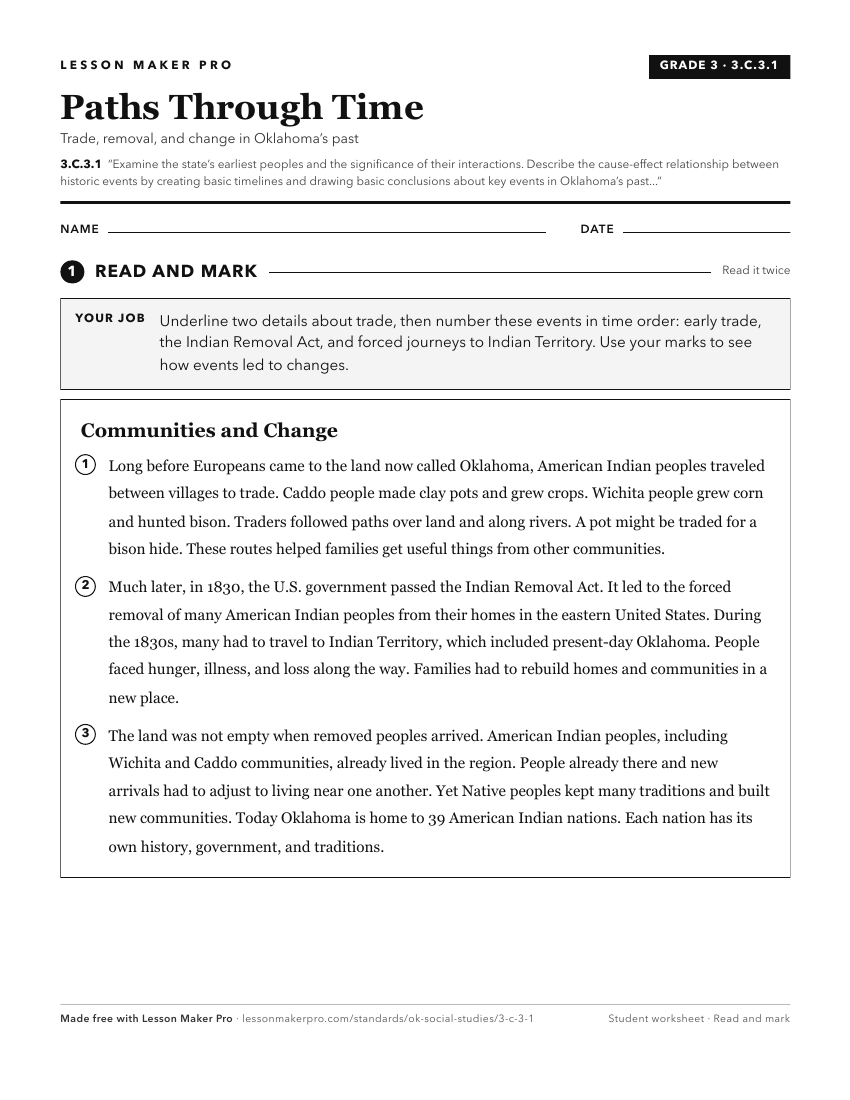
A ready-to-print activity worksheet aligned to 3.C.3.1, with an answer key for the teacher on its own page. No account needed.
PDF, US Letter, prints cleanly in black and white.
Download the worksheetKeep exploring
Related Standards
- 4.C.3
Analyze how geography has impacted cultures and interactions during the early history of our nation.
- OKH.C.1.5
Compare the goals and significance of early European interactions with Native cultures, such as the benefits of trade, the impact of disease, the transformation...
- 4.C.3.1
Examine the various American Indian cultures inhabiting the nation prior to European explorations.
- MWH.C.1
Analyze the impact of the patterns of ancient political, economic, and cultural development.
Turn this cluster into a lesson
Grade, subject, topic, and the complete cluster are prefilled. Create one free, no account needed.
Also for this cluster:Make a WorksheetMake a QuizMake a Sub Lesson