Oklahoma Social Studies MWH.C.1
Standard Cluster
Analyze the impact of the patterns of ancient political, economic, and cultural development. Analyze the influence of religious, political, and philosophical ideas on society. Compare the origins and spread of the world’s major religions and philosophies, including Judaism, Hinduism, Buddhism, Christianity, Islam, Confucianism, and Sikhism. Describe ancient Mesopotamia’s Code of Hammurabi as one of the earliest legal codes. Explain ancient Athens’ experience with direct democracy and identify modern political principles which developed in ancient Greece (e.g., the city-state, civic participation through voting, law-making bodies). Evaluate the contributions of the Roman civilization to law and government by describing the Roman Republic’s development of the principle of separation of powers, the concept of civic duty, written laws, and the rule of law. Compare the impact of Greek and Roman philosophers (e.g., Plato, Aristotle and Cicero) including their lasting influence on principles of government. Examine the influence of Christian moral and legal traditions on the development of Western legal systems. Describe the contributions of the Byzantine Empire, including the significance of the Justinian Code. Describe the feudal system’s influence on European society and government. Explain how geographical and environmental factors impacted settlement and cultural development. Explain different ways in which societies interact across regions (e.g., trade, exploration, colonization) resulting in cultural diffusion (e.g., the Silk Road, Trans-Saharan exchange, Black Death). Describe the institution of slavery prior to the 15th century as a widespread result of warfare and economic practices.
Oklahoma Academic Standards for Social Studies (2026)
Cluster contents
Standards in This Cluster
MWH.C.1 is a cluster heading. These are the individual standards under it.
- MWH.C.1.1
Analyze the influence of religious, political, and philosophical ideas on society.
- MWH.C.1.1.A
Compare the origins and spread of the world’s major religions and philosophies, including Judaism, Hinduism, Buddhism, Christianity, Islam, Confucianism, and Si...
- MWH.C.1.1.B
Describe ancient Mesopotamia’s Code of Hammurabi as one of the earliest legal codes.
- MWH.C.1.1.C
Explain ancient Athens’ experience with direct democracy and identify modern political principles which developed in ancient Greece (e.g., the city-state, civic...
- MWH.C.1.1.D
Evaluate the contributions of the Roman civilization to law and government by describing the Roman Republic’s development of the principle of separation of powe...
- MWH.C.1.1.E
Compare the impact of Greek and Roman philosophers (e.g., Plato, Aristotle and Cicero) including their lasting influence on principles of government.
- MWH.C.1.1.F
Examine the influence of Christian moral and legal traditions on the development of Western legal systems.
- MWH.C.1.1.G
Describe the contributions of the Byzantine Empire, including the significance of the Justinian Code.
- MWH.C.1.1.H
Describe the feudal system’s influence on European society and government.
- MWH.C.1.2
Explain how geographical and environmental factors impacted settlement and cultural development.
- MWH.C.1.2.A
Explain different ways in which societies interact across regions (e.g., trade, exploration, colonization) resulting in cultural diffusion (e.g., the Silk Road,...
- MWH.C.1.2.B
Describe the institution of slavery prior to the 15th century as a widespread result of warfare and economic practices.
Teacher's field guide
What This Cluster Means
What Students Need to Do
- Students compare where major religions and philosophies began, how they spread, and how beliefs shaped laws and daily life. They compare laws and government in Mesopotamia, Athens, Rome, Byzantium, and feudal Europe. They explain how geography, trade, disease, and warfare shaped settlement, cultural exchange, and slavery.
What Mastery Looks Like
- Students can locate the origins of Judaism, Hinduism, Buddhism, Christianity, Islam, Confucianism, and Sikhism, then trace a route of spread for each. They can explain who voted in Athens, how Roman leaders shared power, and why written law codes mattered. They use a map to link a trade route to the spread of goods, beliefs, or disease.
Common Misconceptions
- Students may think everyone could vote in Athens or that Roman government worked just like a modern republic. They may place Sikhism in ancient history or assume the Black Death spread only through battle. Some assume slavery before 1500 existed in just one region or was always based on race.
How to Assess It
- Ask on an exit ticket: “Who could vote in ancient Athens, how did Roman leaders share power differently, and which idea is still used in government today?”
Lesson moves
Ways to Teach It
Give pairs an Afro-Eurasia map and seven belief cards with origin clues; have them mark each origin and draw one spread route.
Read short excerpts from Plato’s Republic, Aristotle’s Politics, and Cicero’s On the Republic; write which gives citizens the most say, citing one line.
Sort cards naming Athens, Rome, Byzantium, and feudal Europe under voting, divided powers, written law codes, and land-for-service duties.
Mark a package’s origin and delivery city on a map, then compare that link with Silk Road routes carrying goods, beliefs, and disease.
Free download
Printable MWH.C.1 Worksheet
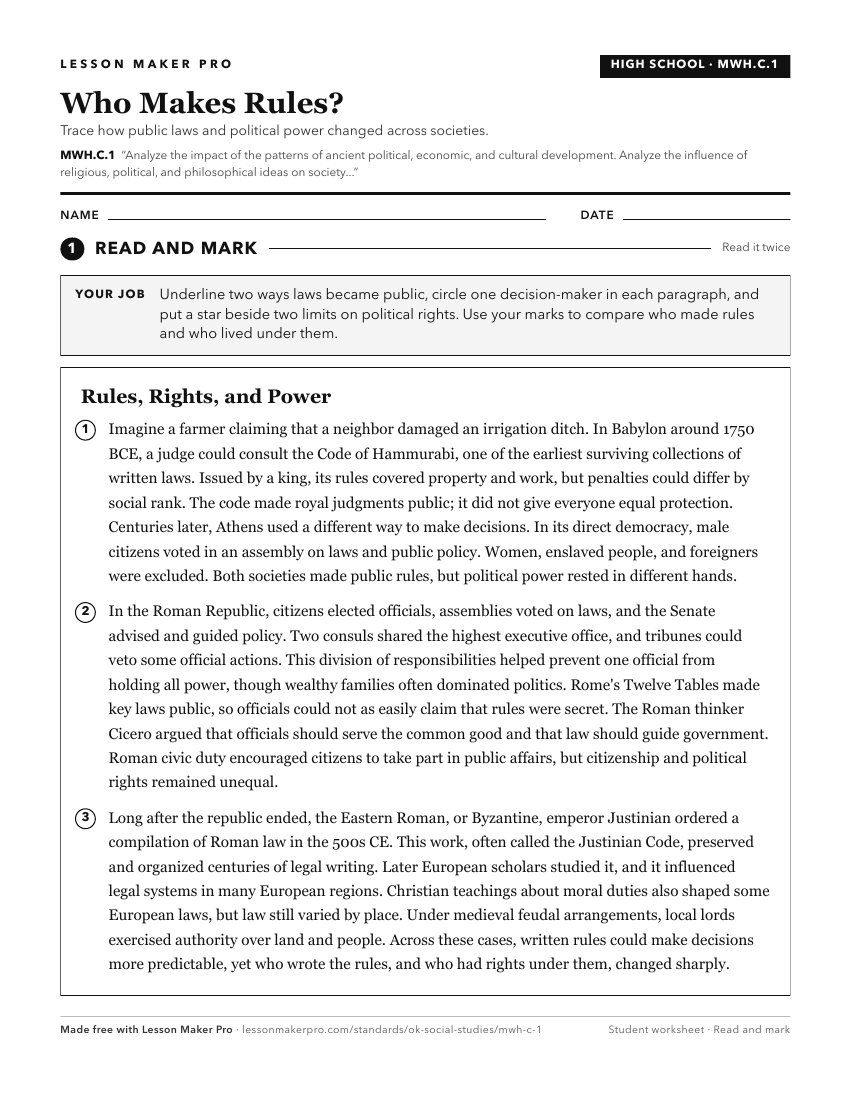
A ready-to-print activity worksheet aligned to MWH.C.1, with an answer key for the teacher on its own page. No account needed.
PDF, US Letter, prints cleanly in black and white.
Download the worksheetKeep exploring
Related Standards
- 6.C.6
Analyze economic systems of the world and how they impact the development of a nation and region.
- MWH.C.2
Analyze patterns of social, economic, political, and cultural changes during the Late Middle Ages to the Age of Exploration.
- MWH.C.3
Analyze developments in politics, science, and philosophy contributing to human advancement and the rise of modern institutions of self-government.
- 7.C.5
Evaluate the development and impact of culture on the major regions and peoples of the Eastern Hemisphere.
Turn this cluster into a lesson
Grade, subject, topic, and the complete cluster are prefilled. Create one free, no account needed.
Also for this cluster:Make a WorksheetMake a QuizMake a Sub Lesson