Oklahoma Social Studies MWH.C.1.2.A
The Standard
- MWH.C.1
- Analyze the impact of the patterns of ancient political, economic, and cultural development.
- MWH.C.1.2
- Explain how geographical and environmental factors impacted settlement and cultural development.
Explain different ways in which societies interact across regions (e.g., trade, exploration, colonization) resulting in cultural diffusion (e.g., the Silk Road, Trans-Saharan exchange, Black Death).
Oklahoma Academic Standards for Social Studies (2026) · MWH.C.1.2
Teacher's field guide
What This Standard Means
What Students Need to Do
- Students trace how trade, exploration, and colonization moved goods, beliefs, technologies, and diseases between regions. They explain who carried them and how places changed after contact.
What Mastery Looks Like
- Students can use a map to explain how paper spread along Silk Road networks or Islam spread through trans-Saharan trade. They can also explain how plague followed trade routes without calling it a cultural practice.
Common Misconceptions
- Students may think traders carried only goods, not beliefs, skills, or diseases. They may describe colonization as a fair exchange or mistake the Black Death for an idea people chose to adopt.
How to Assess It
- Exit ticket: On a Silk Road map, mark one item or belief that traveled, name who carried it, and explain one change it caused.
Lesson moves
Ways to Teach It
Give pairs yarn, a Eurasia map, and silk, paper, and plague cards; have them trace routes and label what traveled.
Ask: How did trans-Saharan caravans move more than salt? Have students use a route map to explain the spread of Islam.
Sort cards showing Silk Road paper, Portuguese spice voyages, and Spanish colonial language spread into trade, exploration, or colonization; explain one effect.
Have students map origins on tea and shirt labels, then discuss which food customs or clothing styles also travel across borders.
Free download
Printable MWH.C.1.2.A Worksheet
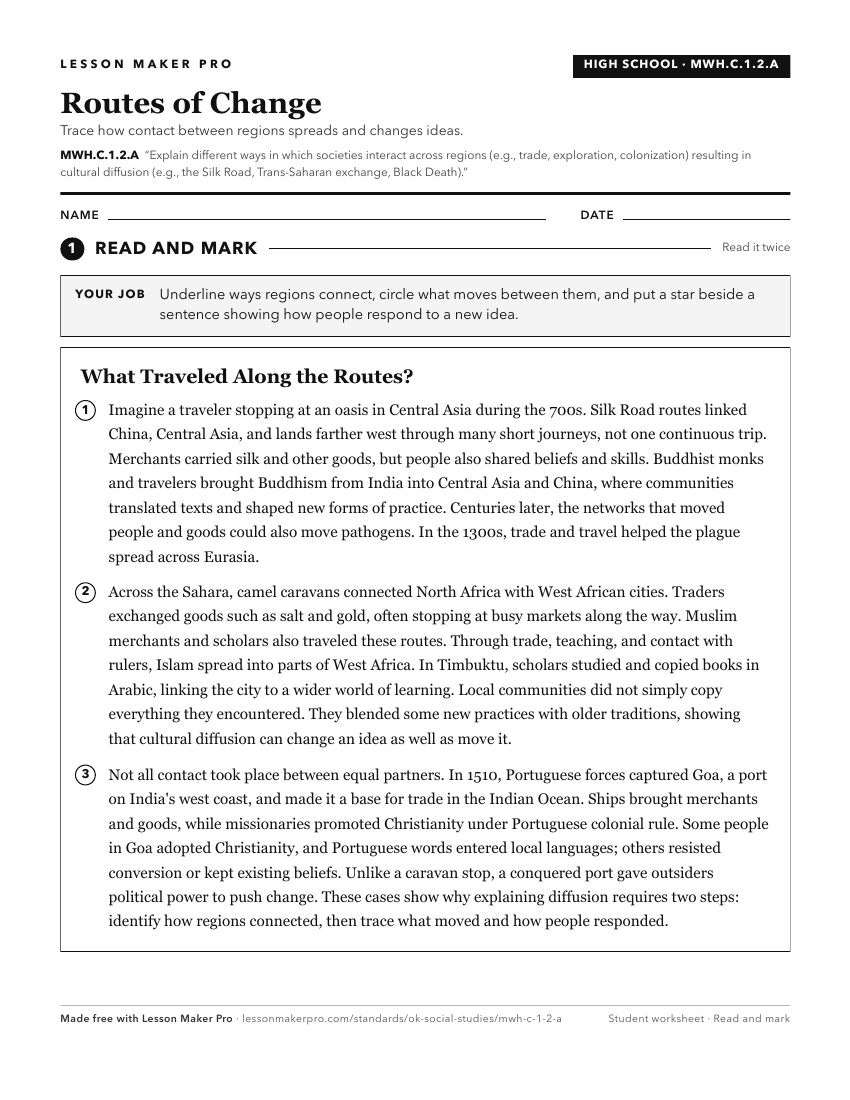
A ready-to-print activity worksheet aligned to MWH.C.1.2.A, with an answer key for the teacher on its own page. No account needed.
PDF, US Letter, prints cleanly in black and white.
Download the worksheetKeep exploring
Related Standards
- 6.C.3.6.A
Identify examples of cultural diffusion (e.g., Columbian Exchange: availability of new commodities and technology; assimilation of American Indian into colonial...
- 6.C.3.3
Define cultural diffusion by describing how cultural characteristics spread and impact contemporary regions (e.g., entertainment, fast foods, social media’s rap...
- WG.C.3.4
Explain the processes of cultural diffusion and interdependence, analyzing their impact on defining a region.
- 7.C.5.1
Compare cultural traits of major cultural regions and explain how culture can change over time through the process of cultural diffusion.
Turn this exact standard into a lesson
Grade, subject, topic, and the complete standard are prefilled. Create one free, no account needed.
Also for this standard:Make a WorksheetMake a QuizMake a Sub Lesson