Oklahoma Social Studies 6.C.3.6.A
The Standard
- 6.C.3
- Identify the characteristics, distribution, and demographic patterns of human populations and systems of the Western Hemisphere.
- 6.C.3.6
- Describe the cultural interactions between American Indian cultures and European settlers which impacted the heritage and history of major regions of the Western Hemisphere.
Identify examples of cultural diffusion (e.g., Columbian Exchange: availability of new commodities and technology; assimilation of American Indian into colonial societies).
Oklahoma Academic Standards for Social Studies (2026) · 6.C.3.6
Teacher's field guide
What This Standard Means
What Students Need to Do
- Students identify foods, animals, and beliefs that spread between cultures after contact. They trace where each came from and where it went. They also explain how colonial pressure changed some Native communities' practices.
What Mastery Looks Like
- A student can show corn moving from the Americas to Europe and horses moving from Europe to the Americas. They can explain that some Native people adopted Christianity under pressure from colonial missions, without assuming all Native communities did.
Common Misconceptions
- Students may think Europeans brought corn to the Americas rather than carrying it to Europe. They may assume Native people always chose to adopt colonial practices freely, or that every Native community changed in the same way.
How to Assess It
- Give students two examples: corn reaching Europe and a colonial mission pressuring Native families to adopt Christianity. Ask them to name what spread in each case and explain how it happened.
Lesson moves
Ways to Teach It
Give pairs an Atlantic map and corn, potato, and horse cards; students mark each origin and draw arrows to new regions.
Ask students to write two sentences comparing a potato reaching Europe with a mission pressuring Native families to adopt Christianity.
Run a three-card relay: teams match corn, horses, and missionary Christianity to descriptions of where each spread.
Use a grocery flyer to find potatoes and corn; students label their American origins and trace how both reached Europe.
Free download
Printable 6.C.3.6.A Worksheet
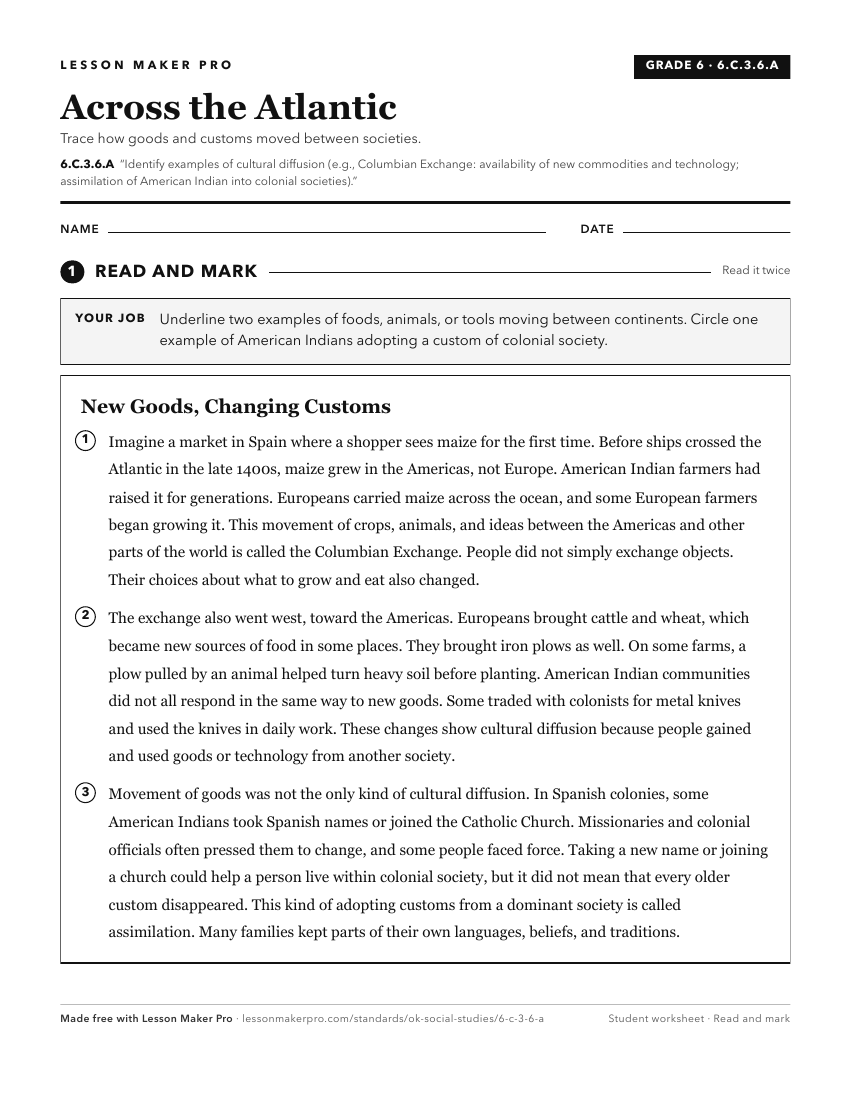
A ready-to-print activity worksheet aligned to 6.C.3.6.A, with an answer key for the teacher on its own page. No account needed.
PDF, US Letter, prints cleanly in black and white.
Download the worksheetKeep exploring
Related Standards
- 4.C.3.2.D
Evaluate the mutual benefits and consequences of the Columbian Exchange, including agriculture, trade, military alliances, technology, slavery, and disease resu...
- 6.C.3.3
Define cultural diffusion by describing how cultural characteristics spread and impact contemporary regions (e.g., entertainment, fast foods, social media’s rap...
- WG.C.3.4
Explain the processes of cultural diffusion and interdependence, analyzing their impact on defining a region.
- MWH.C.1.2.A
Explain different ways in which societies interact across regions (e.g., trade, exploration, colonization) resulting in cultural diffusion (e.g., the Silk Road,...
Turn this exact standard into a lesson
Grade, subject, topic, and the complete standard are prefilled. Create one free, no account needed.
Also for this standard:Make a WorksheetMake a QuizMake a Sub Lesson