Oklahoma Social Studies 4.C.3.2.D
The Standard
- 4.C.3
- Analyze how geography has impacted cultures and interactions during the early history of our nation.
- 4.C.3.2
- Summarize the goals and consequences of European expeditions of North America.
Evaluate the mutual benefits and consequences of the Columbian Exchange, including agriculture, trade, military alliances, technology, slavery, and disease resulting in the significant decline of Native peoples.
Oklahoma Academic Standards for Social Studies (2026) · 4.C.3.2
Teacher's field guide
What This Standard Means
What Students Need to Do
- Students trace how crops, animals, tools, and goods moved between the Americas, Europe, and Africa. They explain how trade and military alliances changed power, why disease killed many Native people, and how slavery harmed Native peoples and Africans.
What Mastery Looks Like
- A student can trace corn from the Americas to Europe, and horses and metal tools to the Americas. They can name who gained from these changes and explain why disease and forced labor caused unequal harm.
Common Misconceptions
- Students may think everyone benefited equally, or that only crops were exchanged. Some assume Native peoples had no trade or tools before Europeans arrived. Others blame disease deaths on poor hygiene rather than lack of prior exposure.
How to Assess It
- Exit ticket: Draw arrows for corn and smallpox on a map of Europe and the Americas. Write who benefited from corn and why smallpox killed so many Native people.
Lesson moves
Ways to Teach It
Have groups place corn, horse, and metal tool picture cards on a map, then draw arrows showing where each moved.
Ask: Why might a Native nation ally with European settlers, and what risks could follow? Have students write two possible outcomes.
Play a card match: pair corn, metal tools, alliances, smallpox, and forced labor with impact cards; have partners explain two matches.
Use a grocery flyer to find corn, tomatoes, and potatoes; have students trace each crop from the Americas to Europe or Africa.
Free download
Printable 4.C.3.2.D Worksheet
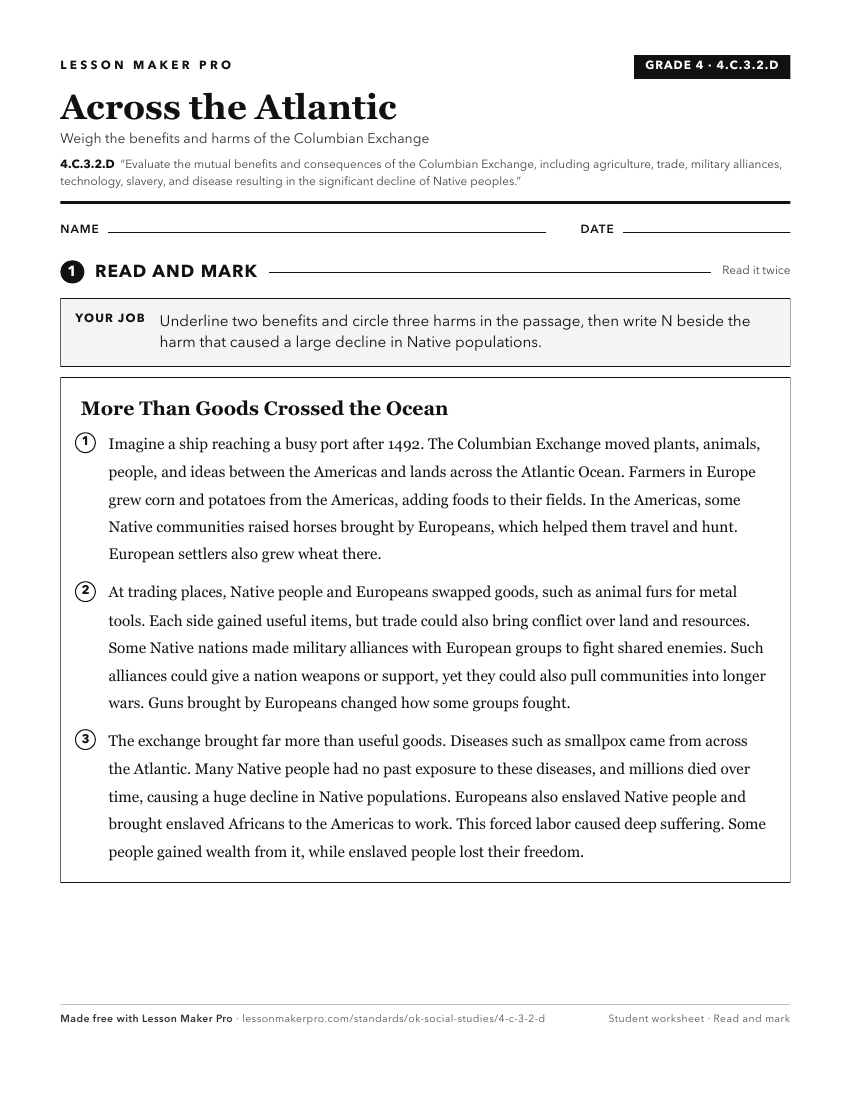
A ready-to-print activity worksheet aligned to 4.C.3.2.D, with an answer key for the teacher on its own page. No account needed.
PDF, US Letter, prints cleanly in black and white.
Download the worksheetKeep exploring
Related Standards
- MWH.C.2.5
Analyze migration, settlement patterns, and the impact on indigenous peoples caused by a competition among European nations during the Age of Exploration.
- 6.C.3.6.A
Identify examples of cultural diffusion (e.g., Columbian Exchange: availability of new commodities and technology; assimilation of American Indian into colonial...
- OKH.C.1.5
Compare the goals and significance of early European interactions with Native cultures, such as the benefits of trade, the impact of disease, the transformation...
- MWH.C.2.5.D
Describe the major economic and cultural effects of the Columbian Exchange and explain how the enslavement of Indigenous peoples and Africans was used for the d...
Turn this exact standard into a lesson
Grade, subject, topic, and the complete standard are prefilled. Create one free, no account needed.
Also for this standard:Make a WorksheetMake a QuizMake a Sub Lesson