Oklahoma Social Studies MWH.C.2.5
Standard Cluster
- MWH.C.2
- Analyze patterns of social, economic, political, and cultural changes during the Late Middle Ages to the Age of Exploration.
Analyze migration, settlement patterns, and the impact on indigenous peoples caused by a competition among European nations during the Age of Exploration. Explain the economic and religious motivations that prompted European exploratory expeditions into the Western Hemisphere and describe how these expeditions led to the expansion of the Spanish and Portuguese empires in Latin America. Examine how the Doctrine of Discovery was used to legitimize European colonization of lands and Indigenous peoples. Explain how the origins of modern capitalism and mercantilism in Europe impacted international trading patterns, prompting global exploration and rivalry. Describe the major economic and cultural effects of the Columbian Exchange and explain how the enslavement of Indigenous peoples and Africans was used for the development of colonial economies. Explain how overseas expansion led to the development of the trans-Atlantic slave trade.
Oklahoma Academic Standards for Social Studies (2026) · MWH.C.2
Cluster contents
Standards in This Cluster
MWH.C.2.5 is a cluster heading. These are the individual standards under it.
- MWH.C.2.5.A
Explain the economic and religious motivations that prompted European exploratory expeditions into the Western Hemisphere and describe how these expeditions led...
- MWH.C.2.5.B
Examine how the Doctrine of Discovery was used to legitimize European colonization of lands and Indigenous peoples.
- MWH.C.2.5.C
Explain how the origins of modern capitalism and mercantilism in Europe impacted international trading patterns, prompting global exploration and rivalry.
- MWH.C.2.5.D
Describe the major economic and cultural effects of the Columbian Exchange and explain how the enslavement of Indigenous peoples and Africans was used for the d...
- MWH.C.2.5.E
Explain how overseas expansion led to the development of the trans-Atlantic slave trade.
Teacher's field guide
What This Cluster Means
What Students Need to Do
- Students explain why European rulers funded Atlantic voyages for trade, religious conversion, and power. They map Spanish and Portuguese settlement and show how European land claims displaced Indigenous peoples. They trace how new trade routes, exchanged goods and diseases, and forced labor shaped colonial economies.
What Mastery Looks Like
- A student can use a map to show where Spain and Portugal built colonies and explain how their rivalry affected Indigenous communities. They can explain how the Doctrine of Discovery denied Indigenous land rights. They can connect mercantilist trade, the Columbian Exchange, and the enslavement of Indigenous peoples and Africans to colonial wealth and the trans-Atlantic slave trade.
Common Misconceptions
- Students may think the Columbian Exchange sent goods only to Europe, missing crops and diseases that traveled in both directions. They may treat European land claims as agreements with Indigenous peoples. They may overlook Indigenous enslavement or assume Africans crossed the Atlantic by choice.
How to Assess It
- Give students a blank Atlantic map. Ask them to mark one Spanish or Portuguese colony and one exchanged crop or disease, then write three sentences linking a voyage motive, a European land claim, and a harm to Indigenous peoples or enslaved Africans.
Lesson moves
Ways to Teach It
Give pairs yarn and a blank Atlantic map to trace Spanish and Portuguese voyages, crop transfers, and routes of forced migration.
Read a short excerpt from the 1493 papal bull, then ask: Whose land rights does it recognize or ignore?
Give groups cards showing sugar, silver, smallpox, maize, horses, and enslaved labor; have them sort by Atlantic direction and explain two effects.
Use a cocoa production map and a chocolate wrapper to compare today's supply chains with colonial sugar trade and ask who profits.
Free download
Printable MWH.C.2.5 Worksheet
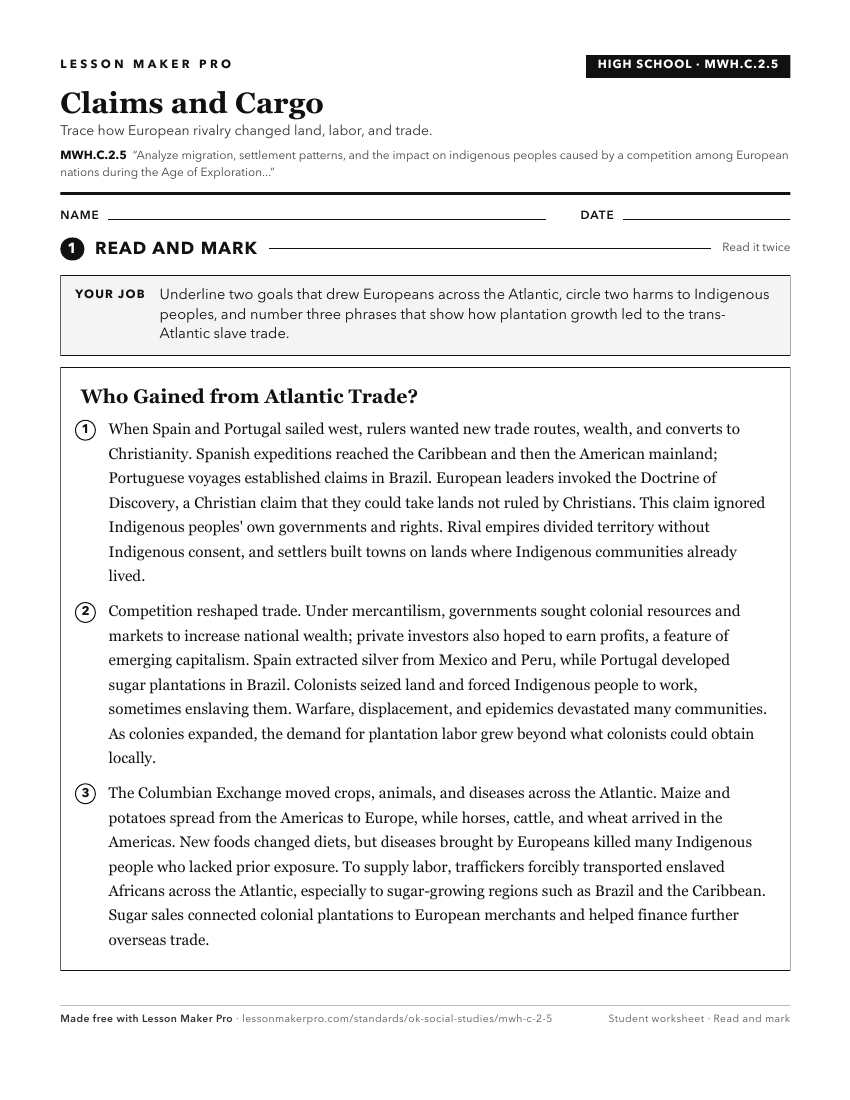
A ready-to-print activity worksheet aligned to MWH.C.2.5, with an answer key for the teacher on its own page. No account needed.
PDF, US Letter, prints cleanly in black and white.
Download the worksheetKeep exploring
Related Standards
- MWH.C.2
Analyze patterns of social, economic, political, and cultural changes during the Late Middle Ages to the Age of Exploration.
- 8.C.9.1.D
Analyze the impact of the waves of immigration from Northern Europe on settlement patterns.
- MWH.C.1
Analyze the impact of the patterns of ancient political, economic, and cultural development.
- 8.C.9.1
Examine multiple perspectives on the justification for and impact on westward expansion and analyze the influence of immigration.
Turn this cluster into a lesson
Grade, subject, topic, and the complete cluster are prefilled. Create one free, no account needed.
Also for this cluster:Make a WorksheetMake a QuizMake a Sub Lesson