Oklahoma Social Studies MWH.C.2
Standard Cluster
Analyze patterns of social, economic, political, and cultural changes during the Late Middle Ages to the Age of Exploration. Describe the impact of medieval English legal and constitutional practices, as established in the Magna Carta, on the rise of modern democratic principles (e.g., common law, limitation of a monarch’s power, and concepts related to the rule of law). Assess the origins and the significance of the Italian Renaissance and the revival of classical learning. Examine intellectual development and advances (i.e., vernacular literature and expanded literacy, the arts, engineering, human anatomy) focusing on selected historical figures (e.g., Machiavelli, Michelangelo, daVinci, Raphael, Erasmus). Describe how humanism furthered the values of republicanism, liberty, and individualism. Summarize the causes of and influence of the theological movements of the Reformation and how those movements subsequently transformed society. Explain reasons for the growing discontent with the Catholic Church, including the main ideas of Martin Luther and John Calvin, and the role of William Tyndale. Explain new ways of disseminating information, such as Gutenberg’s invention of the printing press and the translation of the Bible into the vernacular. Describe tensions between religious and secular authorities contributing to the English Reformation. Trace the spread of Protestantism across Europe, including Lutherans, Reformed (Calvinist) Church of England, Anabaptists, and the effects on European society (e.g., idea and practice of religious tolerance, Calvinist work ethic). Explain the purposes and policies of the Catholic Counter-Reformation. Evaluate the legacy of the Scientific Revolution on society, focusing on major theories and discoveries. Explain how the scientific method and new technologies, such as the telescope and microscope, led to new theories of the universe. Describe the accomplishments of major figures of the Scientific Revolution (e.g., Nicolaus Copernicus, Galileo Galilei, Isaac Newton) as well as the impact of Islamic and Hindu learning on global scholarship and scientific thought. Analyze migration, settlement patterns, and the impact on indigenous peoples caused by a competition among European nations during the Age of Exploration. Explain the economic and religious motivations that prompted European exploratory expeditions into the Western Hemisphere and describe how these expeditions led to the expansion of the Spanish and Portuguese empires in Latin America. Examine how the Doctrine of Discovery was used to legitimize European colonization of lands and Indigenous peoples. Explain how the origins of modern capitalism and mercantilism in Europe impacted international trading patterns, prompting global exploration and rivalry. Describe the major economic and cultural effects of the Columbian Exchange and explain how the enslavement of Indigenous peoples and Africans was used for the development of colonial economies. Explain how overseas expansion led to the development of the trans-Atlantic slave trade.
Oklahoma Academic Standards for Social Studies (2026)
Cluster contents
Standards in This Cluster
MWH.C.2 is a cluster heading. These are the individual standards under it.
- MWH.C.2.1
Describe the impact of medieval English legal and constitutional practices, as established in the Magna Carta, on the rise of modern democratic principles (e.g....
- MWH.C.2.2
Assess the origins and the significance of the Italian Renaissance and the revival of classical learning.
- MWH.C.2.2.A
Examine intellectual development and advances (i.e., vernacular literature and expanded literacy, the arts, engineering, human anatomy) focusing on selected his...
- MWH.C.2.2.B
Describe how humanism furthered the values of republicanism, liberty, and individualism.
- MWH.C.2.3
Summarize the causes of and influence of the theological movements of the Reformation and how those movements subsequently transformed society.
- MWH.C.2.3.A
Explain reasons for the growing discontent with the Catholic Church, including the main ideas of Martin Luther and John Calvin, and the role of William Tyndale.
- MWH.C.2.3.B
Explain new ways of disseminating information, such as Gutenberg’s invention of the printing press and the translation of the Bible into the vernacular.
- MWH.C.2.3.C
Describe tensions between religious and secular authorities contributing to the English Reformation.
- MWH.C.2.3.D
Trace the spread of Protestantism across Europe, including Lutherans, Reformed (Calvinist) Church of England, Anabaptists, and the effects on European society (...
- MWH.C.2.3.E
Explain the purposes and policies of the Catholic Counter-Reformation.
- MWH.C.2.4
Evaluate the legacy of the Scientific Revolution on society, focusing on major theories and discoveries.
- MWH.C.2.4.A
Explain how the scientific method and new technologies, such as the telescope and microscope, led to new theories of the universe.
- MWH.C.2.4.B
Describe the accomplishments of major figures of the Scientific Revolution (e.g., Nicolaus Copernicus, Galileo Galilei, Isaac Newton) as well as the impact of I...
- MWH.C.2.5
Analyze migration, settlement patterns, and the impact on indigenous peoples caused by a competition among European nations during the Age of Exploration.
- MWH.C.2.5.A
Explain the economic and religious motivations that prompted European exploratory expeditions into the Western Hemisphere and describe how these expeditions led...
- MWH.C.2.5.B
Examine how the Doctrine of Discovery was used to legitimize European colonization of lands and Indigenous peoples.
- MWH.C.2.5.C
Explain how the origins of modern capitalism and mercantilism in Europe impacted international trading patterns, prompting global exploration and rivalry.
- MWH.C.2.5.D
Describe the major economic and cultural effects of the Columbian Exchange and explain how the enslavement of Indigenous peoples and Africans was used for the d...
- MWH.C.2.5.E
Explain how overseas expansion led to the development of the trans-Atlantic slave trade.
Teacher's field guide
What This Cluster Means
What Students Need to Do
- Students trace how limits on royal power, Renaissance learning, religious reform, and new science changed European life. They explain how print spread ideas and how European expansion reshaped trade and the lives of Indigenous peoples and Africans.
What Mastery Looks Like
- Students can place major developments in order and use a source to explain a cause and an effect. They can connect the printing press to religious change, scientific tools to new evidence, and colonial trade to displacement and forced labor. They can name how classical, Islamic, and Hindu learning contributed to later scholarship.
Common Misconceptions
- Students may treat the Magna Carta as a promise of equal rights for everyone, though it first protected a narrow group. They may think Europeans discovered lands where Indigenous peoples already lived. They may describe the Columbian Exchange as only crops, leaving out disease and enslavement.
How to Assess It
- Exit ticket: Explain how the printing press helped spread Reformation ideas. Name one social or political effect.
Lesson moves
Ways to Teach It
Give pairs a Magna Carta clause, Luther excerpt, Galileo moon sketch, and colonial trade map to sort by who held power.
Ask: How did Bibles printed in local languages change who could challenge church leaders? Write a claim using a Luther excerpt.
Play timeline relay: teams order cards for the Renaissance, printing press, Reformation, telescope, and Atlantic slave trade, then add one cause arrow.
Read a chocolate bar label, locate cacao and sugar on a Columbian Exchange map, and discuss how colonial demand drove forced labor.
Free download
Printable MWH.C.2 Worksheet
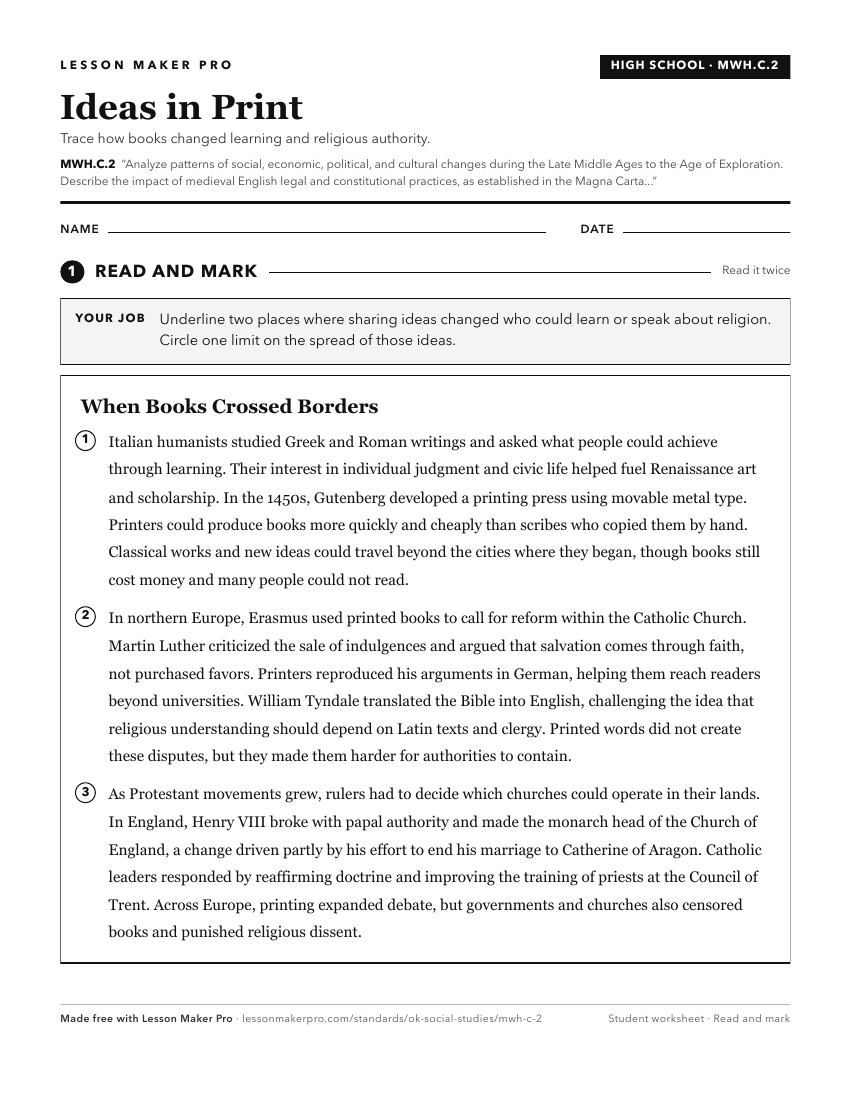
A ready-to-print activity worksheet aligned to MWH.C.2, with an answer key for the teacher on its own page. No account needed.
PDF, US Letter, prints cleanly in black and white.
Download the worksheetKeep exploring
Related Standards
- MWH.C.4
Analyze the political, economic, and social transformations brought about by the events of the age of revolutions.
- AWH.C.10.5
Examine religious, intellectual, cultural, technological, and economic developments in medieval Europe from the Norman Conquest to 1300.
- MWH.C.1
Analyze the impact of the patterns of ancient political, economic, and cultural development.
- AWH.C.12.6
Examine transformations in medieval society.
Turn this cluster into a lesson
Grade, subject, topic, and the complete cluster are prefilled. Create one free, no account needed.
Also for this cluster:Make a WorksheetMake a QuizMake a Sub Lesson