Oklahoma Social Studies MWH.C.4
Standard Cluster
Analyze the political, economic, and social transformations brought about by the events of the age of revolutions. Analyze the complex political, social, and economic causes culminating in the French Revolution (e.g., influence of Enlightenment philosophy, taxation, development of the middle class, excesses and corruption of the French monarchy, demands for reform). Examine the influence of Enlightenment philosophy, economic conditions, the rising influence of the middle class, and the excesses and corruption of the French monarchy on demands for reform. Trace the significant events of the French Revolution (e.g., convening of the Estates General, Tennis Court Oath, storming of the Bastille, execution of Louis XVI, Reign of Terror) and analyze the political concepts present in Declaration of the Rights of Man and the Citizen. Explain the major effects of the French Revolution (e.g., contribution to modern nationalism, political, economic, and cultural debilitation of the Catholic church) and analyze how its support for ideas of popular sovereignty and legal equality served as a model for later revolutions. Explain how the intellectual thoughts of the American and French Revolutions regarding self-rule inspired revolutionary movements globally, such as democratic revolutions in Haiti, Mexico, and South America. Describe the legacy of the Napoleonic Wars including an accelerated rise of nationalism across Europe, Britain’s role in maintaining a balance-of-power, and how the Congress of Vienna attempted to establish a new political order in Europe. Describe the common conditions (e.g., widespread protests and demands of working class; poverty and mass starvation) and democratic ideas (e.g., removal of monarchical power; universal suffrage, free press) contributing to the wave of revolutions of 1848, explaining how they set the stage for the emergence of modern nation-states.
Oklahoma Academic Standards for Social Studies (2026)
Cluster contents
Standards in This Cluster
MWH.C.4 is a cluster heading. These are the individual standards under it.
- MWH.C.4.1
Analyze the complex political, social, and economic causes culminating in the French Revolution (e.g., influence of Enlightenment philosophy, taxation, developm...
- MWH.C.4.1.A
Examine the influence of Enlightenment philosophy, economic conditions, the rising influence of the middle class, and the excesses and corruption of the French ...
- MWH.C.4.1.B
Trace the significant events of the French Revolution (e.g., convening of the Estates General, Tennis Court Oath, storming of the Bastille, execution of Louis X...
- MWH.C.4.1.C
Explain the major effects of the French Revolution (e.g., contribution to modern nationalism, political, economic, and cultural debilitation of the Catholic chu...
- MWH.C.4.2
Explain how the intellectual thoughts of the American and French Revolutions regarding self-rule inspired revolutionary movements globally, such as democratic r...
- MWH.C.4.3
Describe the legacy of the Napoleonic Wars including an accelerated rise of nationalism across Europe, Britain’s role in maintaining a balance-of-power, and how...
- MWH.C.4.4
Describe the common conditions (e.g., widespread protests and demands of working class; poverty and mass starvation) and democratic ideas (e.g., removal of mona...
Teacher's field guide
What This Cluster Means
What Students Need to Do
- Students explain why people in France demanded change, put major revolutionary events in order, and identify the claims in a rights declaration. They trace how ideas about self-rule spread to Haiti and Latin America, then explain how Napoleon, the Congress of Vienna, and the 1848 uprisings changed Europe.
What Mastery Looks Like
- A student can use taxes, representation, and Enlightenment ideas to explain why the French monarchy faced revolt. They can explain how legal equality challenged royal and church privilege and influenced later revolutions. They can show how Napoleon's wars stirred nationalism, Britain and Vienna sought a balance of power, and 1848 protesters demanded votes and national unity.
Common Misconceptions
- Students often think the Third Estate meant only poor peasants, leaving out merchants and professionals. They may assume the rights declaration gave women equal political rights. They may also think the 1848 revolts won voting rights for everyone.
How to Assess It
- Exit ticket: Name one cause of the French Revolution, explain how a claim in the rights declaration addressed it, and connect that claim to Haiti or an 1848 uprising.
Lesson moves
Ways to Teach It
Give pairs cards for five French Revolution events; have them arrange the cards and add one cause and one consequence to each.
Print two short passages from the rights declaration; ask students who gained rights and who remained excluded, using one line as evidence.
Run a match-up race: pairs connect Haiti, Mexico, 1848, and Vienna cards to independence, voting demands, or restored monarchy.
Show a current voter registration form and a 1791 French voting rule; ask students to list who could vote in each.
Free download
Printable MWH.C.4 Worksheet
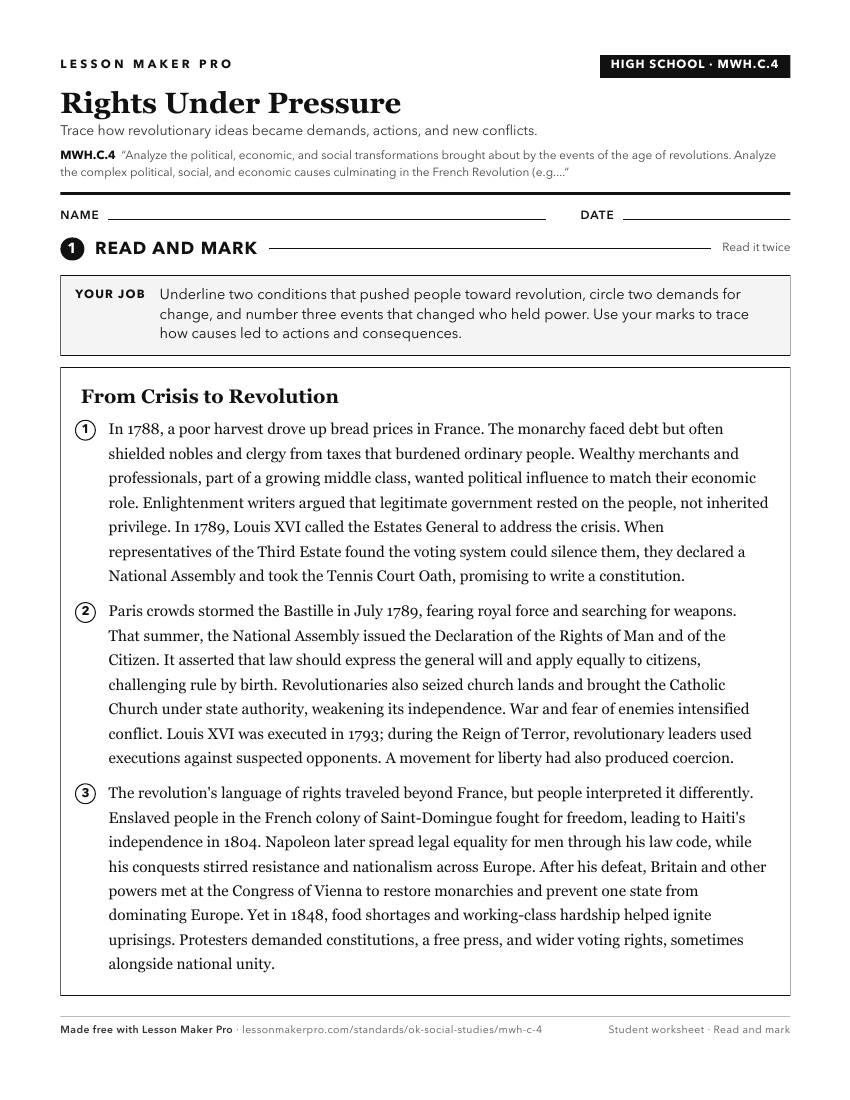
A ready-to-print activity worksheet aligned to MWH.C.4, with an answer key for the teacher on its own page. No account needed.
PDF, US Letter, prints cleanly in black and white.
Download the worksheetKeep exploring
Related Standards
- 8.C.10
Analyze the social and economic transformations of the early nineteenth century.
- USH.C.2
Analyze the social, economic, and political changes that occurred during the American Industrial Revolution, the Gilded Age, and reform movements.
- 8.C.13
Analyze the political, social, and economic transformations during the Reconstruction Era.
- MWH.C.5
Analyze the massive social, economic, and cultural change brought about by the Industrial Revolution.
Turn this cluster into a lesson
Grade, subject, topic, and the complete cluster are prefilled. Create one free, no account needed.
Also for this cluster:Make a WorksheetMake a QuizMake a Sub Lesson