Oklahoma Social Studies MWH.C.4.1.C
The Standard
- MWH.C.4
- Analyze the political, economic, and social transformations brought about by the events of the age of revolutions.
- MWH.C.4.1
- Analyze the complex political, social, and economic causes culminating in the French Revolution (e.g., influence of Enlightenment philosophy, taxation, development of the middle class, excesses and corruption of the French monarchy, demands for reform).
Explain the major effects of the French Revolution (e.g., contribution to modern nationalism, political, economic, and cultural debilitation of the Catholic church) and analyze how its support for ideas of popular sovereignty and legal equality served as a model for later revolutions.
Oklahoma Academic Standards for Social Studies (2026) · MWH.C.4.1
Teacher's field guide
What This Standard Means
What Students Need to Do
- Students explain how the revolution reduced the Catholic Church's wealth and public power. They connect citizen armies and civic symbols to a growing French national identity. They show how later revolutionaries used French ideas about rule by the people and equality before the law.
What Mastery Looks Like
- A student can explain how church land seizures, priest oaths, and mass conscription changed power in France. They can show how Haitian revolutionaries used French ideas about rights while demanding equality for people France had excluded.
Common Misconceptions
- Students may think the Catholic Church disappeared from France, rather than losing land and some authority. They may assume the 1789 promise of equality immediately included women and enslaved people, or confuse nationalism with loyalty to a king.
How to Assess It
- Exit ticket: Explain how church land seizures and mass conscription each changed France. Then name one French idea Haitian revolutionaries used and one limit they challenged.
Lesson moves
Ways to Teach It
Give groups cards for church land seizures, priest oaths, mass conscription, and Haitian independence; have them arrange the cards and label each effect.
Read two lines from France's 1789 rights declaration and ask: Who could claim these rights, and who was left out?
Play a matching game with four event cards and four effect cards, including church land seizures, priest oaths, and mass conscription.
Show photos of Bastille Day and Haitian Independence Day celebrations; ask what each says about who belongs to the nation.
Free download
Printable MWH.C.4.1.C Worksheet
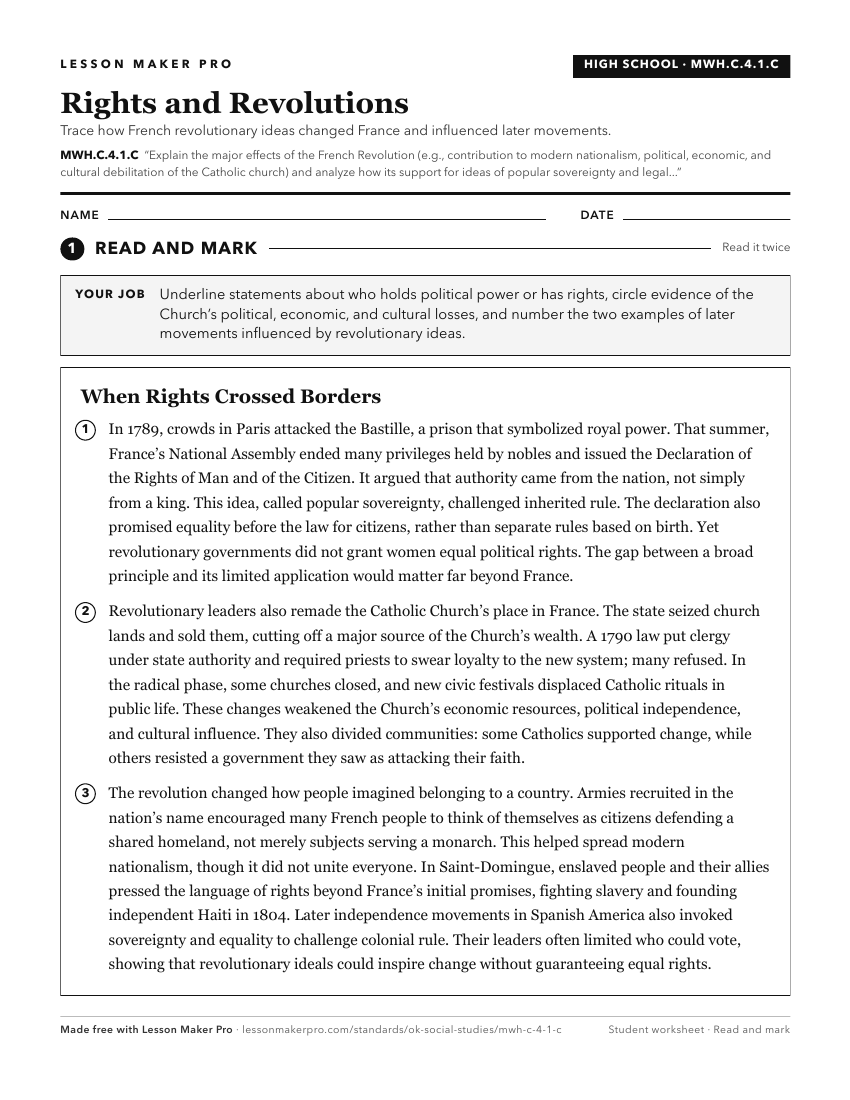
A ready-to-print activity worksheet aligned to MWH.C.4.1.C, with an answer key for the teacher on its own page. No account needed.
PDF, US Letter, prints cleanly in black and white.
Download the worksheetKeep exploring
Related Standards
- MWH.C.4.2
Explain how the intellectual thoughts of the American and French Revolutions regarding self-rule inspired revolutionary movements globally, such as democratic r...
- MWH.C.4.1
Analyze the complex political, social, and economic causes culminating in the French Revolution (e.g., influence of Enlightenment philosophy, taxation, developm...
- MWH.C.4.4
Describe the common conditions (e.g., widespread protests and demands of working class; poverty and mass starvation) and democratic ideas (e.g., removal of mona...
- MWH.C.4.1.B
Trace the significant events of the French Revolution (e.g., convening of the Estates General, Tennis Court Oath, storming of the Bastille, execution of Louis X...
Turn this exact standard into a lesson
Grade, subject, topic, and the complete standard are prefilled. Create one free, no account needed.
Also for this standard:Make a WorksheetMake a QuizMake a Sub Lesson