Oklahoma Social Studies MWH.C.4.4
The Standard
- MWH.C.4
- Analyze the political, economic, and social transformations brought about by the events of the age of revolutions.
Describe the common conditions (e.g., widespread protests and demands of working class; poverty and mass starvation) and democratic ideas (e.g., removal of monarchical power; universal suffrage, free press) contributing to the wave of revolutions of 1848, explaining how they set the stage for the emergence of modern nation-states.
Oklahoma Academic Standards for Social Studies (2026) · MWH.C.4
Teacher's field guide
What This Standard Means
What Students Need to Do
- Students connect food shortages, job loss, and worker protests to demands for voting rights, a free press, and limits on kings. They compare demands in France, the German states, and the Austrian Empire. They explain how calls for national unity shaped later countries, even though many uprisings failed.
What Mastery Looks Like
- A student can explain why a hungry worker might join a protest and why others might demand a constitution. They can describe calls for a united Germany or Italy without claiming either country unified in 1848.
Common Misconceptions
- Students may think every uprising had the same goals or that food shortages alone caused the unrest. They may assume everyone gained the vote or that Germany and Italy unified that year.
How to Assess It
- Exit ticket: Name one hardship and one political demand behind the 1848 uprisings. Then explain how the Frankfurt Parliament's goal pointed toward a later nation-state.
Lesson moves
Ways to Teach It
Give pairs a map of 1848 Europe and cause-and-demand cards to place beside Paris, Vienna, Frankfurt, and Milan.
Ask students to write: Why might a hungry Paris worker and a Frankfurt delegate support revolution for different reasons?
Play a card sort: students group food shortages, unemployment, voting rights, and press freedom as conditions or demands, then defend each choice.
Have students check a local election board's voter rules and compare them with 1848 demands for suffrage.
Free download
Printable MWH.C.4.4 Worksheet
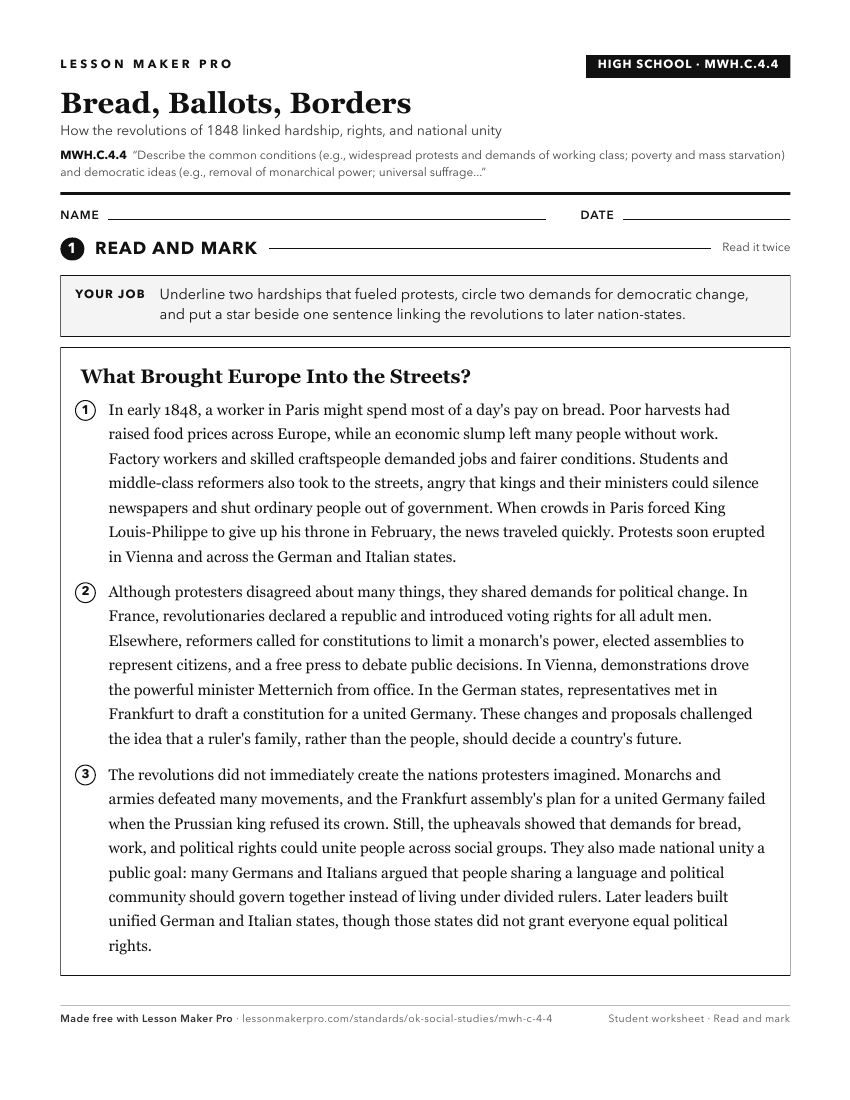
A ready-to-print activity worksheet aligned to MWH.C.4.4, with an answer key for the teacher on its own page. No account needed.
PDF, US Letter, prints cleanly in black and white.
Download the worksheetKeep exploring
Related Standards
- MWH.C.4.2
Explain how the intellectual thoughts of the American and French Revolutions regarding self-rule inspired revolutionary movements globally, such as democratic r...
- MWH.C.4
Analyze the political, economic, and social transformations brought about by the events of the age of revolutions.
- MWH.C.4.1.C
Explain the major effects of the French Revolution (e.g., contribution to modern nationalism, political, economic, and cultural debilitation of the Catholic chu...
- MWH.C.4.1
Analyze the complex political, social, and economic causes culminating in the French Revolution (e.g., influence of Enlightenment philosophy, taxation, developm...
Turn this exact standard into a lesson
Grade, subject, topic, and the complete standard are prefilled. Create one free, no account needed.
Also for this standard:Make a WorksheetMake a QuizMake a Sub Lesson