Oklahoma Social Studies 8.C.13
Standard Cluster
Analyze the political, social, and economic transformations during the Reconstruction Era. Examine the challenges of rebuilding the nation following the end of the Civil War. Evaluate Lincoln’s plans for reconciliation, as expressed in his Second Inaugural Address, and the impact of his assassination on Reconstruction. Compare the plans and policies proposed for Reconstruction (e.g., President Andrew Johnson, the Congressional Republicans) assessing their intended goals and possible consequences. Analyze the impact of state and federal legislation following the Civil War. Explain the impact of the 13th, 14th, and 15th Amendments on the status of formerly enslaved persons, as well as the relationship of the federal government to the states. Assess the impact of the Civil War Amendments in securing political rights for African Americans, resulting in their election to state and national government positions. Evaluate the efforts of the Freedmen’s Bureau to assist freed persons with economic, educational, and political opportunities. Describe how the adoption of Black Codes by many southern state legislatures restricted employment and property rights of Freedmen. Analyze the emerging social structure of the postwar South. Identify the various motives of carpetbaggers including economic gain, exploitative aims, and genuine concern for the civil and political rights of freed Blacks. Describe the expansion of the tenant and sharecropper systems which enabled landowners to reestablish a labor force severely restricting economic mobility. Examine the political and social goals of the Ku Klux Klan, including its acts of intimidation and violence against African Americans. Describe the migration of African Americans from the discriminatory conditions of the South to opportunities in the north and west. Assess the lasting impact of factors leading to the end of Reconstruction. Describe the result of a lack of enforcement of the 14th and 15th Amendments. Examine the development of segregated societies in the South as a result of social norms and legal statutes such as Black Codes. Explain the effects of the presidential election of 1876 and the Compromise of 1877 on Reconstruction. Evaluate the impact of federal policies related to the on-going migration and settlement of the West. Describe how the Homestead Act of 1862 enabled more individuals to obtain land and partake in economic opportunities following the war. Analyze the impact of the development of the Transcontinental Railroad on connecting agricultural goods and products to population centers and markets. Summarize the intent of President Grant’s Peace Policy on the displacement of American Indians from their homelands. Describe the impact of Grant’s policy of government-run boarding schools and missions directed to assimilate Tribal members. Describe escalating conflict between American Indians, military forces, and civilians (e.g., Whitman Mission and Sand Creek Massacres).
Oklahoma Academic Standards for Social Studies (2026)
Cluster contents
Standards in This Cluster
8.C.13 is a cluster heading. These are the individual standards under it.
- 8.C.13.1
Examine the challenges of rebuilding the nation following the end of the Civil War.
- 8.C.13.1.A
Evaluate Lincoln’s plans for reconciliation, as expressed in his Second Inaugural Address, and the impact of his assassination on Reconstruction.
- 8.C.13.1.B
Compare the plans and policies proposed for Reconstruction (e.g., President Andrew Johnson, the Congressional Republicans) assessing their intended goals and po...
- 8.C.13.2
Analyze the impact of state and federal legislation following the Civil War.
- 8.C.13.2.A
Explain the impact of the 13th, 14th, and 15th Amendments on the status of formerly enslaved persons, as well as the relationship of the federal government to t...
- 8.C.13.2.B
Assess the impact of the Civil War Amendments in securing political rights for African Americans, resulting in their election to state and national government p...
- 8.C.13.2.C
Evaluate the efforts of the Freedmen’s Bureau to assist freed persons with economic, educational, and political opportunities.
- 8.C.13.2.D
Describe how the adoption of Black Codes by many southern state legislatures restricted employment and property rights of Freedmen.
- 8.C.13.3
Analyze the emerging social structure of the postwar South.
- 8.C.13.3.A
Identify the various motives of carpetbaggers including economic gain, exploitative aims, and genuine concern for the civil and political rights of freed Blacks...
- 8.C.13.3.B
Describe the expansion of the tenant and sharecropper systems which enabled landowners to reestablish a labor force severely restricting economic mobility.
- 8.C.13.3.C
Examine the political and social goals of the Ku Klux Klan, including its acts of intimidation and violence against African Americans.
- 8.C.13.3.D
Describe the migration of African Americans from the discriminatory conditions of the South to opportunities in the north and west.
- 8.C.13.4
Assess the lasting impact of factors leading to the end of Reconstruction.
- 8.C.13.4.A
Describe the result of a lack of enforcement of the 14th and 15th Amendments.
- 8.C.13.4.B
Examine the development of segregated societies in the South as a result of social norms and legal statutes such as Black Codes.
- 8.C.13.4.C
Explain the effects of the presidential election of 1876 and the Compromise of 1877 on Reconstruction.
- 8.C.13.5
Evaluate the impact of federal policies related to the on-going migration and settlement of the West.
- 8.C.13.5.A
Describe how the Homestead Act of 1862 enabled more individuals to obtain land and partake in economic opportunities following the war.
- 8.C.13.5.B
Analyze the impact of the development of the Transcontinental Railroad on connecting agricultural goods and products to population centers and markets.
- 8.C.13.5.C
Summarize the intent of President Grant’s Peace Policy on the displacement of American Indians from their homelands.
- 8.C.13.5.D
Describe the impact of Grant’s policy of government-run boarding schools and missions directed to assimilate Tribal members.
- 8.C.13.5.E
Describe escalating conflict between American Indians, military forces, and civilians (e.g., Whitman Mission and Sand Creek Massacres).
Teacher's field guide
What This Cluster Means
What Students Need to Do
- Students compare Lincoln’s, Johnson’s, and Congress’s plans for rebuilding the South. They trace how new rights, federal aid, state laws, and violence shaped life after slavery. They also explain how land policies and railroads changed the West for settlers and Native nations.
What Mastery Looks Like
- A student can explain why federal protection grew, then faded after 1877. They can show how sharecropping, Black Codes, and the Freedmen’s Bureau affected freed people’s choices. They can explain how western policies opened land to settlers while displacing Native nations and forcing children into boarding schools.
Common Misconceptions
- Students may think the new amendments ended discrimination on their own, or that freedom came with land and steady wages. Some mistake sharecropping for land ownership or assume all carpetbaggers had the same motives. Others think Grant’s Peace Policy ended Native displacement.
How to Assess It
- Give students the 14th Amendment’s equal protection clause and Mississippi’s 1865 vagrancy law. Ask: “What protection was promised, how did the law undercut it, and who could enforce the protection?”
Lesson moves
Ways to Teach It
Give pairs cards for a Homestead Act claim, a sharecropping contract, and a Black Code; have them sort who gained land, wages, or control.
Read Lincoln’s phrase “with malice toward none,” then ask how Johnson’s and Congress’s plans differed from his approach after his assassination.
Play a timeline race: teams order the 13th, 14th, and 15th Amendments and the Compromise of 1877, then explain each event.
Give students an 1870 railroad map and a map of tribal homelands; have them mark one farm-to-market route and one homeland crossed.
Free download
Printable 8.C.13 Worksheet
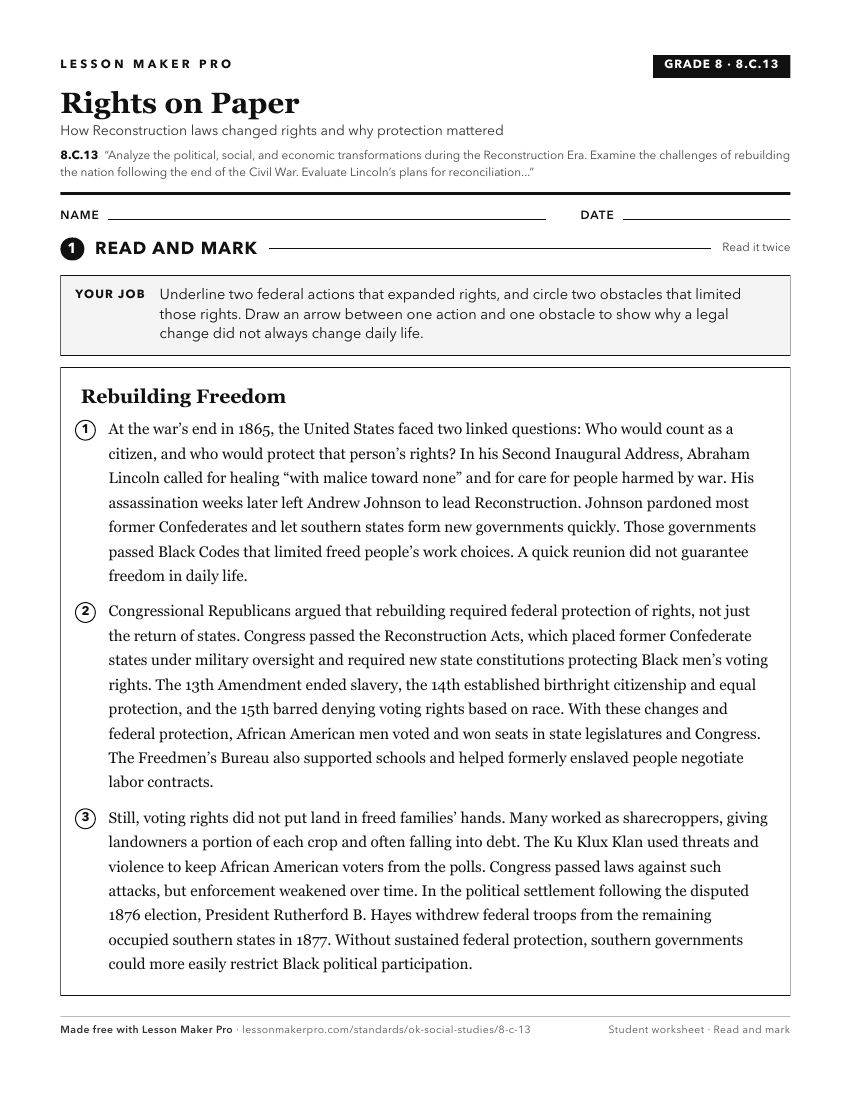
A ready-to-print activity worksheet aligned to 8.C.13, with an answer key for the teacher on its own page. No account needed.
PDF, US Letter, prints cleanly in black and white.
Download the worksheetKeep exploring
Related Standards
- 8.C.8
Examine the political, economic and social transformations of the Jacksonian Era.
- 8.C.10
Analyze the social and economic transformations of the early nineteenth century.
- USH.C.2
Analyze the social, economic, and political changes that occurred during the American Industrial Revolution, the Gilded Age, and reform movements.
- 8.C.7
Examine the political, economic and social transformations during the “Era of Good Feelings.”
Turn this cluster into a lesson
Grade, subject, topic, and the complete cluster are prefilled. Create one free, no account needed.
Also for this cluster:Make a WorksheetMake a QuizMake a Sub Lesson