Oklahoma Social Studies 8.C.13.2
Standard Cluster
- 8.C.13
- Analyze the political, social, and economic transformations during the Reconstruction Era.
Analyze the impact of state and federal legislation following the Civil War. Explain the impact of the 13th, 14th, and 15th Amendments on the status of formerly enslaved persons, as well as the relationship of the federal government to the states. Assess the impact of the Civil War Amendments in securing political rights for African Americans, resulting in their election to state and national government positions. Evaluate the efforts of the Freedmen’s Bureau to assist freed persons with economic, educational, and political opportunities. Describe how the adoption of Black Codes by many southern state legislatures restricted employment and property rights of Freedmen.
Oklahoma Academic Standards for Social Studies (2026) · 8.C.13
Cluster contents
Standards in This Cluster
8.C.13.2 is a cluster heading. These are the individual standards under it.
- 8.C.13.2.A
Explain the impact of the 13th, 14th, and 15th Amendments on the status of formerly enslaved persons, as well as the relationship of the federal government to t...
- 8.C.13.2.B
Assess the impact of the Civil War Amendments in securing political rights for African Americans, resulting in their election to state and national government p...
- 8.C.13.2.C
Evaluate the efforts of the Freedmen’s Bureau to assist freed persons with economic, educational, and political opportunities.
- 8.C.13.2.D
Describe how the adoption of Black Codes by many southern state legislatures restricted employment and property rights of Freedmen.
Teacher's field guide
What This Cluster Means
What Students Need to Do
- Students explain how the postwar amendments ended slavery, established citizenship and equal protection, and barred race-based voting restrictions. They compare those federal rules with state Black Codes that limited freed people's work and property rights. They explain how the Freedmen's Bureau helped with jobs, schools, and political participation, and how Black men won office despite resistance.
What Mastery Looks Like
- A student can match each amendment to its effect and explain how federal protections limited state power. They can use a Black Code and a Freedmen's Bureau record to describe a specific restriction and a specific form of aid. They can identify a Black state lawmaker and a member of Congress elected during Reconstruction.
Common Misconceptions
- Students may think the 13th Amendment granted voting rights, rather than ending slavery. They may think the 15th Amendment gave all Black people the vote, though women still faced voting bans. They may assume federal amendments erased Black Codes at once or that the Freedmen's Bureau gave every freed family land.
How to Assess It
- Exit ticket: A state Black Code limits where freed people can work. Explain how federal law could challenge that rule, name one way the Freedmen's Bureau could help, and link voting rights to Black officeholders.
Lesson moves
Ways to Teach It
Give pairs dated cards for the three amendments, a Black Code, a Bureau school, and Hiram Revels; have them build an effects timeline.
Write two sentences: Why did states pass Black Codes after slavery ended, and how did the 14th Amendment challenge those laws?
Read quick scenarios aloud, such as a contract dispute or denied ballot; teams hold up amendment, Bureau, or Black Code cards and explain.
Show Oklahoma's registration deadline beside the 15th Amendment; ask which rule the state sets and which limit the Constitution sets.
Free download
Printable 8.C.13.2 Worksheet
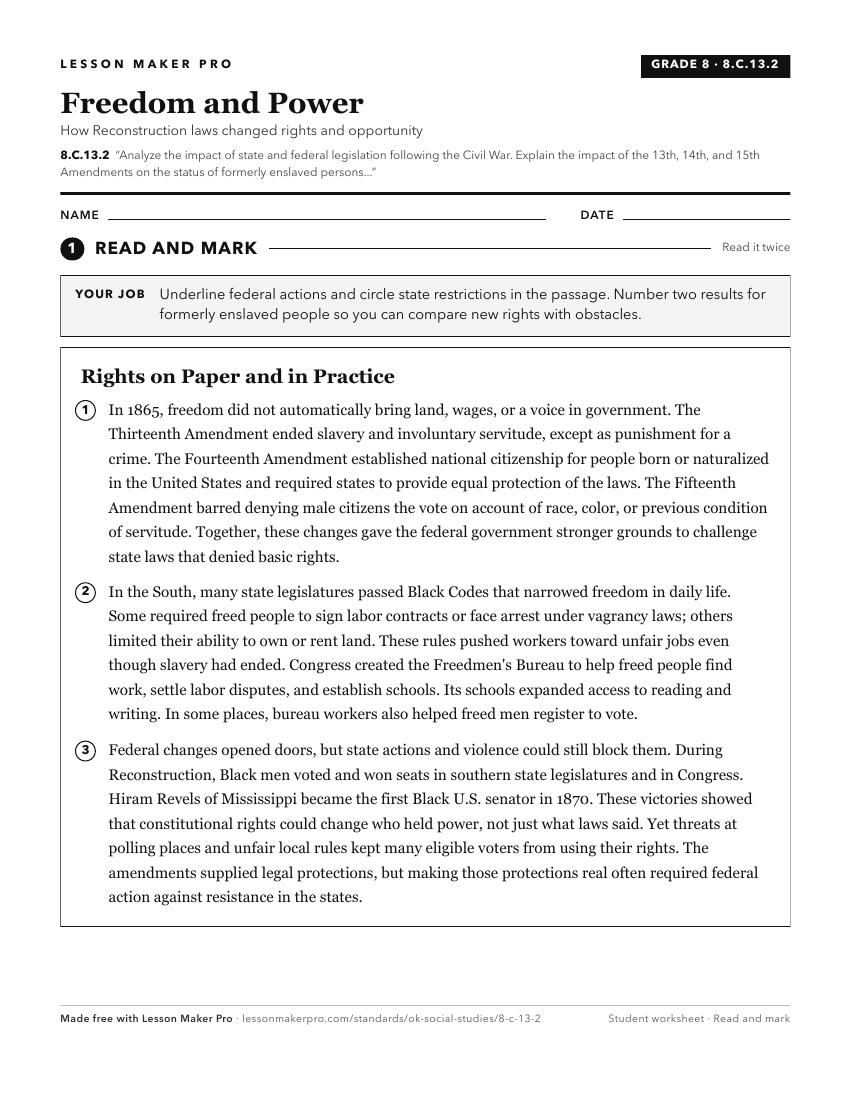
A ready-to-print activity worksheet aligned to 8.C.13.2, with an answer key for the teacher on its own page. No account needed.
PDF, US Letter, prints cleanly in black and white.
Download the worksheetKeep exploring
Related Standards
Turn this cluster into a lesson
Grade, subject, topic, and the complete cluster are prefilled. Create one free, no account needed.
Also for this cluster:Make a WorksheetMake a QuizMake a Sub Lesson