Oklahoma Social Studies USH.C.1.1
Standard Cluster
- USH.C.1
- Analyze the transformation of the United States of America through its civil rights struggles, immigrant experiences, and settlement of the American West during the Post Civil War Era.
Explain the constitutional issues that arise in the post-Civil War era. Summarize the fundamental principles of the United States of America’s constitutional republic and how events of the post-war era affected the Constitution’s balance of the public good with the protection of individual rights. Analyze the Constitution’s concepts of federalism, separation of powers, and the system of checks and balances to changing relationships in American politics as the nation rebuilt following the Civil War. Examine the meaning and effects of the Reconstruction Amendments (13th, 14th, and 15th Amendments) and the Civil Rights Act of 1867, assessing the extent to which each enabled social, political, and economic change.
Oklahoma Academic Standards for Social Studies (2026) · USH.C.1
Cluster contents
Standards in This Cluster
USH.C.1.1 is a cluster heading. These are the individual standards under it.
- USH.C.1.1.A
Summarize the fundamental principles of the United States of America’s constitutional republic and how events of the post-war era affected the Constitution’s ba...
- USH.C.1.1.B
Analyze the Constitution’s concepts of federalism, separation of powers, and the system of checks and balances to changing relationships in American politics as...
- USH.C.1.1.C
Examine the meaning and effects of the Reconstruction Amendments (13th, 14th, and 15th Amendments) and the Civil Rights Act of 1867, assessing the extent to whi...
Teacher's field guide
What This Cluster Means
What Students Need to Do
- Students explain how ending slavery, defining citizenship, and protecting voting rights changed federal and state power. They trace how Congress and President Johnson clashed over Reconstruction. They judge what changed in people's lives and what did not.
What Mastery Looks Like
- A student can link the 13th Amendment to emancipation, the 14th to citizenship and equal protection, and the 15th to the ban on race-based voting restrictions. They can explain Congress's override of Johnson's veto of the 1866 Civil Rights Act and why legal rights did not guarantee land, safety, or access to the polls.
Common Misconceptions
- Students may think the 13th Amendment gave freed people the vote or that the 15th gave women the vote. Some assume new laws ended violence and economic dependence, or that states immediately followed federal protections.
How to Assess It
- Exit ticket: Name one protection addressed by each Reconstruction amendment. Then explain what Congress's override of Johnson's 1866 Civil Rights Act veto shows about checks and balances.
Lesson moves
Ways to Teach It
Give pairs printed excerpts from the three amendments and the 1866 Civil Rights Act; have them mark who gained each protection and who enforced it.
Read a short summary of the 1867 Reconstruction Acts, then ask: Should Congress require states to protect voting rights before rejoining the Union?
Run a card sort matching Johnson's veto, Congress's override, state voting rules, and federal troop deployment to the branch or level of government involved.
Project your state's voter registration rules; ask which requirements concern citizenship, age, or residence, and how those differ from the 15th Amendment's race ban.
Free download
Printable USH.C.1.1 Worksheet
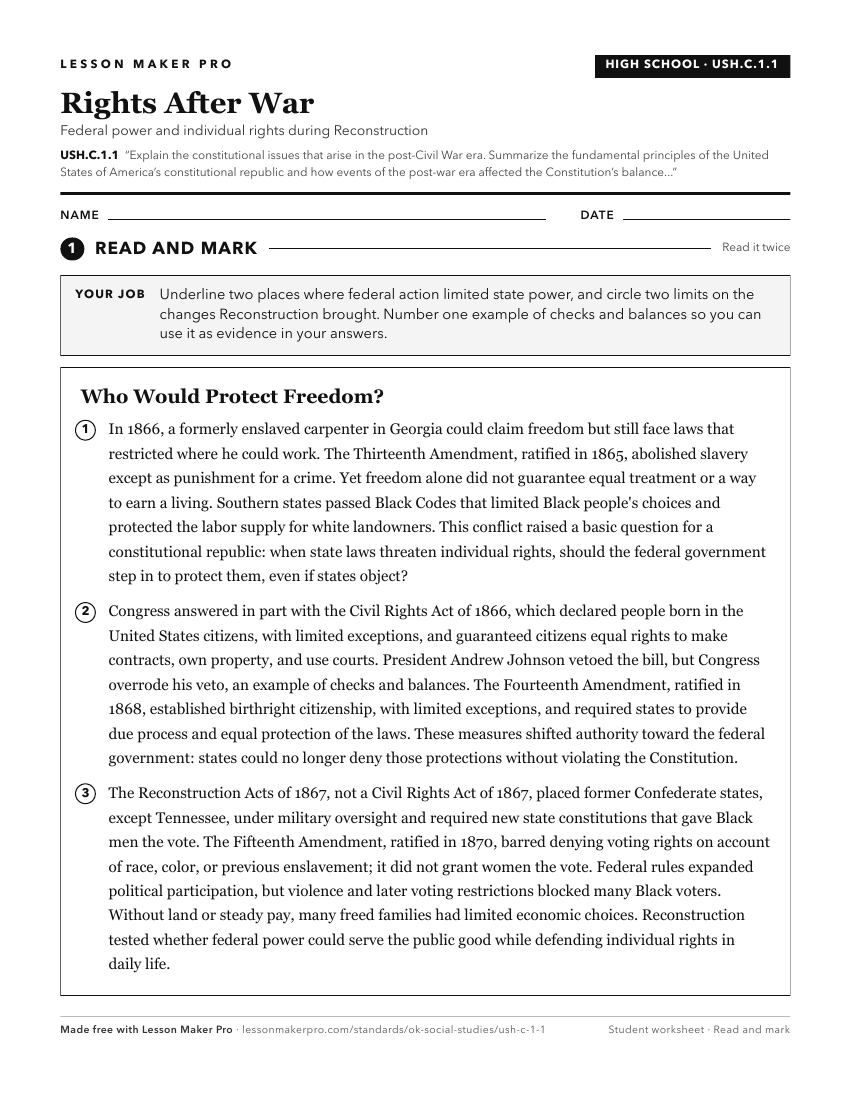
A ready-to-print activity worksheet aligned to USH.C.1.1, with an answer key for the teacher on its own page. No account needed.
PDF, US Letter, prints cleanly in black and white.
Download the worksheetKeep exploring
Related Standards
Turn this cluster into a lesson
Grade, subject, topic, and the complete cluster are prefilled. Create one free, no account needed.
Also for this cluster:Make a WorksheetMake a QuizMake a Sub Lesson