Oklahoma Social Studies 8.C.12
Standard Cluster
Analyze the course and consequences of the Civil War. Analyze major issues of the presidential election of 1860 and its immediate consequences. Describe the fragmentation of the national party system during the election of 1860 and its role in sectional division. Identify President Lincoln’s stance on slavery and intention of preserving the Union, as stated in his Cooper Union Address. Explain slavery as the central factor for the secession of southern states by examining passages from state secession declarations. Describe tensions over the strategic and internally divided border states. Trace the formation of the Confederate States of America under the leadership of Jefferson Davis. Describe how the Confederate attack on Fort Sumter ignited armed civil conflict. Evaluate the advantages and disadvantages of the Union and the Confederacy. Compare natural resources, population, and industrialization. Describe the significance of military leadership and experience (e.g., Robert E. Lee, Ulysses S. Grant). Examine the contributions of free and enslaved persons, such as the 54th Massachusetts Regiment. Describe the value of immigrant troops drafted or recruited to fill Union ranks. Identify the key strategies used during the war and evaluate their effectiveness in determining the war’s outcome. Compare the goal of the Union’s Anaconda Plan to surround and blockade Confederate forces to the goal and strategy of Sherman’s “Total War” strategy. Describe how the Southern military strategy focused on holding Confederate territory in hopes the North would eventually abandon the war effort. Examine the lasting impact of the Civil War, focusing on its devastation of property and the national economy, unrestricted use of weaponry, and the involvement of civilians. Summarize the significance of key battles and turning points of the Civil War. Explain how the Battle of Antietam proved that the Union could withstand the Confederate Army, providing Lincoln the confidence to issue the Emancipation Proclamation. Analyze the Emancipation Proclamation’s role in expanding the goals of the war and its impact on slavery, including the significance of Juneteenth. Describe how the Battle of Gettysburg ended the Confederate attempt to invade the North and analyze Lincoln’s Gettysburg Address clarifying the Union’s motivation for winning the war. Explain how the Confederate loss of Vicksburg opened the way for the North to seize control of the Mississippi River, dividing the Confederate forces. Describe Lee’s surrender at Appomattox Courthouse and the conditions of Grant’s surrender terms.
Oklahoma Academic Standards for Social Studies (2026)
Cluster contents
Standards in This Cluster
8.C.12 is a cluster heading. These are the individual standards under it.
- 8.C.12.1
Analyze major issues of the presidential election of 1860 and its immediate consequences.
- 8.C.12.1.A
Describe the fragmentation of the national party system during the election of 1860 and its role in sectional division.
- 8.C.12.1.B
Identify President Lincoln’s stance on slavery and intention of preserving the Union, as stated in his Cooper Union Address.
- 8.C.12.1.C
Explain slavery as the central factor for the secession of southern states by examining passages from state secession declarations.
- 8.C.12.1.D
Describe tensions over the strategic and internally divided border states.
- 8.C.12.1.E
Trace the formation of the Confederate States of America under the leadership of Jefferson Davis.
- 8.C.12.1.F
Describe how the Confederate attack on Fort Sumter ignited armed civil conflict.
- 8.C.12.2
Evaluate the advantages and disadvantages of the Union and the Confederacy.
- 8.C.12.2.A
Compare natural resources, population, and industrialization.
- 8.C.12.2.B
Describe the significance of military leadership and experience (e.g., Robert E. Lee, Ulysses S. Grant).
- 8.C.12.2.C
Examine the contributions of free and enslaved persons, such as the 54th Massachusetts Regiment.
- 8.C.12.2.D
Describe the value of immigrant troops drafted or recruited to fill Union ranks.
- 8.C.12.3
Identify the key strategies used during the war and evaluate their effectiveness in determining the war’s outcome.
- 8.C.12.3.A
Compare the goal of the Union’s Anaconda Plan to surround and blockade Confederate forces to the goal and strategy of Sherman’s “Total War” strategy.
- 8.C.12.3.B
Describe how the Southern military strategy focused on holding Confederate territory in hopes the North would eventually abandon the war effort.
- 8.C.12.3.C
Examine the lasting impact of the Civil War, focusing on its devastation of property and the national economy, unrestricted use of weaponry, and the involvement...
- 8.C.12.4
Summarize the significance of key battles and turning points of the Civil War.
- 8.C.12.4.A
Explain how the Battle of Antietam proved that the Union could withstand the Confederate Army, providing Lincoln the confidence to issue the Emancipation Procla...
- 8.C.12.4.B
Analyze the Emancipation Proclamation’s role in expanding the goals of the war and its impact on slavery, including the significance of Juneteenth.
- 8.C.12.4.C
Describe how the Battle of Gettysburg ended the Confederate attempt to invade the North and analyze Lincoln’s Gettysburg Address clarifying the Union’s motivati...
- 8.C.12.4.D
Explain how the Confederate loss of Vicksburg opened the way for the North to seize control of the Mississippi River, dividing the Confederate forces.
- 8.C.12.4.E
Describe Lee’s surrender at Appomattox Courthouse and the conditions of Grant’s surrender terms.
Teacher's field guide
What This Cluster Means
What Students Need to Do
- Students trace how the split 1860 election, slavery-based secession, Jefferson Davis’s Confederacy, and Fort Sumter led to war. They compare border states, resources, leaders, war plans, and contributions from Black people and immigrant troops. They explain major battles, emancipation, Juneteenth, surrender, and damage to civilians and property.
What Mastery Looks Like
- A student uses election results and secession declarations to show that slavery drove secession. They explain Lincoln’s opposition to slavery’s expansion and his goal of preserving the Union. They connect Antietam to emancipation, Gettysburg to a stopped invasion, Vicksburg to river control, and Appomattox to Grant’s surrender terms.
Common Misconceptions
- Students may treat states’ rights as separate from slavery, even when secession declarations name slavery. They may think the Emancipation Proclamation freed everyone at once or that Juneteenth marks its signing. They often confuse the Union blockade with Sherman’s march, or Gettysburg with Vicksburg.
How to Assess It
- Exit ticket: Why did southern states secede, and how did Gettysburg and Vicksburg each change the war?
Lesson moves
Ways to Teach It
Give pairs a blank 1861 map and cards showing factories, population, railroads, and border states; have them mark each side’s advantages.
Read short excerpts from Mississippi’s secession declaration and Lincoln’s Cooper Union speech; write two sentences comparing their positions on slavery.
Give teams Antietam, Gettysburg, Vicksburg, and Appomattox cards; have them match each place to its outcome and explain one match.
Show a Juneteenth event flyer; have students write a caption linking the holiday to the 1865 announcement of freedom in Texas.
Free download
Printable 8.C.12 Worksheet
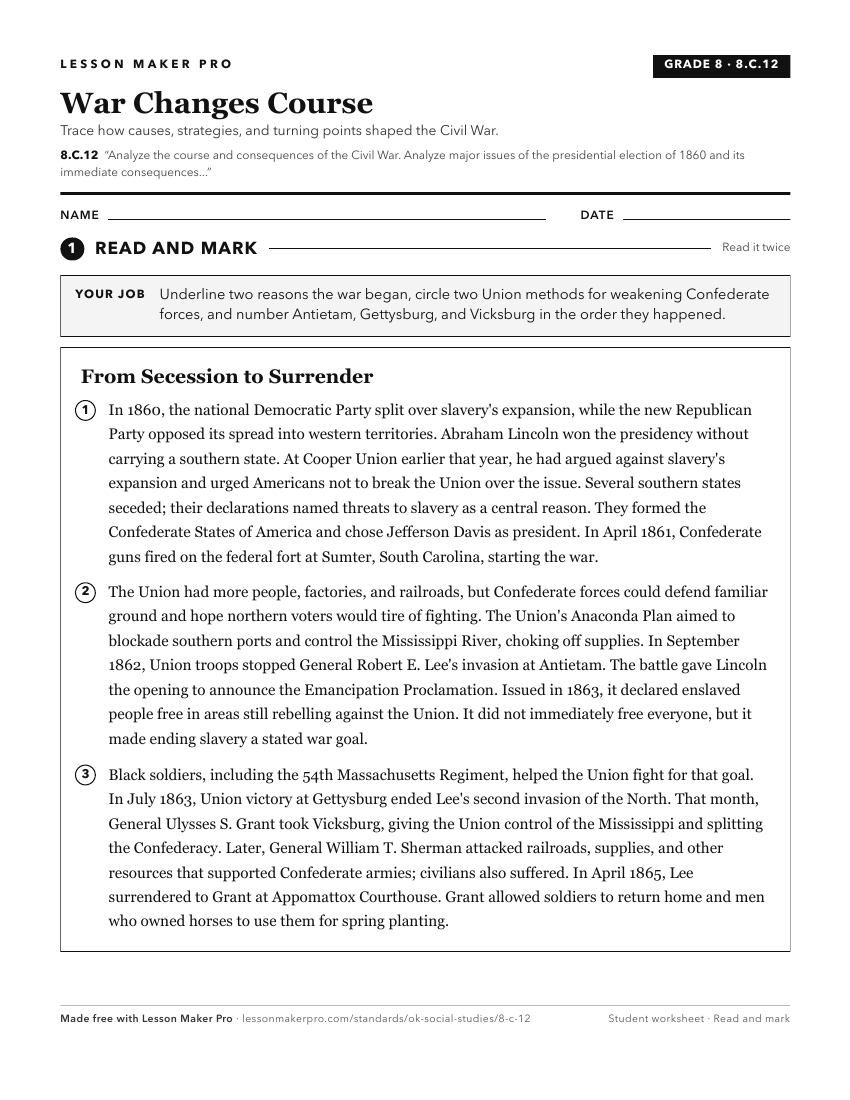
A ready-to-print activity worksheet aligned to 8.C.12, with an answer key for the teacher on its own page. No account needed.
PDF, US Letter, prints cleanly in black and white.
Download the worksheetKeep exploring
Related Standards
Turn this cluster into a lesson
Grade, subject, topic, and the complete cluster are prefilled. Create one free, no account needed.
Also for this cluster:Make a WorksheetMake a QuizMake a Sub Lesson