Oklahoma Social Studies 8.C.12.3
Standard Cluster
- 8.C.12
- Analyze the course and consequences of the Civil War.
Identify the key strategies used during the war and evaluate their effectiveness in determining the war’s outcome. Compare the goal of the Union’s Anaconda Plan to surround and blockade Confederate forces to the goal and strategy of Sherman’s “Total War” strategy. Describe how the Southern military strategy focused on holding Confederate territory in hopes the North would eventually abandon the war effort. Examine the lasting impact of the Civil War, focusing on its devastation of property and the national economy, unrestricted use of weaponry, and the involvement of civilians.
Oklahoma Academic Standards for Social Studies (2026) · 8.C.12
Cluster contents
Standards in This Cluster
8.C.12.3 is a cluster heading. These are the individual standards under it.
- 8.C.12.3.A
Compare the goal of the Union’s Anaconda Plan to surround and blockade Confederate forces to the goal and strategy of Sherman’s “Total War” strategy.
- 8.C.12.3.B
Describe how the Southern military strategy focused on holding Confederate territory in hopes the North would eventually abandon the war effort.
- 8.C.12.3.C
Examine the lasting impact of the Civil War, focusing on its devastation of property and the national economy, unrestricted use of weaponry, and the involvement...
Teacher's field guide
What This Cluster Means
What Students Need to Do
- Students compare how Union blockades, Sherman's march, and Confederate defense aimed to win the war. They use what happened to judge how well each strategy worked. They explain how destroyed property, powerful weapons, and civilian hardship affected the economy.
What Mastery Looks Like
- A student can mark blocked ports, the Mississippi River, and Sherman's route on a map. They can explain how each Union move cut supplies and why holding territory did not wear down the North. They can name lasting costs for civilians and trade.
Common Misconceptions
- Students may think the blockade and Sherman's march were the same plan, or that Sherman focused on winning battles. Some think Confederate forces never attacked because their main strategy was defensive. Others overlook the damage to civilians and the economy.
How to Assess It
- Exit ticket: Explain how the blockade and Sherman's march each weakened the South, and why holding territory did not save it. Name one effect of the war on civilians or the economy.
Lesson moves
Ways to Teach It
On a printed Civil War map, place counters at Confederate ports and along the Mississippi, then trace Sherman's route with yarn.
Write four sentences: How did blocking ports differ from destroying rail lines, and which caused greater supply problems?
Match cards showing blocked ports, damaged tracks, and guarded territory to each side's goal, then explain one match.
Trace a grocery delivery route on a local map, then discuss how a closed road or rail line would affect stores.
Free download
Printable 8.C.12.3 Worksheet
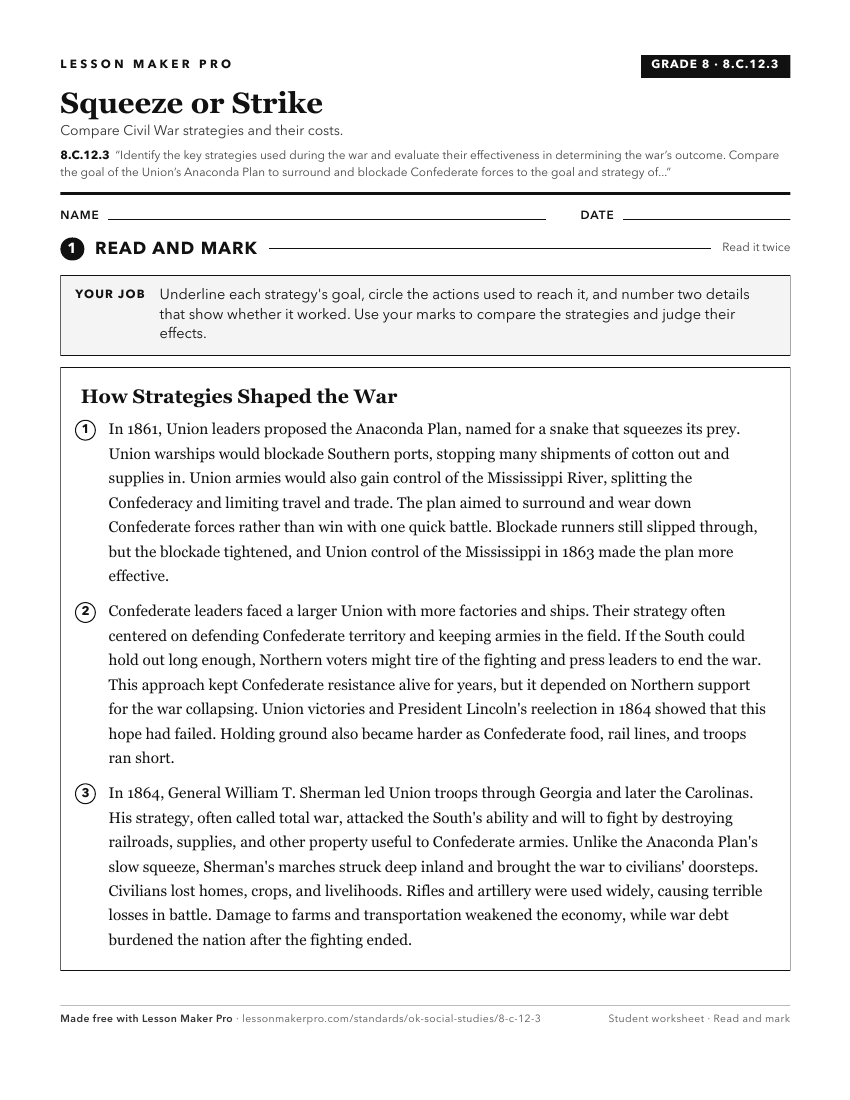
A ready-to-print activity worksheet aligned to 8.C.12.3, with an answer key for the teacher on its own page. No account needed.
PDF, US Letter, prints cleanly in black and white.
Download the worksheetKeep exploring
Related Standards
- USH.C.5.2.A
Identify major battles, military turning points, and key strategic decisions in both the European and Pacific Theaters of Operations (e.g., Pearl Harbor, the D-...
- MWH.C.6.5.B
Compare military campaigns in Africa, Asia, and the Pacific (e.g., Battle of the Atlantic, Battle of Britain, siege of Leningrad, Operation Torch, Operation Ove...
- USH.C.5.2
Analyze the series of events affecting the outcome of World War II.
- USH.C.9.2.B
Assess the goals and management of military engagements (e.g., wars in Afghanistan and Iraq).
Turn this cluster into a lesson
Grade, subject, topic, and the complete cluster are prefilled. Create one free, no account needed.
Also for this cluster:Make a WorksheetMake a QuizMake a Sub Lesson