Oklahoma Social Studies USH.C.5.2
Standard Cluster
- USH.C.5
- Analyze the United States of America’s role in international affairs by examining the major causes, events, and effects of the nation’s involvement in World War II.
Analyze the series of events affecting the outcome of World War II. Identify major battles, military turning points, and key strategic decisions in both the European and Pacific Theaters of Operations (e.g., Pearl Harbor, the D-day Invasion, Stalingrad, Midway, Okinawa, Battle of the Bulge, Iwo Jima, and the island-hopping strategy). Describe the roles of individual American leaders, including Generals MacArthur and Eisenhower, as well as the unique contributions of special fighting forces (e.g., Tuskegee Airmen, 442nd Regimental Combat team, Indian Code Talkers). Explain the purpose of the Allied conferences at Yalta and Potsdam and how such negotiations would affect post-war Europe. Analyze President Truman’s decision to use the atomic bomb and describe the legacy of the development and use of atomic weapons.
Oklahoma Academic Standards for Social Studies (2026) · USH.C.5
Cluster contents
Standards in This Cluster
USH.C.5.2 is a cluster heading. These are the individual standards under it.
- USH.C.5.2.A
Identify major battles, military turning points, and key strategic decisions in both the European and Pacific Theaters of Operations (e.g., Pearl Harbor, the D-...
- USH.C.5.2.B
Describe the roles of individual American leaders, including Generals MacArthur and Eisenhower, as well as the unique contributions of special fighting forces (...
- USH.C.5.2.C
Explain the purpose of the Allied conferences at Yalta and Potsdam and how such negotiations would affect post-war Europe.
- USH.C.5.2.D
Analyze President Truman’s decision to use the atomic bomb and describe the legacy of the development and use of atomic weapons.
Teacher's field guide
What This Cluster Means
What Students Need to Do
- Students put major battles in Europe and the Pacific in order and explain why the fighting shifted. They identify what American commanders and specialized units did. They explain Allied plans for postwar Europe and weigh Truman's decision to use atomic bombs.
What Mastery Looks Like
- A student can explain why Midway and Stalingrad shifted momentum, how D-Day opened a western front, and why island hopping bypassed some Japanese positions. They can link Eisenhower and MacArthur to their commands and describe the work of the Tuskegee Airmen, 442nd Regiment, and Native American code talkers. They can explain how Yalta and Potsdam shaped postwar Europe and use evidence to discuss the bombings and their lasting effects.
Common Misconceptions
- Students may think D-Day ended the war in Europe, rather than leading to more fighting. Some think island hopping meant capturing every island or that Midway was the last Pacific battle. Others confuse Yalta with Potsdam or say the atomic bombs alone ended the war.
How to Assess It
- Exit ticket: Explain how Midway changed the Pacific war, name one role of the Tuskegee Airmen, and give one way Potsdam or atomic weapons shaped the postwar world.
Lesson moves
Ways to Teach It
Place Pearl Harbor, Midway, Stalingrad, D-Day, Bulge, Iwo Jima, and Okinawa cards on theater maps, then draw Allied advance arrows.
Read Truman's 1945 statement and a Hiroshima survivor account; write four sentences weighing his decision and one lasting nuclear consequence.
Match Eisenhower, MacArthur, Tuskegee Airmen, 442nd Regiment, and Native American code talkers to mission cards; explain each match aloud.
Compare a 1945 Germany occupation map with a current map; trace the former East-West border and locate Berlin.
Free download
Printable USH.C.5.2 Worksheet
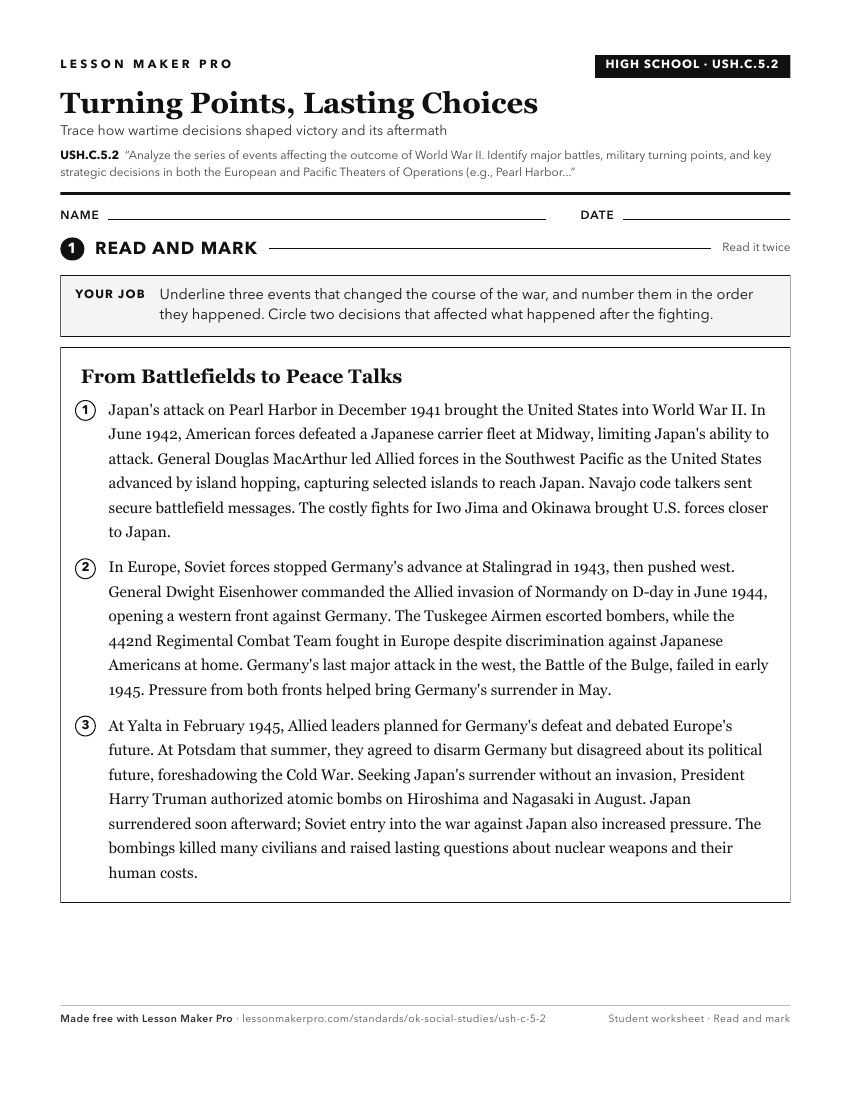
A ready-to-print activity worksheet aligned to USH.C.5.2, with an answer key for the teacher on its own page. No account needed.
PDF, US Letter, prints cleanly in black and white.
Download the worksheetKeep exploring
Related Standards
- MWH.C.6.5
Examine the significant events of World War II from a global perspective.
- MWH.C.6.4
Analyze the economic, social, and political conditions that resulted in World War II.
- MWH.C.7.1
Evaluate the effects of World War II including the origins and escalation of the Cold War.
- USH.C.5
Analyze the United States of America’s role in international affairs by examining the major causes, events, and effects of the nation’s involvement in World War...
Turn this cluster into a lesson
Grade, subject, topic, and the complete cluster are prefilled. Create one free, no account needed.
Also for this cluster:Make a WorksheetMake a QuizMake a Sub Lesson