Oklahoma Social Studies MWH.C.6.4
Standard Cluster
- MWH.C.6
- Evaluate the global transformation created by the World Wars.
Analyze the economic, social, and political conditions that resulted in World War II. Describe the various causes and consequences of the global economic collapse and evaluate how democratic and authoritarian governments responded to the Great Depression, including the growth of social welfare legislation and mixed economies. Explain how violations of the Treaty of Versailles and failure of the League of Nations, including unrealistic reparations demands and failed efforts at international disarmament, fueled a second global conflict. Evaluate the economic, social, and political conditions that allowed the rise of Fascist militarist regimes in Germany, Italy, Spain, and Japan. Identify the characteristics of fascism, including how such totalitarian regimes utilized propaganda, repressed dissention, and instigated antisemitism (e.g., Nuremberg Laws in Germany).
Oklahoma Academic Standards for Social Studies (2026) · MWH.C.6
Cluster contents
Standards in This Cluster
MWH.C.6.4 is a cluster heading. These are the individual standards under it.
- MWH.C.6.4.A
Describe the various causes and consequences of the global economic collapse and evaluate how democratic and authoritarian governments responded to the Great De...
- MWH.C.6.4.B
Explain how violations of the Treaty of Versailles and failure of the League of Nations, including unrealistic reparations demands and failed efforts at interna...
- MWH.C.6.4.C
Evaluate the economic, social, and political conditions that allowed the rise of Fascist militarist regimes in Germany, Italy, Spain, and Japan.
- MWH.C.6.4.D
Identify the characteristics of fascism, including how such totalitarian regimes utilized propaganda, repressed dissention, and instigated antisemitism (e.g., N...
Teacher's field guide
What This Cluster Means
What Students Need to Do
- Students explain how bank failures, debt, and falling trade spread unemployment around the world. They compare democratic relief programs with authoritarian promises of jobs and order. They connect treaty disputes, League inaction, propaganda, repression, and antisemitic laws to the road to war.
What Mastery Looks Like
- A student can use evidence to explain why authoritarian leaders gained support in Germany, Italy, Spain, and Japan without treating those regimes as identical. They can compare welfare programs and mixed economies with one-party rule, censorship, and the Nuremberg Laws. They can explain how reparations, failed disarmament, and unchecked treaty violations increased the risk of war.
Common Misconceptions
- Students may blame the stock market crash alone for the Depression, overlooking bank failures, debt, and falling trade. Some assume every country responded with fascism or that all authoritarian regimes worked the same way. Others think the League could enforce its decisions with an army or that the Nuremberg Laws began during the war.
How to Assess It
- Exit ticket: Name one cause of the Depression, compare one democratic and one authoritarian response, and explain how one League failure helped move a country toward war.
Lesson moves
Ways to Teach It
Have pairs place printed cards for reparations, the 1929 crash, failed disarmament, and invasions on a timeline, then draw cause arrows.
Project a Nuremberg Laws excerpt; ask, 'What did this law take from Jewish people, and how did it support Nazi power?'
Run a card match: students pair bank failures with unemployment and League inaction with unchecked invasions, then defend their matches.
Show a blank unemployment benefits form beside a 1930s relief poster; ask what help each offers and who qualifies.
Free download
Printable MWH.C.6.4 Worksheet
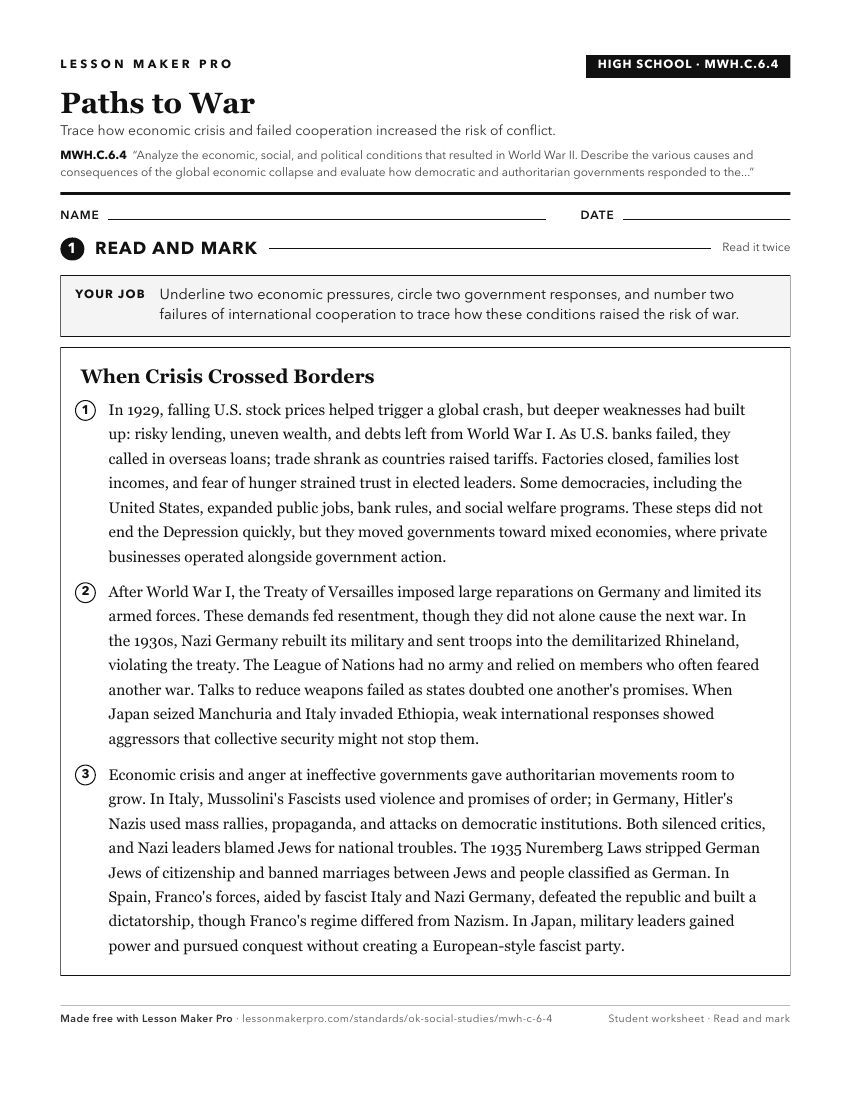
A ready-to-print activity worksheet aligned to MWH.C.6.4, with an answer key for the teacher on its own page. No account needed.
PDF, US Letter, prints cleanly in black and white.
Download the worksheetKeep exploring
Related Standards
- MWH.C.6.5
Examine the significant events of World War II from a global perspective.
- USH.C.5.2
Analyze the series of events affecting the outcome of World War II.
- MWH.C.7.1
Evaluate the effects of World War II including the origins and escalation of the Cold War.
- USH.C.5
Analyze the United States of America’s role in international affairs by examining the major causes, events, and effects of the nation’s involvement in World War...
Turn this cluster into a lesson
Grade, subject, topic, and the complete cluster are prefilled. Create one free, no account needed.
Also for this cluster:Make a WorksheetMake a QuizMake a Sub Lesson