Oklahoma Social Studies MWH.C.6.4.D
The Standard
- MWH.C.6
- Evaluate the global transformation created by the World Wars.
- MWH.C.6.4
- Analyze the economic, social, and political conditions that resulted in World War II.
Identify the characteristics of fascism, including how such totalitarian regimes utilized propaganda, repressed dissention, and instigated antisemitism (e.g., Nuremberg Laws in Germany).
Oklahoma Academic Standards for Social Studies (2026) · MWH.C.6.4
Teacher's field guide
What This Standard Means
What Students Need to Do
- Students identify features of fascist rule, such as extreme nationalism and power concentrated in one leader. They explain how Nazi leaders used propaganda, punished dissent, and made antisemitism into law.
What Mastery Looks Like
- A student can point to a message in a Nazi poster and explain how it tries to win support. They can explain that the 1935 Nuremberg Laws stripped Jews of citizenship and barred marriages between Jews and non-Jews.
Common Misconceptions
- Students may call any political message propaganda, without explaining how it tries to shape opinion. They may think dissent was punished only through arrests, or that the Nuremberg Laws began during World War II.
How to Assess It
- Use this exit ticket: In 1935, Nazi Germany stripped Jews of citizenship and barred marriages between Jews and non-Jews. What did these laws do, and how might propaganda have helped leaders gain support for them?
Lesson moves
Ways to Teach It
Give groups four source cards: a vetted Nazi poster, a translated law excerpt, a newspaper ban, and an arrest report; sort by method of control.
Ask students to write four sentences answering: Why would a regime praise its leader on posters while banning rival newspapers?
Give pairs six short scenarios to label propaganda, repression, antisemitic policy, or overlap; have them explain one disputed choice.
Show a fact-check of a manipulated political image; compare its persuasion tactic with a vetted 1930s propaganda poster without equating the contexts.
Free download
Printable MWH.C.6.4.D Worksheet
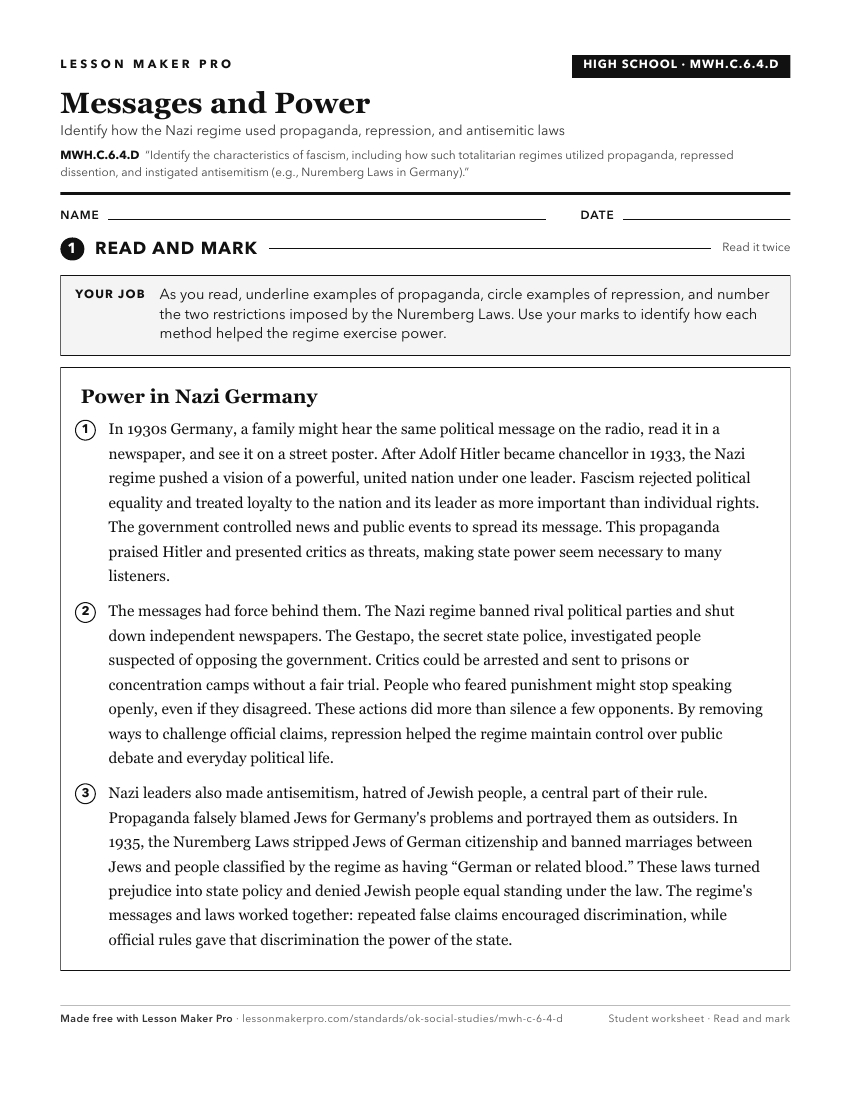
A ready-to-print activity worksheet aligned to MWH.C.6.4.D, with an answer key for the teacher on its own page. No account needed.
PDF, US Letter, prints cleanly in black and white.
Download the worksheetKeep exploring
Related Standards
- TOT.C.4.3
Analyze how the Nazi regime utilized and built on historical antisemitism to create a common enemy of the Jews in order to gain power.
- USH.C.5.1.A
Examine fascism in Germany and Italy, including its roots in economic depression, effects of the Versailles Treaty, and ideology, culminating in German rearmame...
- TOT.C.4.5
Explain how the National Socialist German Workers’ Party, or Nazi Party, grew into a mass movement and maintained power through totalitarian means, including th...
- MWH.C.6.4.C
Evaluate the economic, social, and political conditions that allowed the rise of Fascist militarist regimes in Germany, Italy, Spain, and Japan.
Turn this exact standard into a lesson
Grade, subject, topic, and the complete standard are prefilled. Create one free, no account needed.
Also for this standard:Make a WorksheetMake a QuizMake a Sub Lesson