Oklahoma Social Studies USH.C.5.1.A
The Standard
- USH.C.5
- Analyze the United States of America’s role in international affairs by examining the major causes, events, and effects of the nation’s involvement in World War II.
- USH.C.5.1
- Describe the transformations in American society and government policy as the nation entered World War II.
Examine fascism in Germany and Italy, including its roots in economic depression, effects of the Versailles Treaty, and ideology, culminating in German rearmament and militarization of the Rhineland.
Oklahoma Academic Standards for Social Studies (2026) · USH.C.5.1
Teacher's field guide
What This Standard Means
What Students Need to Do
- Explain how postwar economic trouble and unrest helped Mussolini in Italy, while the Depression and anger over the Versailles Treaty helped Hitler in Germany. Identify fascist beliefs and trace Germany's rearmament and its move into the Rhineland.
What Mastery Looks Like
- Students can put Mussolini's rise, Hitler's rise, German rearmament, and the 1936 Rhineland move in order. They can explain how German joblessness and treaty restrictions shaped events. They can name ultranationalism and rejection of democracy as beliefs shared by both movements.
Common Misconceptions
- Some students say the Great Depression brought Mussolini to power, but he took office in 1922. Others think Germany took the Rhineland from another country, rather than sending troops into German territory it was barred from militarizing. Students may also treat Italian fascism and Nazism as identical, missing how central racist and antisemitic beliefs were to Nazism.
How to Assess It
- Exit ticket: Put Mussolini's 1922 rise, Hitler's 1933 rise, German conscription in 1935, and the 1936 Rhineland move in order. Name one shared fascist belief, then explain why the Depression and Versailles restrictions mattered in Germany.
Lesson moves
Ways to Teach It
Give groups a 1920 Italian strike photo, a Versailles excerpt, and a German unemployment chart; have them build a dated cause-and-effect strip.
Ask: Why did Mussolini gain power before the Great Depression, while Hitler gained power during it? Cite one condition in each country.
Run a six-card sort: students label Italian unrest, German unemployment, Versailles anger, ultranationalism, German conscription, and Rhineland troops as roots, beliefs, or actions.
Draw the school's no-parking zone beside a Rhineland map; ask how a rule can restrict activity without changing who owns the land.
Free download
Printable USH.C.5.1.A Worksheet
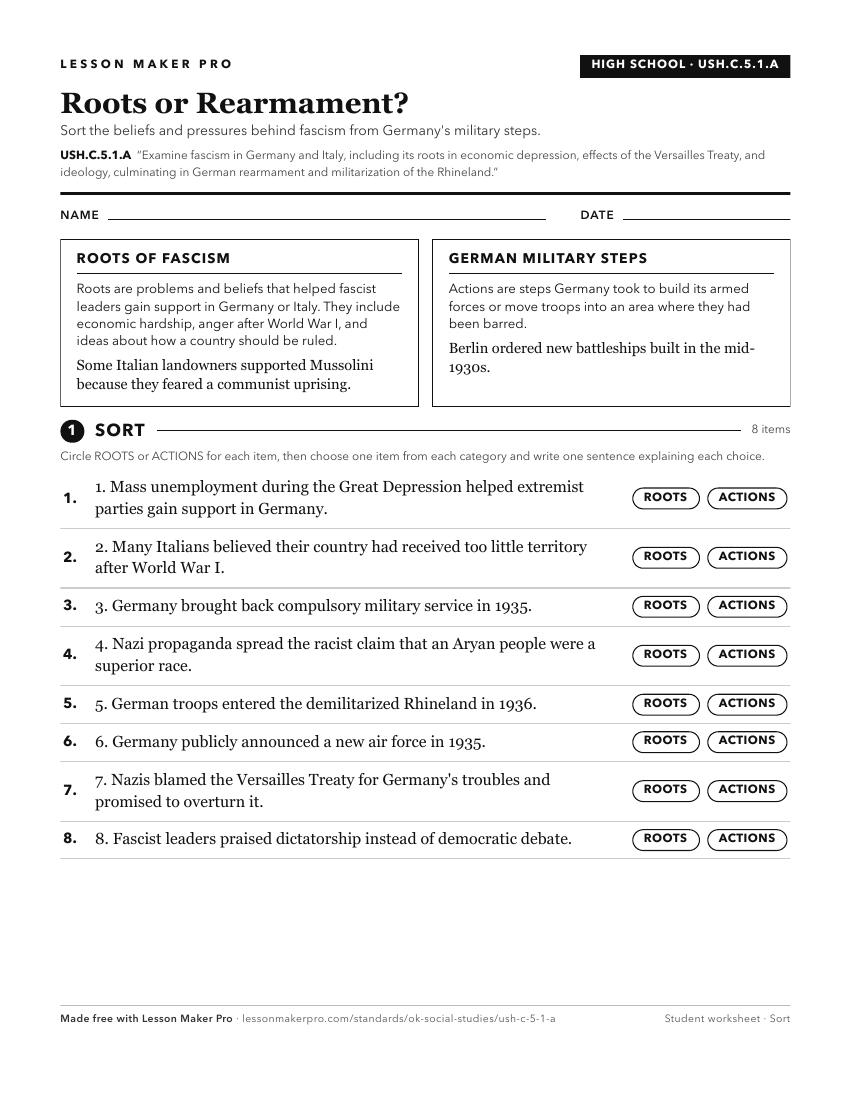
A ready-to-print activity worksheet aligned to USH.C.5.1.A, with an answer key for the teacher on its own page. No account needed.
PDF, US Letter, prints cleanly in black and white.
Download the worksheetKeep exploring
Related Standards
- TOT.C.4.1
Examine German culpability, reparations, and military downsizing as effects of the Treaty of Versailles.
- TOT.C.4.2
Explain how events during the Weimar Republic led to the rise of Nazism (e.g., Ruhr Crisis, hyperinflation, Great Depression, Dawes Plan, failures of the Weimar...
- MWH.C.6.4.D
Identify the characteristics of fascism, including how such totalitarian regimes utilized propaganda, repressed dissention, and instigated antisemitism (e.g., N...
- MWH.C.6.4.C
Evaluate the economic, social, and political conditions that allowed the rise of Fascist militarist regimes in Germany, Italy, Spain, and Japan.
Turn this exact standard into a lesson
Grade, subject, topic, and the complete standard are prefilled. Create one free, no account needed.
Also for this standard:Make a WorksheetMake a QuizMake a Sub Lesson