Oklahoma Social Studies MWH.C.7.1
Standard Cluster
- MWH.C.7
- Evaluate post-World War II regional events leading to the transformations of the modern world.
Evaluate the effects of World War II including the origins and escalation of the Cold War. Explain the major consequences of World War II, including physical and economic destruction, civilian loss of life, mass displacement and expulsion of ethnic minorities, and the accelerated decline of European colonial empires. Compare the ideological, political, and economic distinctions between the United States of America and Western bloc versus the Union of Soviet Socialist Republics (USSR) and the Eastern bloc, leading to the division of Europe and separation by an “Iron Curtain.” Explain how tensions escalated, fueled by the Berlin Blockade, Suez Canal Crisis, and subsequent uprisings by people in Soviet-dominated satellites (e.g., Poland, Hungary, Czechoslovakia). Compare military power shifts caused by the war and a proliferation of nuclear armaments, describing the impact of transnational organizations and alliances (e.g., United Nations, North Atlantic Treaty Organization, Warsaw Pact) and explaining the goals of the Non-Alignment Movement.
Oklahoma Academic Standards for Social Studies (2026) · MWH.C.7
Cluster contents
Standards in This Cluster
MWH.C.7.1 is a cluster heading. These are the individual standards under it.
- MWH.C.7.1.A
Explain the major consequences of World War II, including physical and economic destruction, civilian loss of life, mass displacement and expulsion of ethnic mi...
- MWH.C.7.1.B
Compare the ideological, political, and economic distinctions between the United States of America and Western bloc versus the Union of Soviet Socialist Republi...
- MWH.C.7.1.C
Explain how tensions escalated, fueled by the Berlin Blockade, Suez Canal Crisis, and subsequent uprisings by people in Soviet-dominated satellites (e.g., Polan...
- MWH.C.7.1.D
Compare military power shifts caused by the war and a proliferation of nuclear armaments, describing the impact of transnational organizations and alliances (e....
Teacher's field guide
What This Cluster Means
What Students Need to Do
- Students explain how destruction, civilian deaths, and forced migration weakened European empires after World War II. They compare Western and Soviet political and economic systems, then trace how crises, alliances, and nuclear weapons deepened Europe's divide. They explain why some countries chose not to join either bloc.
What Mastery Looks Like
- A student can use a map to explain Europe's division and the roles of NATO, the Warsaw Pact, and the United Nations. They can explain how the Berlin Blockade, Suez Crisis, and uprisings in Soviet-dominated countries raised tensions. They can describe why newly independent countries might choose nonalignment.
Common Misconceptions
- Students may treat the United Nations as a military alliance or assume nonalignment meant staying out of world affairs. Some think the Iron Curtain was a wall across all of Europe. Others assume colonial rule ended as soon as the war did.
How to Assess It
- Ask on an exit ticket: "How did one effect of World War II help divide Europe? How did the Berlin Blockade make that divide worse?"
Lesson moves
Ways to Teach It
Give pairs a 1955 Europe map and country cards; have them place NATO and Warsaw Pact members and mark divided Berlin.
Read excerpts from Truman's 1947 speech and Zhdanov's 1947 speech; ask, "How does each side describe the other's aims?"
Deal cards for the Berlin Blockade, Suez Crisis, Hungarian uprising, and Prague Spring; teams order them and name one tension each raised.
Print a recent UN Security Council voting record; students mark the five permanent members and explain how postwar power shapes the council.
Free download
Printable MWH.C.7.1 Worksheet
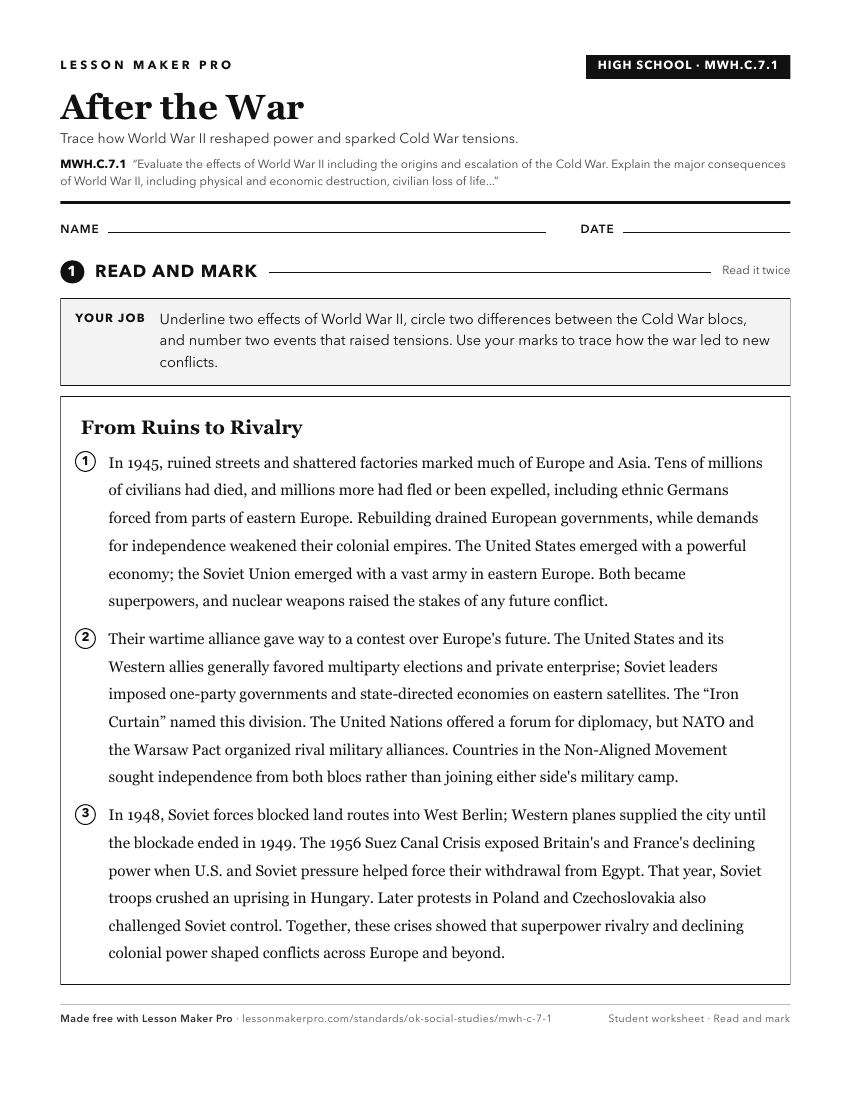
A ready-to-print activity worksheet aligned to MWH.C.7.1, with an answer key for the teacher on its own page. No account needed.
PDF, US Letter, prints cleanly in black and white.
Download the worksheetKeep exploring
Related Standards
- MWH.C.6.5
Examine the significant events of World War II from a global perspective.
- MWH.C.6.4
Analyze the economic, social, and political conditions that resulted in World War II.
- USH.C.5.2
Analyze the series of events affecting the outcome of World War II.
- USH.C.6.3
Analyze the escalation of international tensions by examining the series of events and their long- term foreign and domestic consequences during the height of t...
Turn this cluster into a lesson
Grade, subject, topic, and the complete cluster are prefilled. Create one free, no account needed.
Also for this cluster:Make a WorksheetMake a QuizMake a Sub Lesson